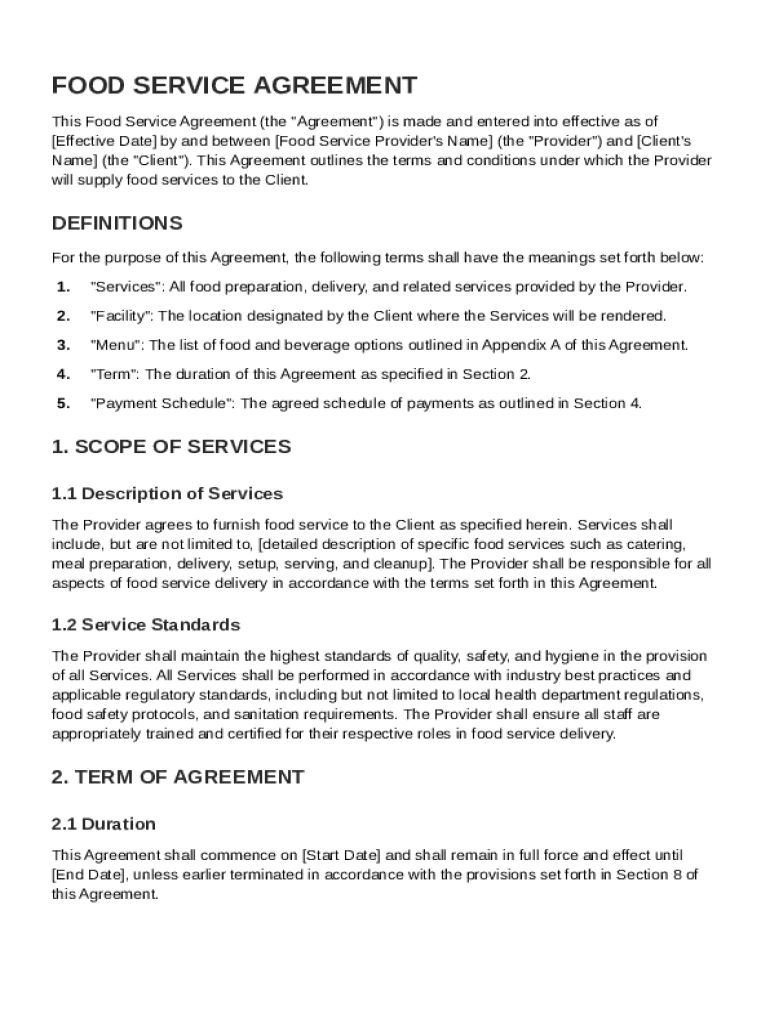







Definition and Purpose of a Food Service Agreement Template
A Food Service Agreement Template is a legally binding document that outlines the terms and conditions between a food service provider and a client. This template serves as a foundational framework to detail the responsibilities of both parties. It specifies aspects such as food preparation, delivery, and allied activities, ensuring both parties clearly understand their obligations and rights. A well-structured agreement will define key terms, the scope of services, payment terms, and clauses related to health standards compliance, dietary accommodations, indemnification, and dispute resolution.
Key Elements of the Food Service Agreement Template
In drafting a Food Service Agreement, several critical elements must be included to ensure comprehensiveness and enforceability:
-
Scope of Services: Clear definition of the services provided, including types of meals, dietary restrictions, and delivery schedules.
-
Payment Terms: Detailed structure of payment, including fees, billing cycles, and methods of payment.
-
Responsibilities: Specific duties and obligations of the food service provider, such as quality control measures and compliance with health standards. Similarly, the client's responsibilities, such as timely payments and providing necessary access to delivery locations.
-
Termination Clauses: Conditions under which the agreement can be terminated by either party, including notice periods and penalties for early termination.
-
Confidentiality Provisions: Clauses that safeguard proprietary information and client data from unauthorized disclosures.
Steps to Complete the Food Service Agreement Template
Completing a Food Service Agreement Template involves a systematic approach to ensure all relevant details are accurately captured:
-
Identify Parties: Clearly state the names and contact details of both the food service provider and the client.
-
Define Scope: Outline the specific services to be provided, including menu options and service hours.
-
Detail Financials: Specify the payment structure including upfront costs, installment payments, and any additional charges.
-
Incorporate Legal Provisions: Add clauses related to liability, indemnification, and how disputes will be resolved.
-
Review and Signing: Both parties should review the agreement to confirm mutual understanding before signing.
Who Typically Uses the Food Service Agreement Template
The Food Service Agreement Template is essential for various stakeholders within the food service industry:
-
Catering Companies: To establish long-term service relationships with corporate clients or event organizers.
-
Restaurants and Cafés: When collaborating with businesses or institutions for regular meal provision.
-
Educational Institutions: Schools and universities use it for services related to student meal plans.
-
Healthcare Facilities: Hospitals and nursing homes employing the document to manage meal services for patients.


Legal Use of the Food Service Agreement Template
To ensure the Food Service Agreement is legally binding and enforceable:
-
Compliance with Local Laws: Adhere to local and federal regulations pertaining to food safety and employment practices.
-
Use of Legal Language: Precise legal terminology should be used to avoid ambiguities in the contract terms.
-
Signatures and Documentation: Include signatures from authorized representatives of both parties along with documented proof of consent.
Examples of Using the Food Service Agreement Template
Real-world scenarios illustrate the utility of the Food Service Agreement Template:
-
Corporate Events: Companies using it to manage caterers during functions, ensuring all service expectations are documented.
-
School Lunch Programs: Agreements with food vendors to provide daily meals in adherence to nutritional guidelines.
-
Long-term Contracts: Healthcare facilities engaging catering services for consistent meal provision to patients and staff.
State-Specific Rules for the Food Service Agreement Template
Since food service regulations can vary significantly by state, the template should be adjusted accordingly:
-
Licensing Requirements: Ensure the agreement reflects state-specific licensure for food handling and service.
-
Health Code Standards: Adherence to local health department standards should be stipulated within the agreement.
-
Tax Implications: Address state-specific sales and use taxes that might impact the service cost.
Benefits of Using the Food Service Agreement Template
Leveraging a Food Service Agreement Template offers multiple advantages:
-
Clarity and Transparency: Ensures both parties understand their commitments, reducing potential conflicts.
-
Efficiency in Operations: A structured template supports streamlined business operations and service delivery.
-
Risk Mitigation: Includes protective clauses that minimize legal and financial risks for both the service provider and the client.