






Definition and Purpose of a Business Continuity Agreement Template
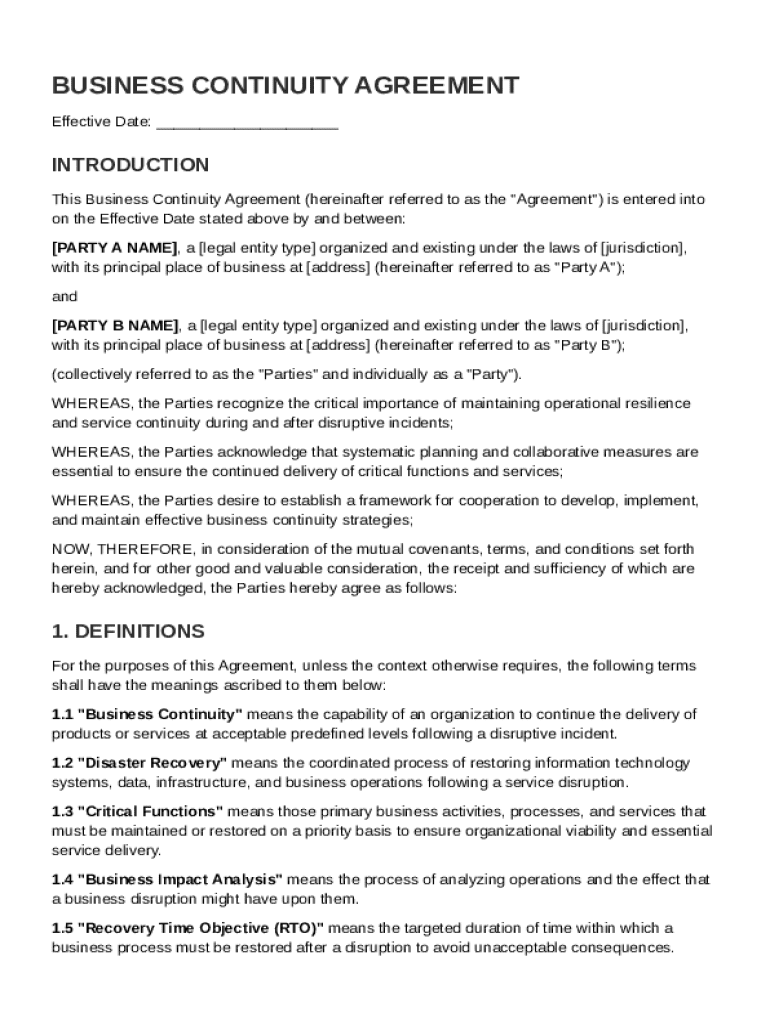
A Business Continuity Agreement Template is a structured document that outlines the cooperative framework between two or more parties to ensure operational resilience and uninterrupted service delivery during unforeseen disruptions. The template provides predefined sections that help organizations plan, respond, and recover from various incidents that could potentially disrupt business operations. It enables companies to define and manage key aspects such as disaster recovery, critical functions, roles, and responsibilities, facilitating the development and maintenance of effective business continuity strategies.
Key Components Included in the Template
- Disaster Recovery Plan: Defines processes to restore critical systems and functions following a disruptive event.
- Roles and Responsibilities: Details the obligations of each party involved in maintaining and executing the plan.
- Communication Protocols: Outlines how information will be communicated before, during, and after an incident.
- Testing and Training Procedures: Emphasizes the importance of regular drills to ensure efficacy.
How to Use the Business Continuity Agreement Template
Utilizing a Business Continuity Agreement Template involves customizing the document to fit your organization's specific needs. Begin by identifying the critical functions of your business that require protection and continuity during emergencies.
Steps to Customize the Template
- Identify Key Operations: List the core activities and processes vital for your business continuity.
- Assign Roles: Determine specific employee roles responsible for each part of the continuity plan.
- Develop Response Protocols: Create response strategies tailored to different types of disruptions.
- Example: For a data center, the plan might focus on restoring IT services quickly after a power outage.
Practical Tips for Implementation
- Regularly review and update the template to reflect changes in your business environment.
- Engage all stakeholders to foster a shared understanding of the continuity plan.
Benefits of Using the Business Continuity Agreement Template
Employing a Business Continuity Agreement Template offers multiple advantages by enabling organizations to preemptively address potential disruptions.
Advantages
- Operational Resilience: Enhances the ability to maintain essential functions during disruptions.
- Compliance Assurance: Ensures adherence to industry-specific legal and regulatory requirements.
- Efficient Resource Allocation: Helps allocate resources effectively to minimize recovery time.
Real-world Application
- Case Study: A financial institution used the template to rapidly adapt to a cyber-attack, ensuring continuous online banking services.
Key Elements of the Business Continuity Agreement Template
Understanding the integral elements within a Business Continuity Agreement Template is essential for its effective application.
Essential Components
- Risk Assessment: An examination of potential threats to the organization’s operations.
- Resource Inventory: A detailed account of necessary resources for maintaining critical business functions.
- Service Continuity Strategies: Methods for ensuring that critical business services remain operational.
Regulatory Compliance
- Legal Obligations: Incorporate terms that reflect compliance with relevant regulations such as the Sarbanes-Oxley Act.
Legal Considerations for the Business Continuity Agreement Template
A Business Continuity Agreement often includes legal stipulations to safeguard the interests of involved parties.
Compliance and Regulatory Requirements
- Confidentiality Clauses: Protects sensitive information shared between parties.
- Termination and Dispute Resolution: Outlines conditions under which the agreement may be dissolved.
Contractual Obligations
- Documentation: Keep a record of all communications and updates to the agreement for accountability.
Who Typically Uses the Business Continuity Agreement Template
Various entities utilize Business Continuity Agreement Templates to safeguard operational integrity.


Typical Users
- Large Corporations: To ensure uninterrupted services and compliance with industry standards.
- Small Businesses: Adapt the template to monitor and respond promptly to emergent threats.
- Non-Profit Organizations: Maintain essential community services during crises.
Business Sectors
- Healthcare Providers: Define emergency response protocols for patient care continuity.
Common Variations of the Business Continuity Agreement Template
While the core structure of a Business Continuity Agreement Template remains constant, variations exist based on organizational needs.
Types of Variants
- Sector-specific Templates: Adapted for industries like healthcare, finance, or telecommunications.
- Organizational Size Adaption: Scaled versions for small, medium, or large enterprises.
Comparing Digital and Paper Versions
- Digital Templates: Offer ease of modification and sharing, suitable for dynamic business environments.
- Paper Templates: Preferred for simpler, less technology-dependent businesses, ensuring accessibility during power outages.
State-Specific Rules Related to the Business Continuity Agreement Template
Understanding state-specific regulations is crucial when implementing business continuity plans in different U.S. states.
Variability Across States
- Example: California may require additional considerations for natural disasters like earthquakes, compared to a state like Minnesota.
Legal Nuances
- Employment Law Integration: Incorporates state-specific labor laws to ensure compliance in employee responsibilities during crises.