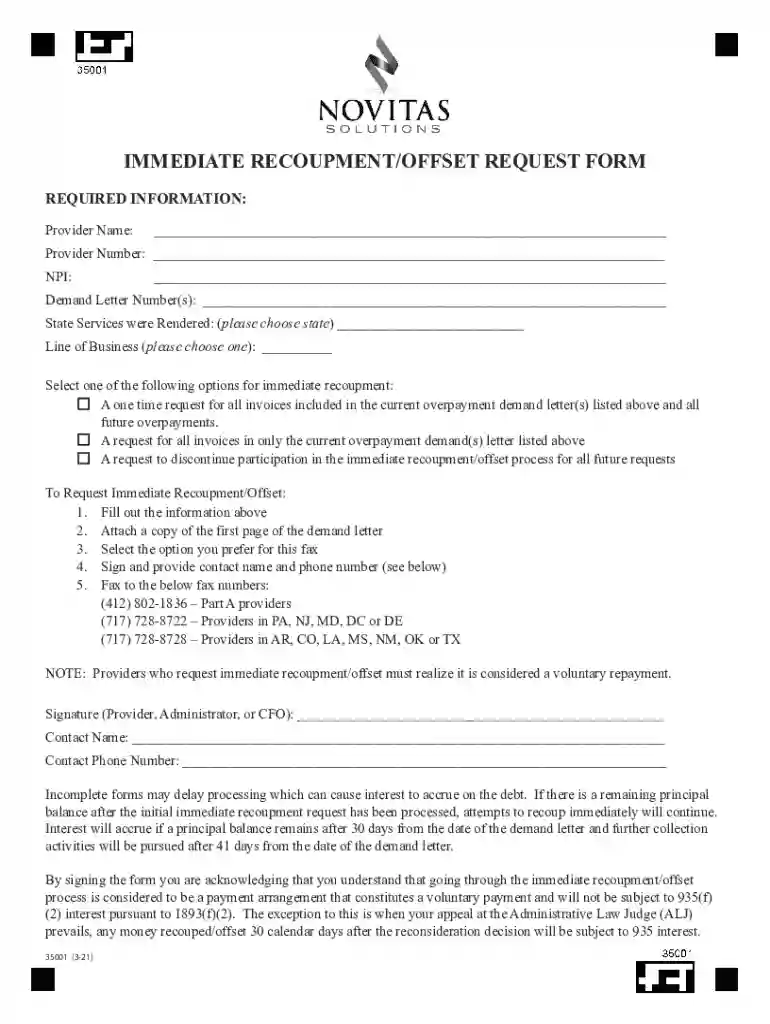
Immediate Recoupment offset Request Form 2026

Get Form
Immediate Recoupment offset Request Form Preview on Page 1

Here's how it works

01. Edit your form online
Type text, add images, blackout confidential details, add comments, highlights and more.

02. Sign it in a few clicks
Draw your signature, type it, upload its image, or use your mobile device as a signature pad.

03. Share your form with others
Send it via email, link, or fax. You can also download it, export it or print it out.

Definition and Meaning of the Immediate Recoupment Offset Request Form

The Immediate Recoupment Offset Request Form is a specialized document used by providers to initiate the process of immediately recouping overpayments received from payers. This process is voluntary and acts as an alternative to waiting for a payer to initiate recoupment or offset procedures on their own. The form requires detailed information that ensures the provider is taking a proactive approach to handle financial discrepancies related to overpayments, thus allowing for a more controlled resolution.

Steps to Complete the Immediate Recoupment Offset Request Form

Correctly filling out the form is critical. Follow these steps to ensure accuracy:

  1. Provider Details

    • Fill out your complete provider information, including name, address, and contact details.
    • Verification of national provider identifier (NPI) ensures accuracy and quick processing.
  2. Demand Letter Numbers

    • Locate and clearly input the demand letter numbers associated with the overpayment in question.
  3. Recoupment Options

    • Choose the preferred method of recoupment from the options provided in the form.
    • Ensure the selected option aligns with your financial management strategy.
  4. Documentation Attachment

    • Attach the necessary supporting documents. These may include demand letters and any previous correspondence related to the overpayment.
  5. Submission

    • The completed form and documents are typically submitted via fax to ensure receipt by the appropriate department.

Who Uses the Immediate Recoupment Offset Request Form

Typically, healthcare providers use this form when dealing with overpayments from insurance companies or government payers like Medicare or Medicaid. These providers range from individual practitioners to larger healthcare organizations. The form provides a structured way for these entities to manage their financial interactions with payers efficiently, promoting transparency and accountability.

Key Elements of the Immediate Recoupment Offset Request Form

The form is comprehensive and includes several key sections:

  • Provider Information: Ensures identification of the entity requesting recoupment.
  • Overpayment Details: Recorded using demand letter numbers and any specific conditions linked to the overpayment.
  • Preferred Recoupment Method: Selection of options available, facilitating a streamlined process.
  • Acknowledgement and Signature: The form must be signed to validate the request, confirming the provider's acknowledgment of the recoupment terms.

Important Terms Related to the Immediate Recoupment Offset Request Form

Understanding the terminology used within this context is crucial:

  • Immediate Recoupment: A voluntary repayment where funds are returned promptly without waiting for payer actions.
  • Offset: Adjusting future payments to account for overpayments.
  • Demand Letter: A notice issued by the payer, outlining the overpayment and repayment options.

Legal Use of the Immediate Recoupment Offset Request Form

Utilization of this form requires compliance with applicable laws and regulations, ensuring the process adheres to legal standards. The ESIGN Act provides the legal framework for electronic submissions, ensuring signatures hold the same validity as traditional ones. This is particularly relevant for documents that are completed and submitted digitally.

Submission Methods for the Immediate Recoupment Offset Request Form

Providers have several submission options, although fax is traditionally preferred for its security and directness. Emerging digital platforms may also facilitate secure online submission, though providers should verify that their methods comply with required standards for confidentiality and data security.

Penalties for Non-Compliance

Failing to properly report and correct overpayments can lead to financial penalties and legal complications. Providers need to act promptly to avoid interest accrual on outstanding overpayment amounts and potential audits, emphasizing the importance of using the form as a proactive measure.

Related Form Variants and Alternatives

Alternative forms or older versions can exist depending on specific payer requirements or changes in regulatory standards. Providers should ensure they are using the most current version to avoid processing delays or non-compliance issues. Additionally, electronic versions of the form may offer enhanced features such as pre-populated fields and digital signatures, streamlining completion and submission processes.

be ready to get more

Complete this form in 5 minutes or less

Get form

Got questions?

We have answers to the most popular questions from our customers. If you can't find an answer to your question, please contact us.
Contact us
An Offset mortgage works in a similar way to a standard mortgage. However, it has an additional feature known as an Offset Saver savings account. This savings account is linked to the mortgage. The amount of money in the Offset Saver savings account is deducted from the mortgage on which interest is charged.
A: A recoupment is a request for refund when we overpay an account. Some of the most common reasons for a recoupment are: We are not aware of a patients other health insurance coverage.
Setoff is an equitable right of a creditor to deduct a debt it owes to the debtor from a claim it has against the debtor arising out of a separate transaction. Recoupment differs in that the opposing claims must arise from the same transaction.
A. Setoff is an equitable right of a creditor to deduct a debt it owes to the debtor from a claim it has against the debtor arising out of a separate transaction. Recoupment differs in that the opposing claims must arise from the same transaction.
In the legal realm, offset refers to a claim made by the opposing party in a lawsuit, which aims to cancel out the original claim made by the plaintiff.

Security and compliance

At DocHub, your data security is our priority. We follow HIPAA, SOC2, GDPR, and other standards, so you can work on your documents with confidence.

Learn more
ccpa2
pci-dss
gdpr-compliance
hipaa
soc-compliance