
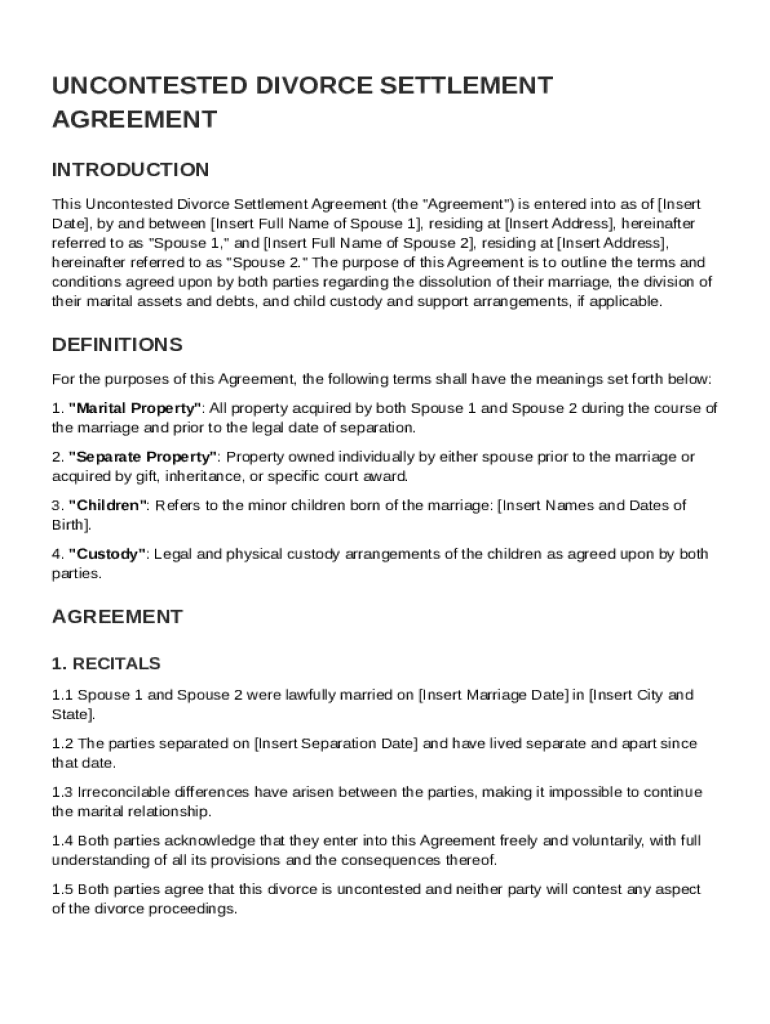







Uncontested Divorce Settlement Agreement: Definition & Meaning
An Uncontested Divorce Settlement Agreement is a legal document used to outline the agreed-upon terms between spouses for the dissolution of their marriage without court intervention. This arrangement includes the division of marital and separate property, asset and debt allocation, child custody and support details, and alimony provisions. Both parties consent to the terms voluntarily, acknowledging a mutual understanding of their respective rights and responsibilities. This type of agreement is preferred for its streamlined approach, avoiding the adversarial process of a contested divorce.
- Marital vs. Separate Property: Clearly differentiates assets and liabilities acquired before and during the marriage.
- Child Custody Arrangements: Outlines the legal and physical custody, with consideration for children's best interests.
- Spousal Support: Details financial support between spouses post-divorce, along with conditions for modification or termination.
Edge Cases and Variations
While uncontested divorce agreements aim for simplicity and cooperation, there are variations depending on state laws regarding property division and spousal support. For example, community property states automatically divide marital property equally, while equitable distribution states divide based on fairness.
Steps to Complete the Uncontested Divorce Settlement Agreement Template
Completing an Uncontested Divorce Settlement Agreement Template involves several key steps to ensure accuracy and legality:
- Gather Financial Information: Collect comprehensive financial details, including bank statements, investment accounts, and property valuations.
- Determine Custody Arrangements: Discuss and agree on custody terms, ensuring the arrangement prioritizes children's well-being.
- Agree on Spousal Support: Negotiate any alimony, considering factors like each spouse's earning capacity and marriage duration.
- Divide Assets and Debts: List all assets and liabilities, then decide on an equitable division.
- Draft the Agreement: Use the template to formalize the terms, ensuring all required sections are completed.
- Review and Revise: Have each party review the draft for errors or omissions, making necessary revisions.
- Obtain Legal Review: Consult an attorney to ensure the agreement meets all legal standards.
- Sign and Notarize: Both parties should sign the document in the presence of a notary to add legal validity.
Practical Examples
- Custody Battles: Even in uncontested divorces, custody negotiations can be complex. Illustrate an agreement where one parent retains primary custody, and the other receives substantial visitation rights.
- Spousal Support: Examine cases with significant income disparities that might necessitate ongoing alimony.
State-Specific Rules for Uncontested Divorce Settlement Agreements
State laws significantly impact divorce agreements, affecting everything from child support calculations to property divisions. Understanding these differences is crucial for compliance and enforceability.
- Community vs. Equitable States: States like California adhere to community property rules, while New York follows equitable distribution.
- Child Support Calculations: Each state has its formula, often based on income, to calculate child support obligations.
- Alimony Considerations: State-specific factors like marriage length and spouse earning potential influence alimony decisions.
State-by-State Variations
- Texas: Community property laws split marital assets equally.
- Florida: Uses the "best interests of the child" standard for custody.
Key Elements of the Uncontested Divorce Settlement Agreement Template
The template for an Uncontested Divorce Settlement Agreement includes essential sections ensuring comprehensive coverage of all critical marital dissolution aspects:
- Party Information: Identifies the couple, including names, addresses, and marriage dates.
- Asset & Debt Division: Details how assets and debts are divided, acknowledging separate property.
- Child Custody and Support: Specifies arrangements for custody and financial support for children.
- Spousal Support Terms: Outlines periodic payments, conditions, and duration for alimony.
- Mutual Release: Each spouse waives rights to future claims against each other.
- Dispute Resolution: Defines procedures for handling potential disagreements or modifications.
Real-World Scenarios
- Asset Allocation: Illustrate equitable asset distribution in complex financial marriages, such as dividing the family home and retirement benefits.
- Child Custody: Delve into custody arrangements for long-distance parenting, including visitation schedules.
Legal Use of the Uncontested Divorce Settlement Agreement Template
Legal protocols must be observed to uphold the validity of an Uncontested Divorce Settlement Agreement. This involves ensuring parties fully understand the document and willingly consent without coercion. Each party should have an opportunity for independent legal consultation.
- Voluntary Participation: Confirm both parties willingly agree to the terms without undue pressure.
- Court Approval: The agreement requires submission to the court for final approval, which involves a judge reviewing and ratifying the terms.
- Modification Clauses: Clarifies processes for future adjustments to custody, support, or other elements.
Legal Considerations
- Court Involvement: Although seemingly autonomous, courts must review uncontested divorces to ensure fairness and legality.
- Binding Nature: Once signed and approved, settlements become legally binding, obligating compliance or subject to enforcement actions.
Who Typically Uses the Uncontested Divorce Settlement Agreement Template
The template serves a broad audience, including:
- Couples seeking amicable splits, preferring low-conflict resolutions to contentious litigation.
- Individuals with simple asset and debt structures, simplifying division and reducing legal complexities.
- Families prioritizing children’s stability, creating tailored plans to maintain harmonious co-parenting and support.


Examples
- Childless Couples: Simplify the process through straightforward asset division and mutual release agreement.
- High-Net-Worth Couples: Requires detailed asset catalogs and valuations for accurate division while avoiding prolonged legal conflict.
How to Use the Uncontested Divorce Settlement Agreement Template
The template acts as a guide through the settlement crafting process, ensuring comprehensive coverage and mutual agreement.
- Accessing the Template: Available through platforms like DocHub, where it can be easily filled and customized.
- Document Customization: Supports adding or modifying clauses to suit individual needs, preserving compliance with state-specific regulations.
- Digital Submission: Completed documents can be signed electronically, leveraging legal e-signature capabilities.
Digital Utilization
- DocHub Compatibility: Beneficial for easy electronic edits, collaborations, and filing, integrating seamlessly with Google Workspace for enhanced workflow.
Important Terms Related to the Uncontested Divorce Settlement Agreement Template
Understanding essential terms within the divorce agreement ensures clarity and informed decision-making:
- Marital vs. Separate Property: Defines ownership based on acquisition timing.
- Custody Types: Differentiates legal and physical custody, affecting decision-making and childcare logistics.
- Alimony Versus Child Support: Distinguishes between spousal and child maintenance.
- Modification Rights: Establishes grounds and procedures for future agreement amendments.
Clarifying Key Definitions
- Legal Custody: Involves decision-making responsibility for children's welfare and education.
- Physical Custody: Relates to the location of children’s primary residence.
These sections outline the core components and legal complexities involved in preparing an Uncontested Divorce Settlement Agreement, providing insightful, comprehensive coverage for those seeking information or participating in the process.




