







Definition & Meaning
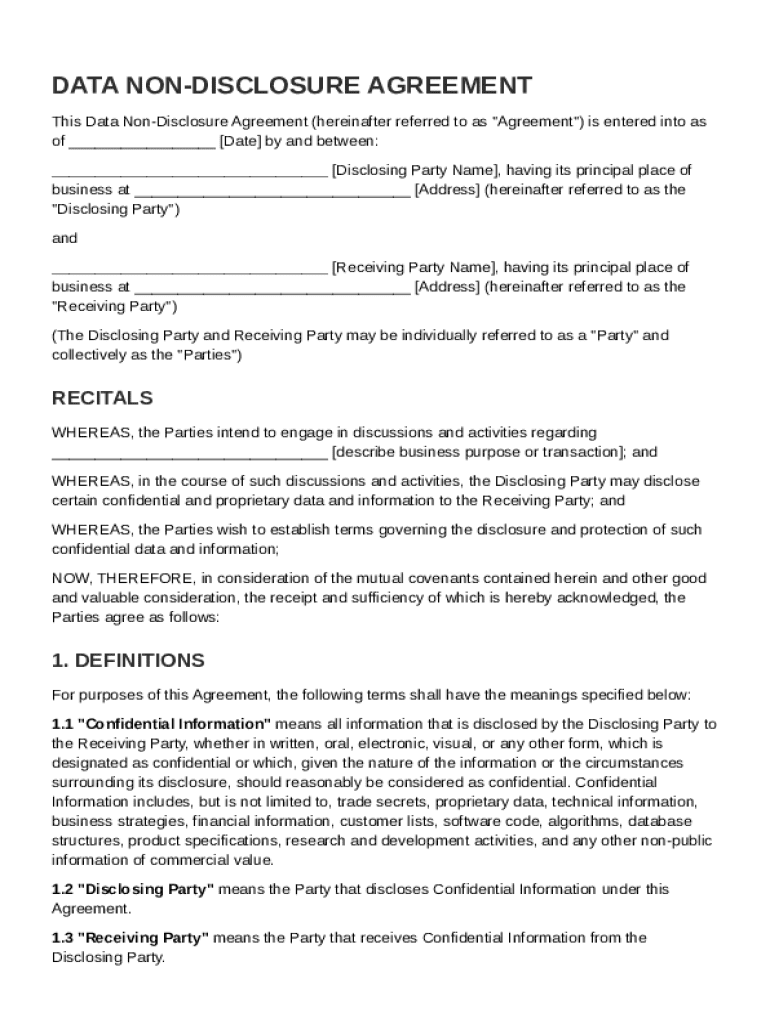
The Data Non-Disclosure Agreement (NDA) is a legal contract that outlines the terms and conditions under which confidential information is shared between parties. It defines key terms such as the "Disclosing Party" and the "Receiving Party." Confidential information typically includes proprietary data and trade secrets that must remain private. The agreement ensures that the Receiving Party understands its obligation to maintain confidentiality and restricts the use of disclosed information for unauthorized purposes. It is an essential tool in protecting business interests and maintaining competitive advantage.
Confidential Information
- Clearly outlines what constitutes confidential information.
- Examples include business plans, customer lists, proprietary technology, and financial data.
Obligations of the Receiving Party
- The Receiving Party must not disclose any confidential information.
- Agreement may include specific measures for maintaining confidentiality, such as using secure methods for storing data.
Key Elements of the Data Non Disclosure Agreement Template
A comprehensive Data NDA template contains several critical sections to ensure legal protection.
Exclusions from Confidentiality
- Information that is already public or becomes public through no fault of the Receiving Party is excluded.
- Data independently developed by the Receiving Party without reference to the Disclosing Party's information.
Permitted Disclosures
- Conditions under which the information may be disclosed, such as legal obligations or consent from the Disclosing Party.
Return or Destruction of Information
- Upon termination of the agreement, the Receiving Party must return or destroy all proprietary information.
Governing Law
- Specifies the jurisdiction’s law that governs the agreement, which is crucial for legal enforcement.
Steps to Complete the Data Non Disclosure Agreement Template
Completing an NDA template involves a structured process to ensure clarity and effectiveness.
-
Identify the Parties Involved
- Clearly state the full legal names of the Disclosing Party and the Receiving Party.
-
Outline the Scope of Confidentiality
- Define what information is protected and any specifics on how it should be handled.
-
Specify the Duration
- The agreement should outline the period during which confidentiality is maintained, including any post-agreement obligations.
-
Include Legal Provisions
- Add clauses for amendments, severability, and dispute resolution to cover potential legal challenges.
Example Clause
- “This Agreement shall remain in effect for a period of two years from the date of execution, unless terminated earlier by mutual consent.”
Who Typically Uses the Data Non Disclosure Agreement Template
NDAs are widely used across different industries to safeguard intellectual property and business strategies.

Business Entities
- Corporations, partnerships, and LLCs aiming to protect trade secrets during collaborations.
Individual Use
- Entrepreneurs and freelancers ensuring their innovative ideas remain confidential when presenting to potential partners or investors.
Educational Institutions
- Universities and research bodies that exchange advanced research data with commercial partners.
Legal Use of the Data Non Disclosure Agreement Template
Adhering to legal standards, NDAs provide a binding assurance of confidentiality.
Enforceability
- To be enforceable, NDAs must comply with relevant state and federal laws, such as the ESIGN Act for electronic signatures.
Legal Recourse
- In the event of a breach, the Disclosing Party might seek injunctions or monetary damages.
Limitations
- Courts may limit the scope of an NDA if deemed overly broad or restrictive without just cause.
Important Terms Related to Data Non Disclosure Agreement Template
Understanding key legal terms within an NDA ensures clarity and compliance.
Amendment
- Procedures for making changes to the agreement post-signature.
Severability
- A clause stating that if one part of the agreement is invalid, the rest remains effective.
Remedies for Breach
- Specified actions or compensation in the event of a breach, enhancing deterrence.
State-Specific Rules for the Data Non Disclosure Agreement Template
NDAs must consider state-specific legal requirements, especially for enforcement.
California's Unique Approach
- California law restricts non-compete clauses, often included in broader NDAs.
New York Jurisdiction
- NDAs in New York may include specific clauses for commercial information due to stringent state privacy laws.
Examples of Using the Data Non Disclosure Agreement Template
The practical application of NDAs can vary based on the context and industry.
Collaborative Research
- Universities and corporations partnering for medical research to ensure data remains protected.
Product Development
- Tech companies sharing pre-launch product details with marketing firms while safeguarding innovation.
Mergers & Acquisitions
- Disclosures during M&A processes where sensitive financial and strategic information is exchanged.




