
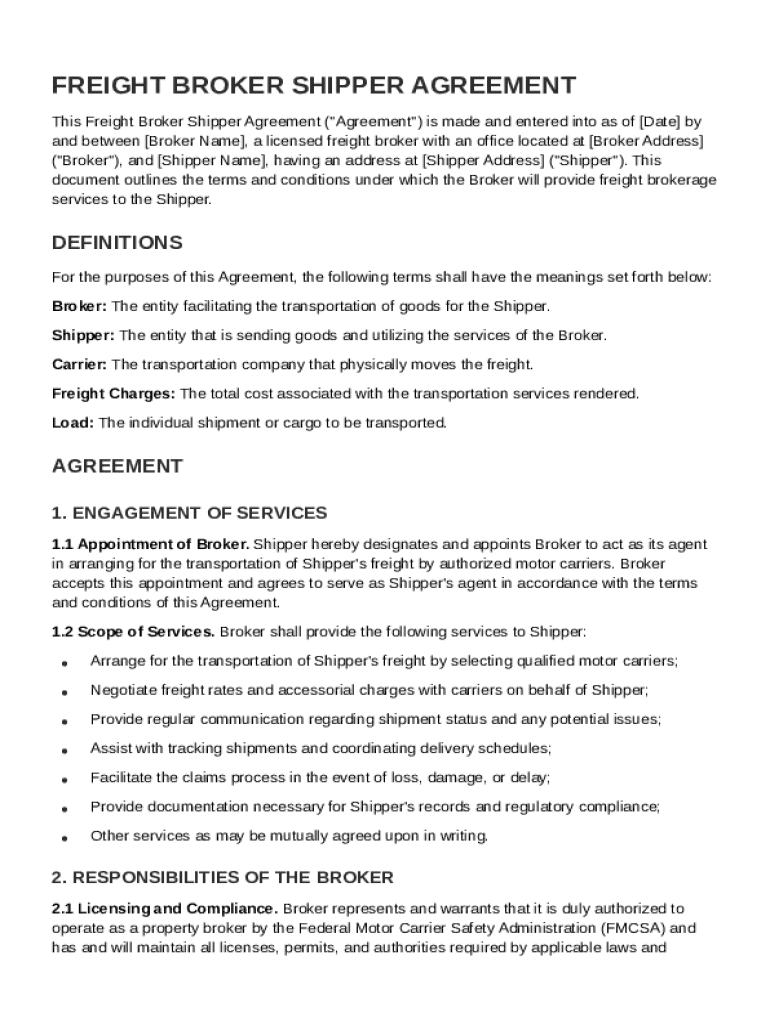







Definition & Meaning
The Freight Broker Shipper Agreement Template is a formal contract that establishes the terms and conditions between a licensed freight broker and a shipper for the transportation of goods. It delineates the roles, responsibilities, and obligations of both parties. This agreement ensures clarity on services provided by the broker, payment terms, and liability limitations. It also includes confidentiality requirements, dispute resolution processes, and termination clauses, which guarantee compliance with pertinent laws and regulations.
Key Elements of the Freight Broker Shipper Agreement Template
A comprehensive Freight Broker Shipper Agreement Template should include:
- Parties Involved: Clearly identify the freight broker and the shipper, along with their contact information and any relevant business credentials.
- Services Provided: Define the scope of services the broker will offer, such as arranging the transportation of goods and any additional logistics services.
- Compensation and Payment Terms: Outline payment structures, including rates, billing cycles, and payment methods.
- Liability and Insurance: Detail liability limitations, highlighting the broker's responsibility for damage or loss of goods in transit. Include insurance requirements.
- Confidentiality: Set terms regarding the handling and confidentiality of sensitive information shared between parties.
- Termination Clauses: Include conditions under which the agreement can be terminated by either party.
Steps to Complete the Freight Broker Shipper Agreement Template
- Gather Information: Collect necessary details about both the freight broker and the shipper, including legal names, addresses, and contact information.
- Define Services: Clearly specify the services to be provided by the broker, including any special handling or logistical needs.
- Set Payment Terms: Establish how and when payments will be made, including any penalties for late payments or non-payment.
- Detail Liability Obligations: Provide a clear outline of each party's liability and the types of insurance coverage required.
- Review Confidentiality Agreements: Include provisions for confidentiality and how sensitive data will be protected.
- Finalize and Sign: Have both parties review the completed document, make necessary revisions, and sign the agreement.
Legal Use of the Freight Broker Shipper Agreement Template
The use of the Freight Broker Shipper Agreement Template serves to legally bind both the freight broker and the shipper under stipulated conditions. The contract must comply with general U.S. contract law principles, asserting voluntary agreement, lawful purpose, and capacity to contract. The template ensures that both parties understand and agree to fundamental terms such as service provision, responsibilities, and dispute resolution mechanisms. Parties are encouraged to seek legal advice to ensure compliance with industry-specific regulations and state laws.
Who Typically Uses the Freight Broker Shipper Agreement Template
Typically, logistics companies, freight brokers, and shippers employ the Freight Broker Shipper Agreement Template to formalize their business transactions. Freight brokers act as intermediaries, coordinating shipping services on behalf of the shipper. Shippers, often manufacturers or distributors, use this agreement to ensure that their goods are transported efficiently and safely. Such agreements are vital for freight companies looking to establish transparent, legally protected relationships with clients.


Important Terms Related to Freight Broker Shipper Agreement Template
Familiarity with several key terms used in this template is crucial:
- Freight Broker: An intermediary who arranges transportation for shippers and handles related logistics.
- Shipper: The party requiring the transport of goods from one location to another.
- Bill of Lading: A document issued by a carrier to acknowledge receipt of cargo for shipment.
- Tariffs: Fees and charges for transportation services set by carriers and brokers.
- Claims: Requests for compensation due to loss or damage to goods.
State-Specific Rules for the Freight Broker Shipper Agreement Template
While the Freight Broker Shipper Agreement Template generally follows federal transportation laws, certain state-specific rules may apply. For instance, regulations regarding insurance and liability may differ by state. It is vital for parties involved to review state laws that govern logistics and freight transportation to ensure full compliance. Consulting with legal professionals knowledgeable in state-specific nuances can help in tailoring the template to meet particular legal requirements.
Examples of Using the Freight Broker Shipper Agreement Template
A manufacturing company, XYZ Manufacturing, partners with ABC Logistics as its freight broker. They utilize the Freight Broker Shipper Agreement Template to outline roles such as ABC's responsibility to coordinate all shipping routes and schedules. Payment terms are set to $10,000 monthly with a detailed mediation process in case of delivery disputes. This formalized agreement ensures both parties have a clear understanding of their responsibilities, fostering a smooth business relationship.
Digital vs. Paper Version
Choosing between a digital or paper version of the Freight Broker Shipper Agreement Template depends on operational preferences. Digital agreements can be more efficient, allowing for online signing, storage, and easy retrieval via platforms like DocHub. They also facilitate seamless sharing and real-time collaboration, useful for integrating with digital workflows. Conversely, some may prefer traditional paper versions for tactile interaction or when digital options are challenging due to limited technological access. Both versions require careful execution to ensure legality, authenticity, and proper storage.
Software Compatibility
The Freight Broker Shipper Agreement Template is compatible with a variety of document editing tools, including DocHub, which supports formats like PDF, DOC, and others. Such compatibility allows modifications, form-filling, and signing through a single platform without requiring document conversion. Additionally, this template can be integrated into software ecosystems like Google Workspace, enabling easy document management and collaboration. Such flexibility enhances the ease with which users can complete and manage agreements efficiently.




