







Definition & Meaning
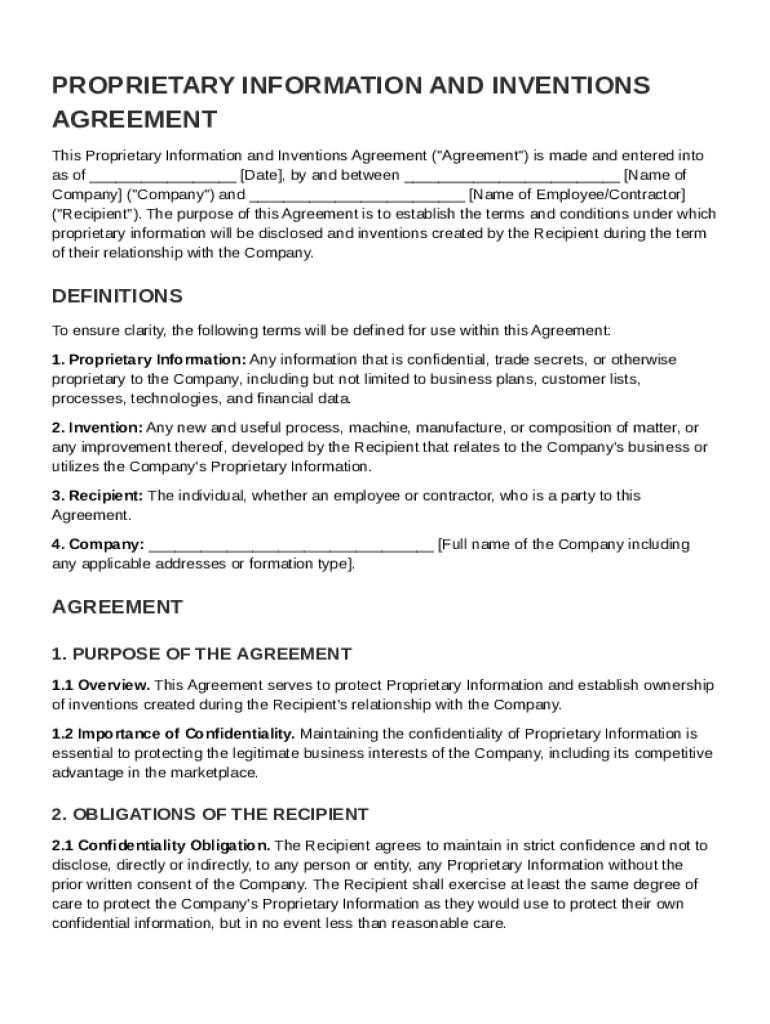
The Proprietary Information and Inventions Agreement Template, commonly referred to as the Proprietary Information and Inventions Agreement (PIIA), is a specialized legal document designed to protect sensitive proprietary information and to establish the ownership of inventions. This agreement is primarily used between employers and their employees or independent contractors, emphasizing confidentiality and legal obligations surrounding intellectual property created during the course of employment or contract. The PIIA serves as a binding contract that outlines specific terms and conditions that are essential for maintaining the integrity and security of a company's intellectual assets.
Key Elements of the Proprietary Information and Inventions Agreement Template
Confidentiality Obligations
One of the primary purposes of the PIIA is to enforce confidentiality. Employees and contractors are required to handle proprietary information—like trade secrets and sensitive business data—with utmost discretion. The agreement typically defines what constitutes proprietary information and sets terms for how it can be used or disclosed.
Ownership of Inventions
The PIIA explicitly states that any inventions or intellectual property created by the employee or contractor during their tenure belong to the company. It covers inventions developed directly as part of the individual's role as well as those made with the use of company resources or information.
Governing Law
This section of the PIIA dictates which legal system governs the agreement. Given its widespread use in the U.S., the agreement frequently points to state laws that apply to contractual and intellectual property matters, providing legal clarity and recourse in case of disputes.
Important Terms Related to the Proprietary Information and Inventions Agreement Template
Inventions
Inventions refer to technological, methodological, or conceptual advancements that are eligible for intellectual property protection. The PIIA covers not only patentable inventions but also other creations that may not qualify for formal intellectual property protection but are valuable to the company.
Intellectual Property
Intellectual Property (IP) is a core term in the agreement, encompassing patents, copyrights, trademarks, and trade secrets. The PIIA delineates how the company retains rights to such properties developed by its workforce.
Severability
A standard legal clause, severability ensures that if any part of the PIIA is deemed unenforceable, the remaining provisions still hold valid. This protects the integrity of the agreement, ensuring that a single unenforceable clause does not compromise the entire document.
Steps to Complete the Proprietary Information and Inventions Agreement Template
-
Personal Information Entry: Begin by entering the full names and addresses of both the employer and the employee or contractor.
-
Define Proprietary Information: Clearly specify the type of proprietary information covered by the agreement, including examples if necessary.
-
Assignment of Inventions: Detail how invention ownership is assigned to the company and any exceptions that might apply.
-
Signatures and Date: Both parties must sign and date the document, establishing its enforceability.
-
Legal Review: Before execution, it might be prudent to have a legal professional review the agreement for compliance with applicable laws and company needs.
Legal Use of the Proprietary Information and Inventions Agreement Template
The PIIA is utilized in legal contexts to navigate disputes over intellectual property and confidentiality breaches. Courts often reference these agreements to determine the rightful ownership of inventions created during employment. The document also aids in enforcement actions against unauthorized disclosures of proprietary information. Regulations such as the Defend Trade Secrets Act in the U.S. further underscore the legal weight behind such agreements.
Who Typically Uses the Proprietary Information and Inventions Agreement Template


Employers
Companies, regardless of size, use this agreement to protect their intellectual property by ensuring employees and contractors fully understand their obligations concerning proprietary information and inventions.
Employees and Contractors
Individuals engaging in work where innovation or access to sensitive information is involved are typically required to sign this agreement, reflecting the mutual understanding and acceptance of its terms.
State-Specific Rules for the Proprietary Information and Inventions Agreement Template
While many principles within a PIIA are universal, certain states in the U.S. have specific rules regarding non-compete clauses and the assignation of inventions. For instance, California law restricts the extent to which employers can claim rights over employee inventions developed entirely on personal time without the use of company resources.
Digital vs. Paper Version
The choice between a digital and paper version of the PIIA can affect its accessibility and storage. Digital versions allow for easy editing, signing, and archiving, especially when using platforms like DocHub that offer secure and efficient document handling. Paper versions, however, might still be preferred in traditional environments or where digital signatures are not accepted. Both formats should ensure compliance with legal standards for enforceability.




