
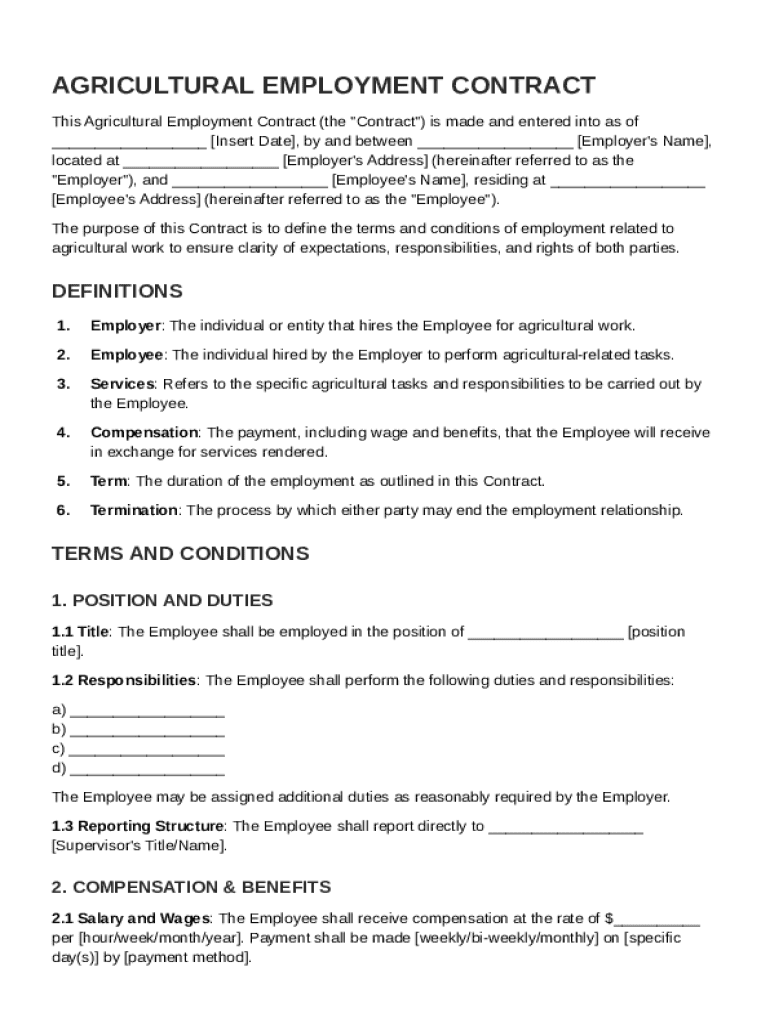





Definition and Purpose of the Agricultural Employment Contract Template
The Agricultural Employment Contract Template serves as a legally binding agreement between an employer and an employee engaged in agricultural work. It delineates the terms and conditions under which the work will be performed, including responsibilities, compensation, and other significant employment conditions. By clarifying expectations for both parties, this template helps prevent misunderstandings and ensures that all details are explicitly agreed upon, fostering a transparent employer-employee relationship.
How to Use the Agricultural Employment Contract Template Effectively
Utilizing the Agricultural Employment Contract Template involves several key steps to ensure comprehensive and accurate completion:
-
Review Template Content: Before filling out the form, thoroughly review each section of the template to understand what information is required.
-
Customize Details: Tailor the contract to suit specific employment arrangements, including roles, responsibilities, and compensation structure.
-
Clarify Roles and Responsibilities: Clearly define the worker's duties and the employer's expectations to avoid any ambiguity.
-
Specify Compensation and Benefits: Detail the salary, any applicable benefits, and payment schedule to ensure mutual understanding.
-
Include Legal Obligations: Incorporate relevant legal information such as confidentiality agreements and termination procedures.
-
Review with Legal Expert: It is advisable to have a legal professional review the document to ensure it meets all requisite legal standards.
Key Elements of the Agricultural Employment Contract Template
The Agricultural Employment Contract Template comprises several critical elements that must be carefully documented:
- Employer and Employee Information: Full legal names and contact details.
- Job Description: Detailed outline of duties and responsibilities assigned to the employee.
- Work Schedule: Specification of days and hours the employee is expected to work.
- Compensation Details: Salary, benefits, and any bonuses or incentives, along with payment intervals.
- Confidentiality Clause: Terms under which sensitive information must be handled.
- Termination Procedures: Conditions under which the contract may be terminated by either party.
- Governing Law: State or federal laws that apply to the employment relationship.
Steps to Complete the Agricultural Employment Contract Template
Execution of the Agricultural Employment Contract Template involves a series of methodical steps. These ensure the document is completed correctly and all relevant sections are addressed:
- Gather Information: Collect all necessary details about the employer, employee, job description, and agreed terms.
- Fill Out Section by Section: Start from the top of the form and proceed methodically, ensuring no section is overlooked.
- Review and Revise: Once filled, go over each section to confirm all information is accurate and complete.
- Finalize and Sign: After thorough review, both parties should sign the document to formalize the agreement.
- Distribute Copies: Provide copies to the employer and employee to retain for their records.
State-Specific Rules for the Agricultural Employment Contract Template
Employment laws can vary significantly from state to state, making it essential to tailor the Agricultural Employment Contract Template to comply with local regulations:
- Minimum Wage Requirements: Ensure adherence to state-specific minimum wage laws.
- Overtime Regulations: State variations may affect how overtime is calculated and compensated.
- Worker's Compensation: Confirm state-specific requirements for worker's compensation insurance.
- Seasonal Work Laws: Some states have additional protections or conditions for seasonal agricultural workers.
Legal Use and Compliance
The Agricultural Employment Contract Template must comply with relevant legal standards to ensure its enforceability. Legal use involves:
- Compliance with Federal Labor Laws: Ensure alignment with the Fair Labor Standards Act and other federal regulations governing agricultural work.
- Adhering to State Employment Laws: Tailor the contract to reflect specific state employment laws related to agriculture.
- Incorporating Necessary Legal Clauses: Include required legal language for liability, dispute resolution, and other standard clauses.
Examples of Using the Agricultural Employment Contract Template
There are various scenarios where this template can be effectively utilized, given the diversity in agricultural employment arrangements:
- Seasonal Worker Contracts: Structured for temporary labor during specific planting or harvesting seasons.
- Full-Time Agricultural Employees: Used to create agreements for permanent positions with stable work hours.
- Part-Time Farm Labor: Adapted for workers engaged on a part-time basis, specifying pro-rated compensation and benefits.
Who Typically Uses the Agricultural Employment Contract Template
The template serves different stakeholders in the agricultural sector, ensuring clear communication and formalized agreements:
- Farm Owners and Managers: Who need to formalize employment terms for hired help on their farms.
- Agricultural Corporations: Use it as a standard contract for multiple employees across various operational levels.
- Employment Agencies: Facilitate matching agricultural labor with demand, utilizing standardized contracts for clarity and efficiency.