
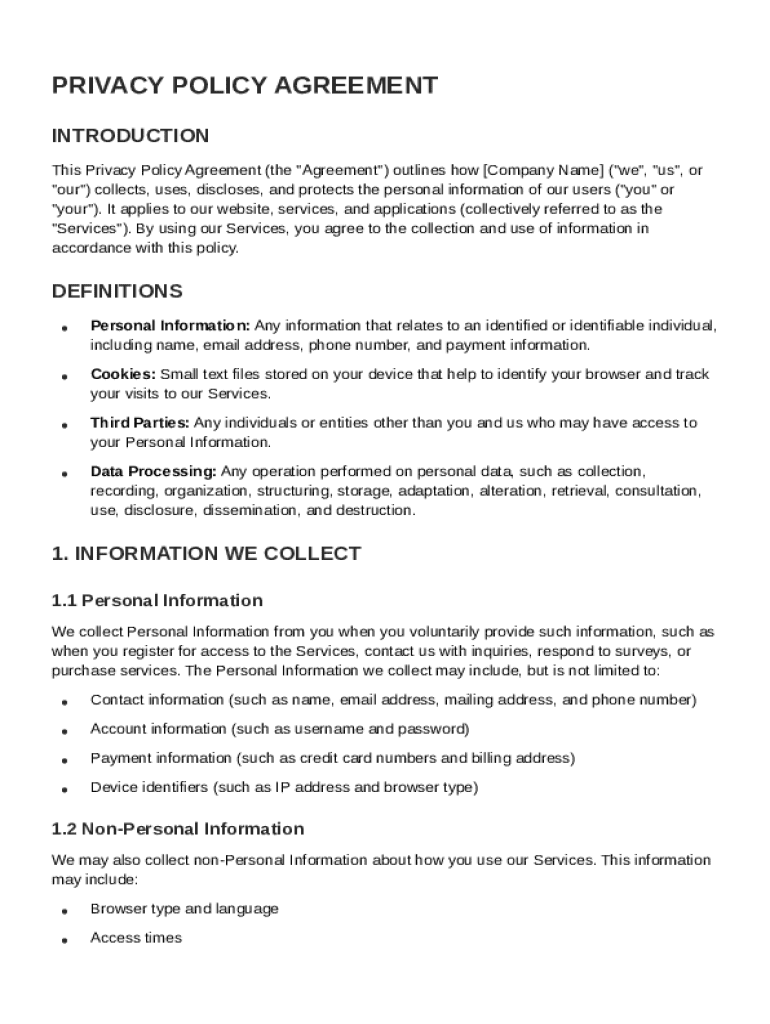







Definition & Meaning
The Privacy Policy Agreement Template is a structured document that outlines the methods a company employs to collect, utilize, disclose, and protect the personal information of its users. Specifically designed to meet legal and ethical standards, it details the types of data gathered, intended uses, and sharing practices with third parties. It also establishes the company's data retention policies, security measures, and user rights. In the United States, such agreements are integral for compliance with privacy laws such as the California Consumer Privacy Act (CCPA) and the General Data Protection Regulation (GDPR) for companies operating in or with connections to the EU.
The purpose of this template is to communicate to users how their personal data will be handled, allowing them to make informed decisions about their interactions with a company or service. It serves as a comprehensive guide for users regarding their rights to access, correct, or delete their personal information, ensuring transparency and fostering trust between the user and the company.
Key Elements of the Privacy Policy Agreement Template
The Privacy Policy Agreement Template contains crucial components that ensure comprehensive coverage of data protection practices. These elements provide clarity both to the company drafting the policy and to the users it affects:
-
Information Collection Practices: This section details the types of personal information collected from users, such as name, email address, and payment details.
-
Usage of Information: Here, the company explains how the collected information will be used, including direct marketing, service improvements, or communication purposes.
-
Disclosure to Third Parties: This part outlines if and how information is shared with third parties, including partners, affiliates, or service providers, while ensuring compliance with legal obligations.
-
Data Retention Policy: Specifications on how long personal data is retained before it is securely deleted ensure users know the duration their information is kept.
-
Security Measures: It describes the security protocols in place, such as encryption and access controls, to protect personal information against unauthorized access.
-
User Rights: Clearly laid out user rights concerning access, correction, and deletion of their personal data.
-
Cookie Usage: Explanation of the cookies used, if any, and their purpose in tracking and enhancing user experience.
How to Use the Privacy Policy Agreement Template
To use the Privacy Policy Agreement Template effectively, follow these detailed steps:
-
Identify Your Data Practices: Begin by compiling a detailed list of the types of personal data your company collects. This may include personal identifiers, payment information, or user behavior data.
-
Customize Template Sections: Tailor each section of the template to reflect your specific data usages accurately. Pay particular attention to how information is collected, used, and shared.
-
Consult Legal Advisors: Engage a privacy expert or legal advisor to review the customized template to ensure it complies with relevant federal and state privacy laws.
-
Review and Revise Regularly: Set a schedule to review and update the privacy policy regularly, especially when your data practices or external legal requirements change.
-
Educate Your Team: Ensure that all company stakeholders understand the privacy policy and their responsibilities regarding user data.
Steps to Complete the Privacy Policy Agreement Template
Completing the Privacy Policy Agreement Template involves a series of methodical steps that require attention to detail and a comprehensive understanding of the company's data handling practices:
-
Gather Information: Collect detailed information on all personal data collected by your company, including the purpose and methods of collection.
-
Customize the Template: Adjust the template sections to match your company’s specific practices and the data lifecycle, from collection to deletion.
-
Legal Compliance Check: Have your privacy policy reviewed by a qualified legal professional to ensure compliance with applicable laws like CCPA and GDPR.
-
Obtain Approval: Secure approval from relevant company executives or board members to ensure the policy aligns with business objectives and legal compliance.
-
Implement and Communicate: Implement the completed privacy policy across all platforms where user data is collected and communicate the policy to all users transparently.
Legal Use of the Privacy Policy Agreement Template
In the United States, the implementation of a Privacy Policy Agreement is a legal requirement for organizations that collect personal information from users. This template serves to demonstrate the company's commitment to protecting user data by detailing:
- Compliance with federal and state privacy laws, such as CCPA.
- Protection parameters for sensitive data.
- Legal repercussions for non-compliance, which can include fines or sanctions imposed by regulatory bodies-like the Federal Trade Commission (FTC).
For businesses operating internationally, adherence to GDPR or similar international regulations may also be essential. Legally binding, the Privacy Policy Agreement safeguards both the user and the company, serving as a critical legal document in data privacy defense.
Important Terms Related to Privacy Policy Agreement Template
Understanding key terms associated with the Privacy Policy Agreement Template is essential for both companies and users:
-
Data Controller: Refers to the entity that determines the purposes and means of processing personal data.
-
Data Processor: The entity that processes data on behalf of the data controller.
-
Personal Data: Any information relating to an identified or identifiable individual.
-
Consent: Freely given, specific, informed, and unequivocal indication of the data subject's wishes whereby they signify agreement to their data being processed.
-
Data Breach: A security incident in which information is accessed without authorization.
Examples of Using the Privacy Policy Agreement Template
The practical application of a Privacy Policy Agreement Template can vary across different sectors. Below are some specific scenarios:
-
E-commerce Platforms: Describes data collection practices during user registration, transactions, and interactions with the website.
-
Mobile Applications: Details permissions requested from users, such as access to contacts and location data, and the purpose of such access.
-
Healthcare Services: Outlines how patient data is collected and handled, ensuring adherence to HIPAA regulations in addition to broader privacy laws.
-
Social Media Networks: Explains the use of user-generated content and data analytics for personalized advertisements.
Software Compatibility
Privacy Policy Agreement Templates can be edited and managed using a range of software solutions to ensure ease of use and accessibility:
-
DocHub: A versatile tool that allows users to edit, sign, and share documents online, supporting formats like DOC, PDF, PPT, and more.
-
Google Workspace: Seamless integration with Google Drive and Gmail enables importing, editing, and exporting privacy policies directly through Google platforms.
-
Adobe Acrobat: Useful for creating and editing PDF versions of the privacy policy, ensuring wide distribution and accessibility.
This compatibility allows for the adaptation of privacy policy templates into various formats convenient for diverse organizational needs, maintaining the integrity and accessibility of the document.




