






Definition & Meaning
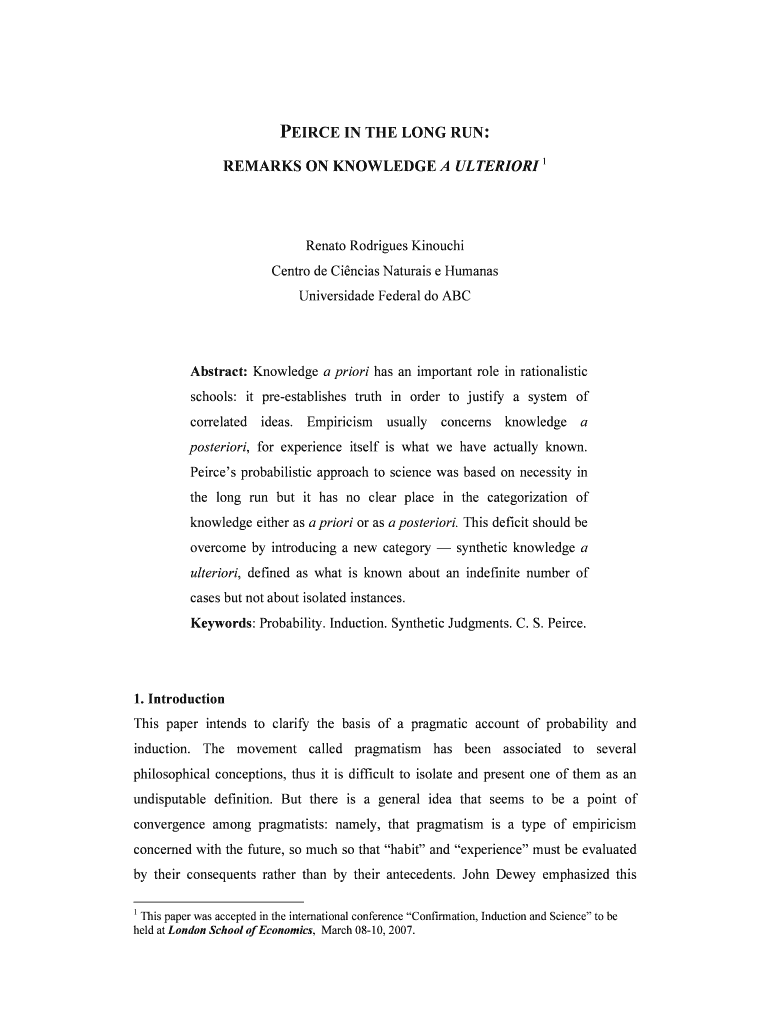
The document "PEIRCE IN THE LONG RUN: REMARKS ON - PhilSci-Archive - philsci-archive pitt" examines the philosophical ideas of C.S. Peirce, particularly his approach to probability and induction. It introduces the notion of 'synthetic knowledge a ulteriori,' which is knowledge that pertains to indefinite cases rather than isolated instances. This concept extends beyond traditional Kantian classifications and emphasizes collective necessity within probabilistic statements. Peirce's method of examining long-run frequencies offers a broadened view of scientific inquiry and probabilistic determinism.
How to Use the Document
When engaging with "PEIRCE IN THE LONG RUN: REMARKS ON - PhilSci-Archive - philsci-archive pitt," consider it as a philosophical resource that explores the interplay between probability, induction, and pragmatism. Researchers and scholars can delve into the nuances of Peirce's philosophy, applying insights to modern scientific and philosophical debates. The document serves as a cornerstone for understanding probabilistic frameworks within scientific inquiry, making it a valuable tool for advancing theoretical discussions.
Steps to Complete the Understanding
-
Background Reading: Before engaging with the text, familiarize yourself with basic concepts in probability, induction, and pragmatism, especially as related to C.S. Peirce's works.
-
Identify Key Themes: Focus on the main themes like 'synthetic knowledge a ulteriori' and collective necessity. Understanding these ideas provides context for the document's arguments.
-
Deep Dive into Sections: Analyze sections discussing probabilistic determinism and long-run frequencies, which are pivotal to Peirce's philosophical framework.
-
Cross-reference with Secondary Sources: Enhance your understanding by consulting secondary literature that critiques or expands on Peirce's ideas.
-
Synthesize with Current Research: Consider how Peirce's conclusions might inform or challenge current scientific methodologies.
Why Should You Explore It
Engaging with this document enables a deeper understanding of foundational philosophical arguments that impact the study of probability and scientific inquiry. Peirce's approach, particularly his focus on long-run frequencies, offers a robust framework for interpreting probabilistic determinism. For philosophers, scientists, and scholars, these insights support the advancement of theoretical discussions and empirical research.
Who Typically Uses the Document
The primary audience for "PEIRCE IN THE LONG RUN: REMARKS ON - PhilSci-Archive - philsci-archive pitt" includes:
- Philosophers: Who are exploring the intersections of probability, induction, and pragmatism.
- Scientists and Researchers: Interested in applying philosophical insights to empirical methodologies.
- Academics: Involved in higher education and scholarly pursuits, focusing on the history of philosophy and scientific theory.


Key Elements Explored
-
Synthetic Knowledge a Ulteriori: A pivotal idea that challenges traditional Kantian classification and expands on the nature of knowledge.
-
Collective Necessity: Essential in understanding probabilistic statements and their implications for scientific inquiry.
-
Long-run Frequencies: Peirce's emphasis on this concept frames his unique interpretation of probabilistic determinism.
Important Terms Related to Peirce's Philosophical Framework
-
Pragmatism: A philosophical tradition that considers thought as a tool for prediction, problem-solving, and action.
-
Probabilistic Determinism: The belief that probability can be used to determine future events based on long-term frequency analyses.
-
Induction: A method of reasoning that involves deriving general principles from specific observations.
Examples of Using the Document
-
Academic Research: Use the document as a primary source in philosophical studies exploring the evolution of logic and probability.
-
Lectures and Seminars: Incorporate Peirce's theories into discussions on the philosophy of science and its application within contemporary research contexts.
-
Philosophical Critiques: Analyze Peirce's ideas to critique or support alternative theories of knowledge and scientific understanding.
Software Compatibility and Integration
For modern interactions, this document and its themes can integrate into various academic software platforms used for research and collaboration, such as:
-
EndNote or Zotero: For managing bibliographies and referencing in scholarly articles.
-
Literature Review Tools: Platforms that allow integration of philosophical texts into larger databases for research purposes.
-
Collaborative Scholarly Platforms: Such as Overleaf, for real-time document editing and collaborative projects in academia.