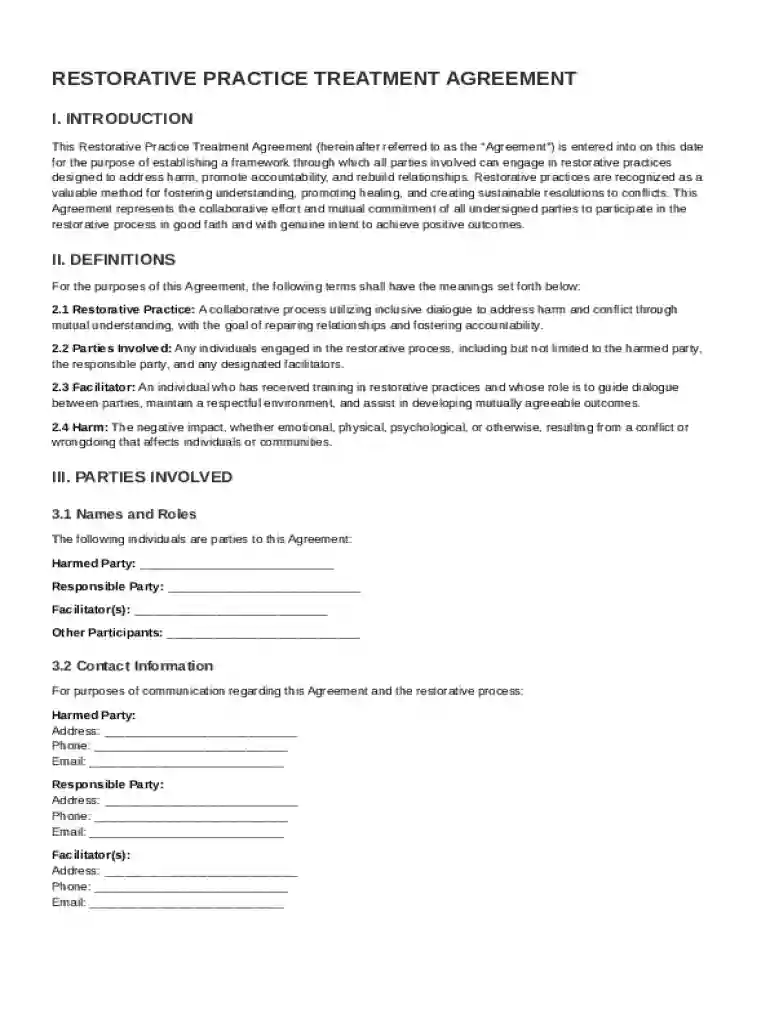
Restorative Practice Treatment Agreement Template 2026

Get Form
Restorative Practice Treatment Agreement Template Preview on Page 1

Here's how it works

01. Edit your form online
Type text, add images, blackout confidential details, add comments, highlights and more.

02. Sign it in a few clicks
Draw your signature, type it, upload its image, or use your mobile device as a signature pad.

03. Share your form with others
Send it via email, link, or fax. You can also download it, export it or print it out.

Definition & Meaning

The Restorative Practice Treatment Agreement Template is a formal document that establishes guidelines for parties involved in a conflict to participate in restorative practices. These practices focus on addressing harm, fostering accountability, and rebuilding relationships. The template details essential elements such as participant roles, the goals of the restorative process, and the commitments required from both the harmed and responsible parties. It functions as an essential contract that defines responsibilities and ensures all parties understand the process and objectives.

Key Components:

  • Participant Roles: Outlines the roles of all involved, from facilitators to participants, ensuring clarity on responsibilities.
  • Goal Articulation: Establishes objectives for the restorative process, focusing on healing and future prevention.
  • Confidentiality Provisions: Emphasizes the importance of privacy throughout the mediation process.

Key Elements of the Restorative Practice Treatment Agreement Template

Understanding the essential components of the Restorative Practice Treatment Agreement Template is crucial for successful outcomes. This section outlines the template’s primary elements, ensuring that users know what to expect and incorporate.

Essential Elements:

  • Definitions: Provides clear definitions of key terms used within the agreement, ensuring all parties have a mutual understanding.
  • Commitments: Details the obligations of both harmed and responsible parties to contribute to a successful resolution.
  • Facilitator’s Responsibilities: Outlines the mediator's role in guiding the process and ensuring adherence to the agreement's terms.
  • Follow-up Provisions: Includes guidelines for follow-up meetings to review progress and the effectiveness of the resolution.

How to Use the Restorative Practice Treatment Agreement Template

Utilizing the template effectively involves understanding each step and ensuring that all components are completed properly. This section outlines how to navigate and complete the template.

  1. Review Definitions: Start by familiarizing yourself with the definitions to ensure accurate interpretation of terms.
  2. Define Participants and Roles: Clearly identify everyone involved in the process and their respective roles.
  3. Outline Goals and Commitments: Clearly list the desired outcomes and commitments from all parties.
  4. Ensure Confidentiality: Establish agreements on confidentiality to protect the involved parties’ information.
  5. Schedule Follow-ups: Set dates for follow-up meetings to evaluate the agreement's effectiveness.

Steps to Complete the Restorative Practice Treatment Agreement Template

Completing the Restorative Practice Treatment Agreement Template involves several methodical steps. This section details a step-by-step guide to ensure thorough and accurate completion.

Step-by-Step Process:

  1. Initial Meeting: Gather all parties for an introductory meeting to explain the purpose and process of the agreement.
  2. Discussion & Clarification: Address any questions regarding the definitions and terms used in the agreement.
  3. Role Assignment: Assign and agree upon the roles for each participant, including the facilitator’s tasks.
  4. Agreement Draft: Fill out the template with specific details discussed during initial meetings.
  5. Review & Modify: Revisit the agreement to make necessary amendments based on participants' feedback.

Legal Use of the Restorative Practice Treatment Agreement Template

The legal considerations around employing the Restorative Practice Treatment Agreement Template are pivotal for its validity and effectiveness. Here, we explore how the template aligns with legal standards.

Legal Framework:

  • Compliance with Confidentiality Laws: Ensures that all confidentiality provisions comply with applicable U.S. laws.
  • Legal Binding Nature: Explains how the commitments and roles defined within the template are enforceable.
  • Facilitator Neutrality: Mandates that the facilitator remains impartial to uphold fairness.

Who Typically Uses the Restorative Practice Treatment Agreement Template

Knowing who generally utilizes this template provides insight into its varied applications. This section identifies typical users and scenarios where the agreement is applicable.


decoration image ratings of Dochub

Typical Users:

  • Schools and Educational Institutions: Use the template to mediate conflicts between students or between students and faculty.
  • Community Organizations: Apply the template to resolve neighborhood disputes and foster community harmony.
  • Corporate Environments: Leverage the agreement to handle workplace conflicts and improve employee relationships.

Examples of Using the Restorative Practice Treatment Agreement Template

Real-world scenarios help illustrate the practical application of the template. This section includes examples to provide a better understanding of its use.

Practical Examples:

  • Student Disputes: Schools employ the template to facilitate mediation between students involved in bullying incidents.
  • Workplace Conflict: Corporations use it to address disputes between co-workers, promoting resolution and team cohesion.
  • Community Conflicts: Community mediators apply the agreement to resolve issues among neighborhood residents.

State-Specific Rules for the Restorative Practice Treatment Agreement Template

While the Restorative Practice Treatment Agreement Template is broadly applicable, state-specific regulations might influence its implementation. This section delves into any variations based on state laws.

Examples of State Differences:

  • Confidentiality: Some states may have stricter rules regarding the confidentiality of mediation processes.
  • Mediation Regulations: Certain states might mandate specific qualifications for facilitators.
  • Enforceability: The enforceability of the agreement’s terms might vary, requiring familiarity with local statutes.

Important Terms Related to the Restorative Practice Treatment Agreement Template

A comprehensive understanding of related terminology ensures more effective use of the template. This section elucidates crucial terms associated with the agreement.

Glossary:

  • Restorative Practice: A process that seeks to repair relationships and address harm through collaborative resolution.
  • Facilitator: An impartial individual guiding the restorative process and ensuring adherence to agreed terms.
  • Accountability: The obligation of the responsible party to acknowledge harm and engage in remedial actions.
be ready to get more

Complete this form in 5 minutes or less

Get form

Got questions?

We have answers to the most popular questions from our customers. If you can't find an answer to your question, please contact us.
Contact us
The three E principles consistently occurred: engagement, explanation, and expectation clarity.
According to the Restorative Justice Council, there are six principles of restorative practice: restoration, voluntarism, impartiality, safety, accessibility, and empowerment. Harm reduction aligns with each of these principles in meaningful ways.
What is a Restorative Justice Outcome Agreement? An Outcome Agreement is written up during a Restorative Justice meeting, with input from all parties, to establish next steps. The agreement details the plan going forward, with SMART (Specific, Measurable, Achievable, Relevant, and Time-Bound) objectives.

Security and compliance

At DocHub, your data security is our priority. We follow HIPAA, SOC2, GDPR, and other standards, so you can work on your documents with confidence.

Learn more
ccpa2
pci-dss
gdpr-compliance
hipaa
soc-compliance