






Definition & Meaning
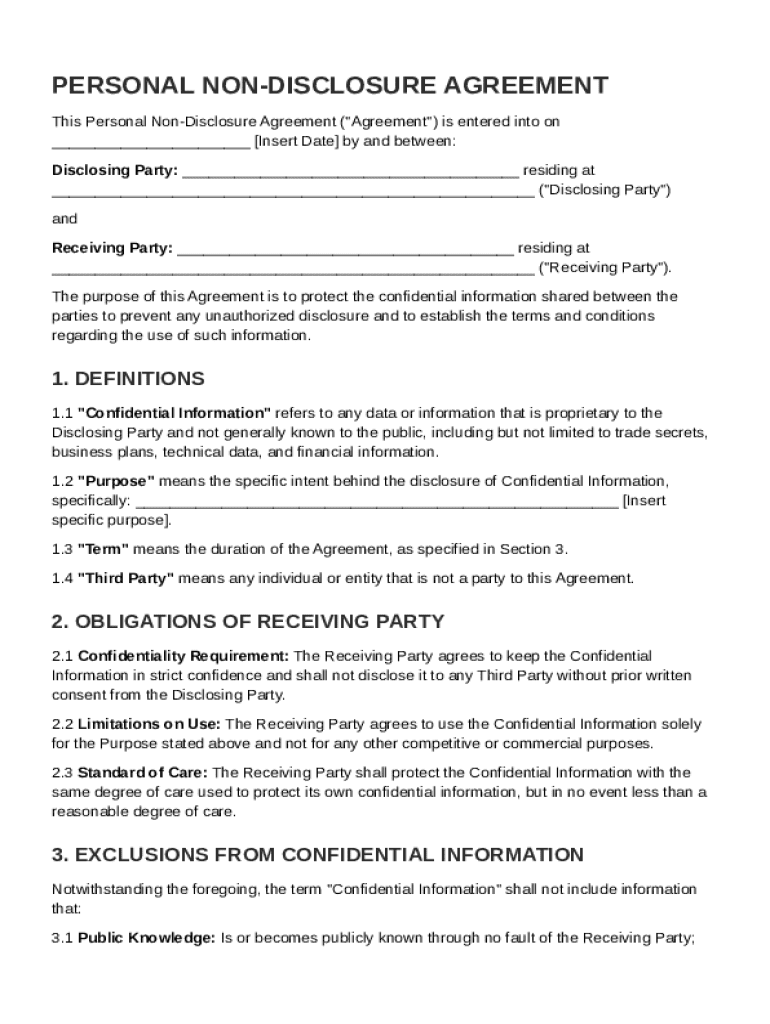
A Personal NDA Agreement Template, or Personal Non-Disclosure Agreement, is a legally binding document crafted to protect sensitive information exchanged between two parties, known as the Disclosing Party and the Receiving Party. This agreement is primarily focused on safeguarding confidential information from being disclosed or misused without authorization. Within this template, the definitions of what constitutes confidential information are clearly outlined, along with the specific obligations the Receiving Party must adhere to. These obligations include maintaining confidentiality, using the information solely for intended purposes, and not disclosing it to unauthorized parties. The agreement also specifies exclusions to what is considered confidential, ensuring clarity on what information can be shared.
Key Elements in a Personal NDA
- Confidential Information: Clearly defined terms that outline what information is protected.
- Obligations of Receiving Party: Duties and responsibilities concerning the use and protection of confidential data.
- Exclusions: Specific examples of information not covered under confidentiality.
- Terms of Duration and Termination: Conditions under which the agreement begins, ends, or can be terminated.
- Breach Remedies: Legal consequences and actions available for unauthorized disclosures.
- Miscellaneous Provisions: Additional terms covering scenarios not included in the main sections.
How to Use the Personal NDA Agreement Template
Utilizing the Personal NDA Agreement Template involves a few clear steps to ensure both parties understand and agree to the terms. Initially, both parties should review the document to confirm all elements relevant to their situation are accurately captured. This ensures mutual understanding and the protection of confidential information.
-
Review and Customize: Begin by carefully reading through the entire template to understand each section. Personalize the document by filling in specific details relevant to the parties involved, such as names and contact information.
-
Agree on Terms: Discuss and modify any sections that require changes to reflect the specific needs and expectations of both parties.
-
Sign and Execute: Once both parties are satisfied with the agreement, all parties should sign the document. Consider using a platform like DocHub for legally binding electronic signatures, ensuring all signatures are recorded and easy to track.
-
Distribute Copies: Ensure each party retains a signed copy of the NDA for their records.
Key Elements of the Personal NDA Agreement Template
The template includes various essential components that determine how the confidentiality agreement will be executed and upheld.
Confidential Information
- Identification and Classification: Specifics on what constitutes confidential information.
- Protection Measures: Methods and strategies for safeguarding confidential data.
Obligations and Responsibilities
- Use of Information: Explicit directions on how the Receiving Party can use the information.
- Non-Disclosure Requirements: Clear restrictions on sharing information without proper authorization.
Legal Provisions
- Governing Law: States the jurisdiction that will govern any legal disputes.
- Remedies for Breach: Lists potential outcomes and actions if a breach occurs.
Steps to Complete the Personal NDA Agreement Template
Completing a Personal NDA Agreement Template requires careful attention to ensure all necessary details are accurately included.
-
Fill Out Party Information: Enter the complete details of both the Disclosing and Receiving Parties, ensuring all identifiers are accurate.
-
Define Confidential Information: Clearly list or describe information that needs protection.
-
Outline Obligations: Specify the responsibilities each party has regarding the use of confidential information.
-
Set Terms for Duration and Termination: Determine how long the NDA will remain in effect and circumstances for its termination.
-
Review Legal Provisions: Carefully examine any clauses related to governing law and remedies to ensure they align with both parties' legal frameworks.
-
Sign the Document: Use electronic signatures to finalize the document efficiently and securely.
Legal Use of the Personal NDA Agreement Template
The Personal NDA Agreement Template must comply with legal standards to ensure enforceability. This involves adhering to relevant laws, such as the ESIGN Act, which allows for legally binding electronic signatures. Additionally, it should reflect the legal principles applicable to the jurisdiction identified within the agreement's governing law clause.
Important Considerations
- Legally Binding Nature: The NDA must meet all local and federal requirements to be considered enforceable.
- Adherence to the ESIGN Act: Electronic signatures obtained through platforms like DocHub are valid under this act.
Who Typically Uses the Personal NDA Agreement Template
This template is versatile and utilized by various individuals and entities seeking to protect confidential information.


Common Users
- Individual Contractors: Protect proprietary information shared with clients and partners.
- Small Businesses: Secure trade secrets and sensitive operations data during collaborations.
- Startups: Safeguard innovative concepts and ideas in early development stages.
- Freelancers: Ensure client information remains confidential during and after projects.

Examples of Usage
-
Business Partnerships: Prior to merging operations or sharing strategic plans, businesses may enter into an NDA to protect sensitive data.
-
Consultations or Discussions: Engaging in talks concerning potential investments or business opportunities often requires a confidentiality agreement to prevent intellectual property theft.
State-Specific Rules for the Personal NDA Agreement Template
While the general principles of a Personal NDA are widely applicable, state-specific variations can impact the template's legality.
State Variations
- Different Interpretations: Legal interpretations of NDA clauses can vary from state to state.
- Enforcement Policies: Some states impose more stringent requirements on non-disclosure agreements, which can alter their enforceability.
This section is crucial for entities operating across multiple states, as they need to adapt or consult local legal experts to ensure compliance.
State-Specific Differences and Compliance
It is important to consider that each state in the U.S. might have distinct regulations concerning NDAs. Therefore, verifying the specific legal requirements of the state where the NDA will be enforced is essential.
Adapting to State Regulations
- Consult with a legal expert to ensure the NDA complies with state laws.
- Adjust terms to align with state-specific restrictions or mandates, such as employee confidentiality agreements or trade secret laws.
Being aware of these nuances and variations ensures the Personal NDA Agreement Template remains effective and legally enforceable across different jurisdictions in the United States.