
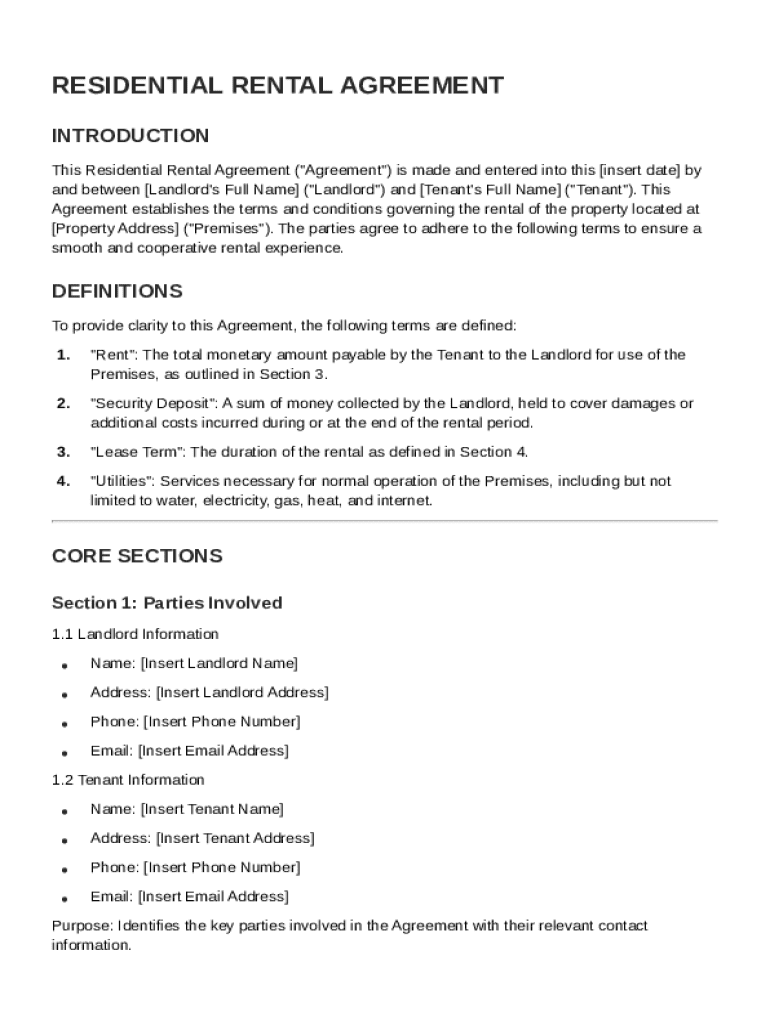







Definition & Meaning
A Rental Document Agreement Template is a predefined structure that outlines the terms and conditions for renting a property. It is primarily used to detail the agreement between a landlord and tenant, specifying the rights and responsibilities of each party. This template standardizes the format, making it easier for users to fill in property-specific details while maintaining legal and formal consistency.
Key Features
- Legally Binding: Establishes a formal, enforceable agreement.
- Clarity: Clearly defines terms such as rent, lease duration, and maintenance responsibilities.
- Standardization: Provides a uniform structure to ensure all necessary details are included.
- Customizable: Allows adaptation to specific rental conditions or additional clauses.
Key Elements of the Rental Document Agreement Template
A comprehensive Rental Document Agreement Template includes several critical components that ensure clarity and fairness for both landlord and tenant.
Essential Sections
- Parties Involved: Identifies landlord and tenant, including contact details.
- Property Description: Provides full details of the rental property, including address and any included fixtures.
- Lease Term: Outlines the start and end dates of the lease agreement.
- Rent Payment: Specifies the amount, due dates, and acceptable payment methods.
- Security Deposit: Details the amount, conditions of return, and usage.
- Maintenance: Clarifies repair responsibilities and maintenance duties.
- Termination Clauses: Defines conditions under which the lease can be terminated early.
Legal Use of the Rental Document Agreement Template
The template must comply with legal standards to be enforceable. Proper use ensures that the document will hold up in a court of law if disputes occur.
Legal Requirements
- Compliance with State Laws: Align with local state rental laws and regulations.
- Equal Housing Opportunity: Avoid discrimination based on race, religion, gender, etc.
- Disclosure Norms: Include mandatory disclosures, such as lead paint or asbestos presence.
Real-World Example
If a tenant disputes a rent increase, a clearly defined clause within the template regarding notification and justification of rent changes can provide resolution.
How to Use the Rental Document Agreement Template
Using the Rental Document Agreement Template involves a series of systematic steps to ensure completeness and precision.
Step-by-Step Instructions
- Download the Template: Obtain the template from a credible source such as DocHub.
- Fill In Parties' Details: Enter accurate information of both landlord and tenant.
- Property Details: Include a comprehensive description of the rental property.
- Define Lease Terms: Set the lease period, rental amount, and security deposit.
- Insert Additional Clauses: Add any specific terms or conditions pertinent to the agreement.
- Review for Accuracy: Double-check all entries for correct and up-to-date information.
- Finalize with Signatures: Both parties should sign the document to validate it.
Important Terms Related to Rental Document Agreement Template
Understanding specific terminology is crucial when dealing with rental agreements. These terms often dictate the interpretation of the document.
Common Terms
- Lessee and Lessor: Legal names for tenant and landlord respectively.
- Prorated Rent: Adjusted rent amount when a tenant moves in mid-month.
- Sublease: Agreement allowing original tenants to lease the property to another party.
- Default: Failure to comply with terms, potentially leading to eviction.
State-Specific Rules for the Rental Document Agreement Template
Each U.S. state may have variations in legislation concerning rental agreements. It is crucial to tailor the template to comply with state laws.
Examples of State-Specific Rules
- California: Requires extensive disclosure and tenant rights specified.
- New York: May have stringent rent control policies or limitations.
- Texas: Often involves specific maintenance obligations or notice periods for termination.
Adjusting for Compliance
Adapt the template to reflect these requirements by consulting local legislation or a legal professional to ensure compliance.
Why Should You Use a Rental Document Agreement Template
Using a Rental Document Agreement Template offers numerous advantages, primarily centered around saving time and ensuring legal soundness.
Benefits
- Efficiency: Reduces time spent drafting from scratch.
- Risk Mitigation: Ensures all legal requirements are met, reducing potential for disputes.
- Professional Presentation: Conveys seriousness and professionalism to tenants.
Practical Scenario
For landlords managing multiple properties, a standardized template allows for quicker agreement setups, maintaining legal compliance across all rentals.
Examples of Using the Rental Document Agreement Template
The application of the Rental Document Agreement Template is varied and flexible, suitable for multiple scenarios.
Scenarios
- Residential Properties: Standard rentals between individual landlords and tenants.
- Commercial Leases: Adapted to include clauses specific to business or retail spaces.
- Short-Term Rentals: Like vacation homes or Airbnbs, with adjusted terms for short durations.
By understanding and implementing these key blocks, users can maximize the effectiveness of Rental Document Agreement Templates to manage property rentals efficiently and within legal frameworks.




