






Definition & Meaning
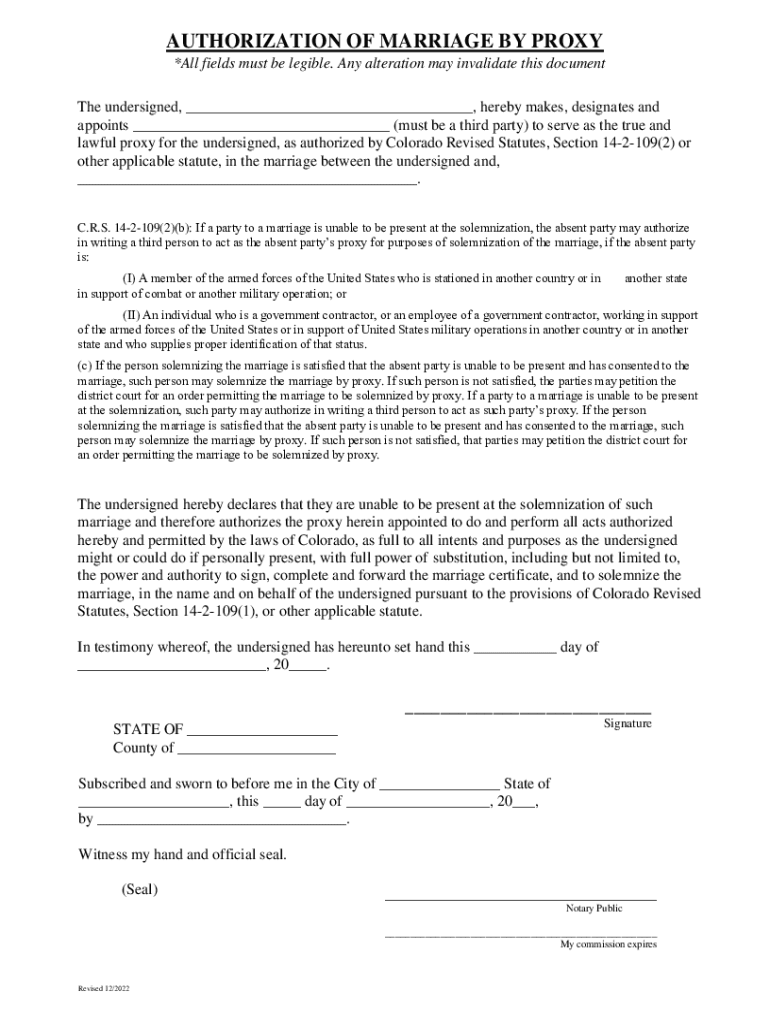
The "Clerk Application for Marriage License Absentee Affidavit" is a legal document used to facilitate the marriage license process when one or both parties cannot be present in person. This form is crucial for individuals who are unable to attend due to distance, illness, or other compelling circumstances. It allows a representative, often referred to as a proxy, to stand in for the absent party during the application for a marriage license. This affidavit is particularly important in jurisdictions that permit marriage by proxy, a legal provision that accommodates those in the armed forces or on government assignments.
Who Typically Uses the Clerk Application for Marriage License Absentee Affidavit
Typically, this affidavit is used by individuals such as military personnel stationed away from home or government contractors working overseas. It is also valuable for other scenarios where personal presence isn't feasible or practical. Couples who face health-related challenges that prevent travel may also find this form beneficial. This legal instrument ensures that geographical distance or physical inability does not become a barrier to obtaining a marriage license.


Steps to Complete the Clerk Application for Marriage License Absentee Affidavit
-
Obtain the Form: Acquire the affidavit from the county clerk's office or their official website.
-
Fill in Personal Details: Provide accurate personal information of both parties involved, including full names, addresses, and identification numbers.
-
Designate a Proxy: Identify the person who will act as the proxy. Include their details and relationship to the parties involved.
-
Notarization: Have the form notarized to affirm the authenticity of the signatures and information provided. This step typically requires that all signatories appear before a notary public.
-
Submit the Form: Return the completed and notarized affidavit to the issuing clerk's office. Depending on local regulations, this may be done in person, by mail, or through authorized electronic submissions.
Legal Use of the Clerk Application for Marriage License Absentee Affidavit
The legal use of this affidavit ensures that marriages can proceed even if personal attendance at the clerk's office is not possible. Under U.S. law, various states have provisions that allow proxy marriages, often under specific circumstances. The affidavit serves as an official declaration of one party's intention to marry, allowing the clerk to issue a marriage license without both parties being physically present. This process adheres to legal standards and protects the integrity of the marriage contract.
Important Terms Related to Clerk Application for Marriage License Absentee Affidavit
- Proxy: An individual authorized to represent another in legal or official proceedings.
- Notarization: The act of certifying a document's authenticity by a notary public.
- Affidavit: A written statement confirmed by oath or affirmation, used as evidence in legal processes.
State-Specific Rules for the Clerk Application for Marriage License Absentee Affidavit
Although this affidavit serves a uniform purpose, each state may impose specific rules and requirements. For example, some states require both parties to be residents, while others might permit only one resident party. There may also be restrictions on who can act as a proxy. It is crucial to check local statutes to ensure compliance with state-specific regulations when using this form.
Key Elements of the Clerk Application for Marriage License Absentee Affidavit
- Applicant Information: Complete and precise information of the party using the affidavit.
- Proxy Consent: Evidence of the proxy's willingness to act on behalf of the applicant.
- Declaration of Intent: A formal declaration of the absent party's intention to marry.
- Notary Section: The notarization block for validation purposes.
Form Submission Methods (Online / Mail / In-Person)
The methods for submitting this form can vary:
- Online Submission: Some clerk offices allow for electronic submission via secure web portals.
- Mail: The form can be mailed to the relevant clerk's office, provided it is properly notarized and any accompanying documentation is included.
- In-Person: In certain situations, a representative may deliver the affidavit directly to the county clerk's office.
These submission options provide flexibility, making the process accommodating for different circumstances.