






Key Elements of the Exclusive Agreement Template
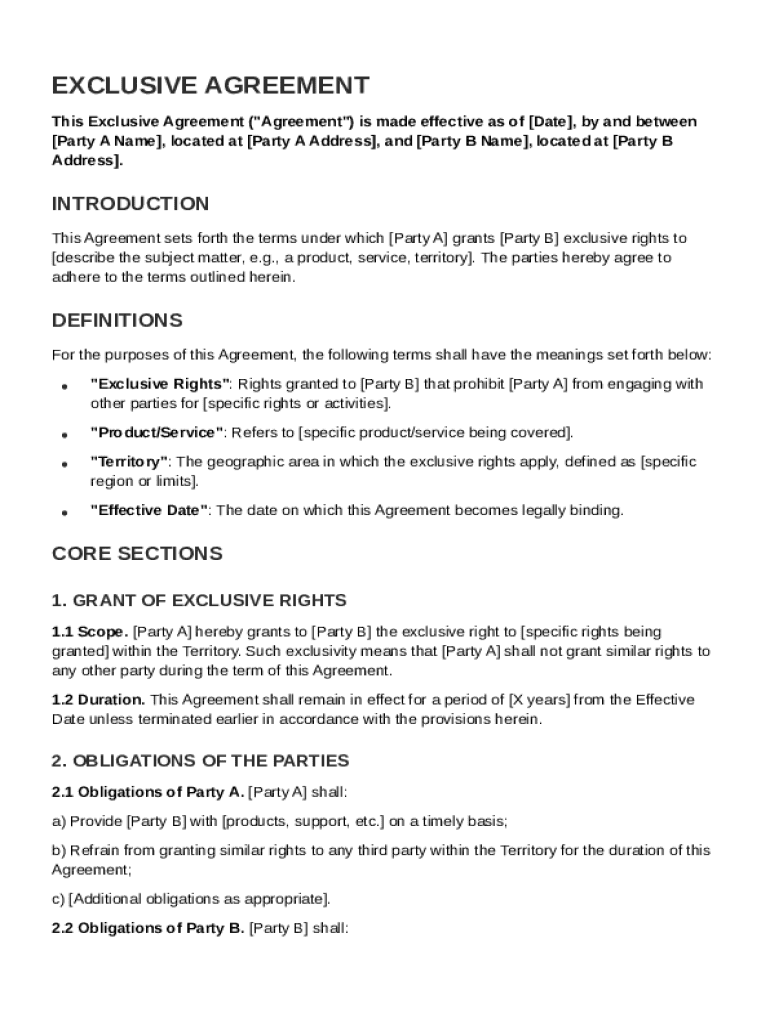
An Exclusive Agreement Template serves as a comprehensive document detailing the parameters under which exclusive rights are granted to a party for a specific product, service, or territory. Crucial elements include:
- Grant of Exclusivity: Details the scope and nature of the exclusive rights, specifying what is exclusive (e.g., sales, distribution) and any geographical or market limitations.
- Obligations of Parties: Clearly outlines each party's responsibilities, ensuring mutual understanding and commitment to obligations.
- Payment Terms: Specifies any financial arrangements, including upfront payments, royalties, or periodic fees.
- Confidentiality Clauses: Addresses the need for privacy regarding sensitive information shared between parties.
- Termination Conditions: States conditions under which the agreement can be terminated by either party.
- Governing Law: Establishes which jurisdiction’s laws will apply to the agreement.
- Miscellaneous Provisions: Covers any additional terms that don’t fit into the previous categories but are necessary for clarity.
Steps to Complete the Exclusive Agreement Template
Completing an Exclusive Agreement Template involves several methodical steps:
- Identify Parties: Clearly state the full legal names and designations of each involved party.
- Define Exclusive Rights: Specify what rights are being granted, including any territorial limitations.
- Outline Obligations: Define both parties' obligations to avert future misunderstandings.
- Detail Compensation: Clearly articulate the payment structure, including amounts, frequency, and conditions for payment adjustments.
- Establish Confidentiality Measures: Include a clause to protect proprietary information shared during the agreement.
- Specify Termination Clauses: Detail the terms under which the agreement can be ended by either party.
- Verify Governing Law: Ensure the agreement states the jurisdiction under which any legal disputes will be resolved.
- Ensure Proper Execution: Both parties should sign and date the agreement to render it effective.
How to Use the Exclusive Agreement Template
Using the Exclusive Agreement Template effectively involves:
- Customizing the Template: Tailor the template to reflect the specific details and conditions relevant to the transaction or relationship.
- Consulting Legal Counsel: Review the document with a legal professional to ensure compliance with applicable laws and regulations.
- Ensuring Mutual Understanding: Confirm that both parties have a clear understanding of all terms and conditions before finalizing.
- Finalizing and Signing: Once both parties agree on the content, the document should be signed to acknowledge the acceptance of terms.
- Maintaining Records: Keep a signed copy of the agreement in both physical and digital formats for reference and legal purposes.
Important Terms Related to the Exclusive Agreement Template
Several key terms are integral to understanding the Exclusive Agreement Template:
- Exclusivity: A condition granting sole rights for specific activities within a defined domain or geographical area.
- Indemnification: A commitment to compensate the other party for any losses or damages incurred as a result of the agreement.
- Breach of Contract: The failure to perform any term of a contract without a legitimate legal excuse.
- Force Majeure: A clause freeing both parties from liability in the event of an unforeseeable cause preventing fulfillment of the contract.
- Assignment: The transfer of rights or obligations under a contract to another party.
Legal Use of the Exclusive Agreement Template
The Exclusive Agreement Template serves multiple legal functions, adhering to U.S. laws and business practices:
- Compliant Documentation: Provides a legal framework for exclusive rights, serving as enforceable evidence in legal disputes.
- Risk Mitigation: Protects against potential legal conflicts by clearly defining the rights and duties of involved parties.
- Binding Agreement: Functions as a legally binding document once signed, ensuring compliance with agreed-upon terms.
- Customizable Legal Terms: Allows for modifications to adapt to specific legal requirements or industry regulations.
- Enforcement: Enables legal enforcement of terms, ensuring parties adhere to the conditions set forth.
Examples of Using the Exclusive Agreement Template
Real-world scenarios demonstrate the flexibility and applicability of exclusive agreements:
- Product Distribution: A company grants a distributor exclusive rights to market its products in a specific region.
- Service Offerings: An IT firm provides a service provider with exclusive access to certain software solutions.
- Franchise Operations: A franchise agreement may include exclusive rights to operate in a defined area.
These examples illustrate how exclusive agreements can effectively manage business relationships across various industries.
Who Typically Uses the Exclusive Agreement Template
The Exclusive Agreement Template is frequently utilized by:
- Businesses: Companies seeking to establish secure and explicit contractual relationships.
- Entrepreneurs: Start-ups that wish to control market entry and competitive strategies.
- Distributors: Those needing assurance of market control for specific products or services.
- Service Providers: Firms looking to establish long-term partnerships with exclusive rights.
This usage variety highlights the template's adaptability across diverse business activities.


State-specific Rules for the Exclusive Agreement Template
Exclusive agreements may encounter state-specific legal variations:
- Jurisdictional Nuances: State laws can influence enforceability and interpretation of agreements, affecting confidentiality and termination clauses.
- Regulatory Compliance: Businesses must comply with local regulations which may impose restrictions or additional requirements.
- Contract Law Discrepancies: Varies in applicability and interpretation, necessitating state-specific legal review.
Understanding these differences ensures comprehensive compliance with relevant state laws, safeguarding against potential legal issues.