




01. Edit your form online
Type text, add images, blackout confidential details, add comments, highlights and more.

Type text, add images, blackout confidential details, add comments, highlights and more.

Draw your signature, type it, upload its image, or use your mobile device as a signature pad.

Send it via email, link, or fax. You can also download it, export it or print it out.
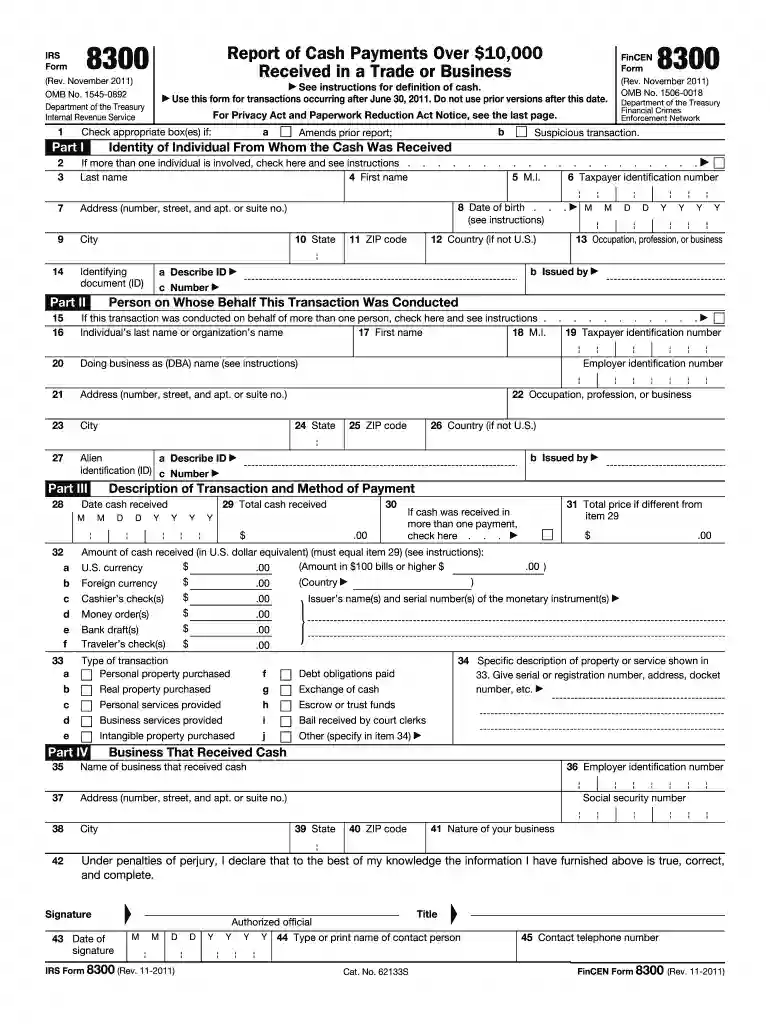
The IRS Form 8300 is a document used to report cash payments over $10,000 received in a trade or business. This form helps the Internal Revenue Service (IRS) and the Financial Crimes Enforcement Network (FinCEN) monitor large cash transactions to detect potential money laundering and tax evasion. Businesses that receive substantial cash payments must file Form 8300 to comply with federal regulations, thereby aiding law enforcement in its efforts to combat financial crime.
Form 8300 is primarily used by businesses to report any cash transaction that exceeds $10,000 to the IRS. Businesses must provide detailed information about the payer and the transaction itself. The form is structured to capture essential details that help identify and scrutinize high-value cash exchanges. Primary areas of focus include the amount received, the date of the transaction, and the nature of the trade or business concerned.
The IRS has established clear guidelines for filing Form 8300, emphasizing the importance of accurate and timely submission. Businesses are required to file the form within 15 days post-transaction. Failure to adhere to these guidelines can result in penalties. The IRS also offers guidance on what constitutes a reportable transaction, including multiple payments that aggregate to over $10,000 in a single event.
Form 8300 must be filed within 15 days after the transaction date. It’s crucial for businesses to track cash payments meticulously to ensure compliance. If the 15-day deadline falls on a weekend or federal holiday, the deadline extends to the next business day. Filing late can attract penalties, highlighting the need for prompt action.
Non-compliance with Form 8300 filing requirements can lead to significant penalties. Businesses may be fined if they fail to file the form on time, provide incomplete information, or neglect to notify the payer about the form’s filing. Penalties increase for businesses that intentionally disregard filing obligations, emphasizing the importance of compliance.
Form 8300 can be submitted either digitally or via paper. Digital submission is typically encouraged due to its efficiency and reduced chance for errors. Electronic filings can be done through the BSA E-Filing System, which provides a secure platform for submission. The paper version requires mailing to the appropriate IRS address, with the potential for longer processing times.
Filing Form 8300 electronically can be facilitated using various software platforms like QuickBooks or TurboTax. These platforms often include updated templates and can directly integrate with IRS systems, simplifying the process and ensuring accuracy. Businesses using such software must ensure they have the latest versions to accommodate any IRS changes to the form or filing procedure.
When filling out Form 8300, businesses should prepare relevant documentation to support the transaction details provided. This includes copies of payment receipts, customer identification forms, and transaction records. Keeping detailed records is essential not only for compliance but also for potential audits by the IRS.
We've got more versions of the Form 8300 (Rev July 2012) - Internal Revenue Service form. Select the right Form 8300 (Rev July 2012) - Internal Revenue Service version from the list and start editing it straight away!
At DocHub, your data security is our priority. We follow HIPAA, SOC2, GDPR, and other standards, so you can work on your documents with confidence.


Jul 8, 2012 Form 8300 (Rev. 7-2012) File Form 8300 by the 15th day after the date the cash was received. File the form with the Internal Revenue Service,
Form 8300 (Rev. 7-2012) You must complete all three items (a, b, and c) Enter the date you received the cash. amount to exceed $10,000. Internal Revenue


