






Definition & Meaning
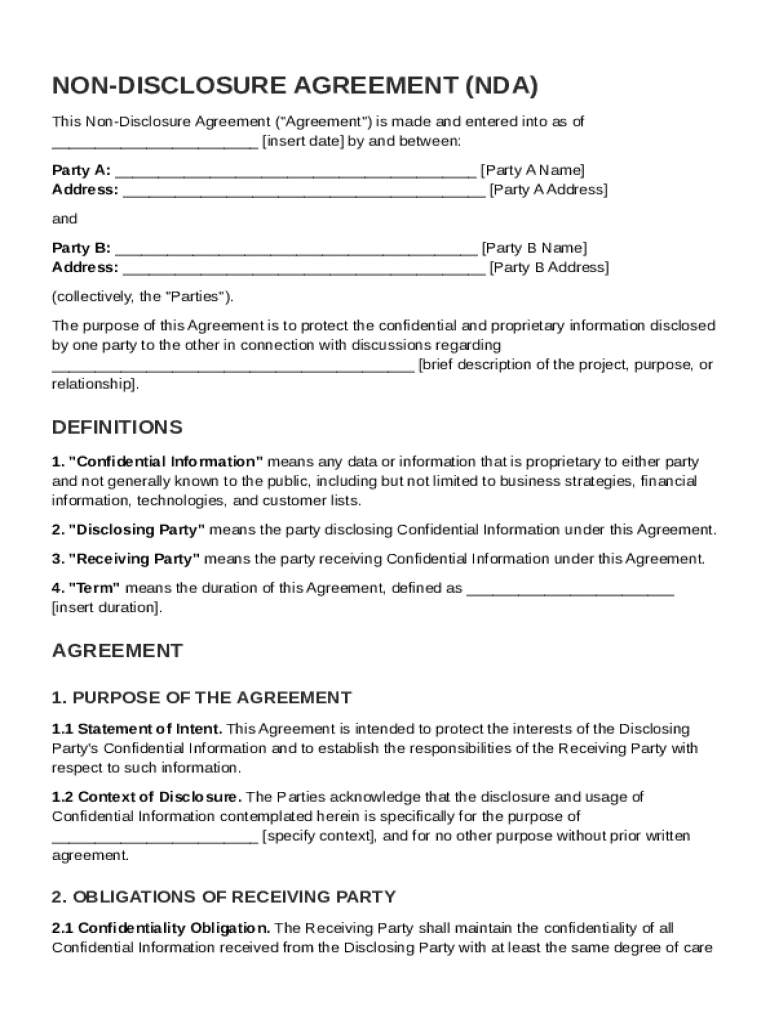
A Non-Disclosure Agreement (NDA) for Small Business is a legally binding contract designed to protect confidential information shared between parties. This agreement stipulates that the receiving party must maintain the secrecy of the information and only use it for specific, agreed-upon purposes. NDAs are crucial for small businesses to safeguard proprietary data, technical know-how, client details, and business strategies from unauthorized disclosure.
Key Characteristics
- Confidentiality Protection: Ensures sensitive information remains private.
- Usage Limitations: Specifies permissible uses of the shared information.
- Duration: Defines how long the confidentiality obligations last.
How to use the Non Disclosure for Small Business Agreement Template
Utilizing the NDA template involves a systematic process to ensure that all legal requirements are met while customizing it to your business needs.
Steps for Effective Use
- Download the Template: Begin by obtaining the NDA template from a reputable source or document management platform such as DocHub.
- Tailor to Specific Needs: Fill in the necessary details, including the names of the parties involved, the confidential information to be protected, and the agreed-upon obligations.
- Review and Customize: Customize sections that detail exclusions from confidentiality, the governing law, and any additional clauses.
- Legal Review: It is advisable to have a legal professional review the customized agreement to ensure it adheres to current legal standards.
Steps to complete the Non Disclosure for Small Business Agreement Template
Completing the NDA requires careful attention to detail to avoid any potential legal loopholes or omissions.
Detailed Process
- Identify Parties: Clearly specify the disclosing and receiving parties, including businesses and individuals involved.
- Define Confidential Information: Outline what constitutes confidential information, ensuring specificity to avoid ambiguity.
- State Obligations: Clearly enumerate the obligations of the receiving party to maintain confidentiality.
- Specify Duration: Determine the timeline for which the NDA remains effective and the duration of post-agreement confidentiality obligations.
- Include Signatures: Ensure that all parties provide signatures to validate the contract, enhancing enforceability.
Important terms related to Non Disclosure for Small Business Agreement Template
Several critical terms are central to understanding and effectively creating an NDA.
Key Terms
- Confidential Information: Any data or knowledge that the disclosing party considers private or proprietary.
- Recipient: The party receiving confidential information who is bound by the NDA.
- Disclosing Party: The party sharing confidential information.
- Exclusions from Confidentiality: Situations where certain information is not considered confidential.
Legal use of the Non Disclosure for Small Business Agreement Template
The legal enforceability of an NDA depends on several factors, including its drafting, execution, and compliance with specific jurisdictional laws.
Legal Considerations
- Jurisdictional Compliance: Ensure the NDA complies with state-specific laws where the agreement will be enforced.
- Mutual vs. Unilateral NDAs: Determine whether the NDA is mutual (both parties disclose information) or unilateral (only one party discloses information).
- Validity and Enforceability: Ensure the agreement is not overly broad, which could render it unenforceable.
Key elements of the Non Disclosure for Small Business Agreement Template
An NDA template typically consists of several sections, each serving a distinct legal purpose.
Core Components
- Definitions: Clarifies key terms and concepts within the contract.
- Confidentiality Obligations: Details the expectations and duties of the receiving party.
- Exclusions and Exceptions: Outlines what is not considered confidential.
- Dispute Resolution: Specifies how disputes will be addressed, including arbitration or litigation options.
- Termination: Outlines the conditions under which the agreement can be terminated.
Examples of using the Non-Disclosure for Small Business Agreement Template
Understanding real-world applications of NDAs underscores their value and relevance.
Practical Applications
- Partnerships and Collaborations: Protects sensitive data when forming partnerships with other companies.
- Employee Onboarding: Utilized during the hiring process to safeguard business strategies and proprietary processes.
- Vendor and Supplier Relationships: Ensures suppliers or third-party vendors maintain the confidentiality of product designs or technical specifications.
Business types that benefit most from Non-Disclosure for Small Business Agreement Template
Not all businesses require an NDA, but for those that do, the protective benefits are substantial.
Beneficiaries of NDAs
- Tech Startups: To protect intellectual property and technical innovations.
- Creative Agencies: Safeguards creative concepts and marketing strategies from being copied.
- Consulting Firms: Protects client information and proprietary methods from unauthorized use.
State-by-State Differences
NDAs are affected by state laws, which can influence their enforcement and terms.
Jurisdictional Variations
- California: Known for specific restrictions on employee NDAs, requiring careful attention to non-compete clauses.
- New York: Generally supportive of NDAs, but courts demand clear and reasonable terms.
- Texas: Requires reasonable scope and duration for enforceability.
By understanding these aspects, small businesses can optimize their data protection strategies and ensure compliance with legal standards aligned to their geographical and operational context.