
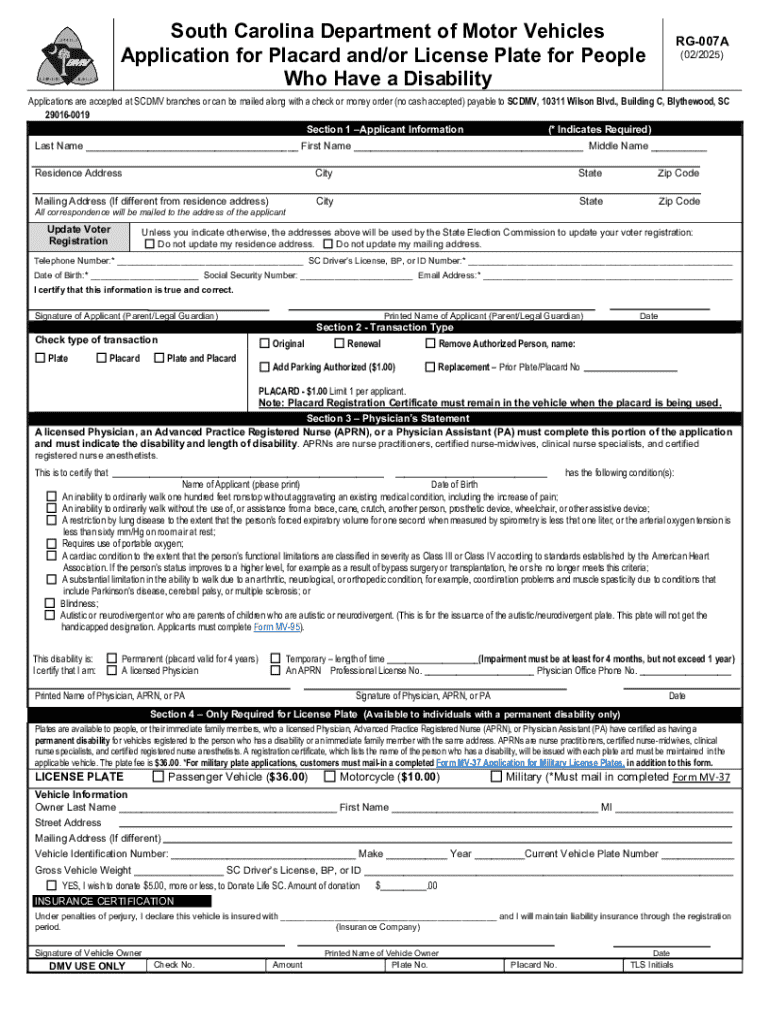







Definition and Meaning of the Disabled Placard License Plate Application
The disabled placard license plate application is a formal request made by individuals with disabilities to obtain a special placard or license plate that allows for accessible parking. This application serves as a means for qualifying individuals to demonstrate their need for parking accommodations due to mobility challenges. The placards or license plates vary by state, with specific symbols or identifiers to indicate a driver's eligibility for reserved parking spaces designed for those with disabilities.
Importance of the Application
The relevance of this application cannot be overstated. By providing designated parking for individuals with disabilities, the application helps ensure that they have easier access to public facilities, workplaces, and other essential services. This accessibility promotes independence and reduces barriers faced by individuals with mobility impairments.
Variants and Types
Some states offer different types of placards, such as temporary or permanent versions. A temporary placard might be issued to individuals recovering from surgery, while a permanent placard is granted for long-term disabilities. Each state has its own regulations and criteria for issuing these placards, influencing which version an applicant may be eligible for.
Steps to Complete the Disabled Placard License Plate Application
Completing the application requires careful attention to detail to avoid delays. Here is a step-by-step overview of the process:
-
Obtain the Application Form:
- You can typically access the application form from your state's Department of Motor Vehicles (DMV) website or local DMV office. For example, in South Carolina, applicants can refer to SC DMV Form RG-007A.
-
Gather Necessary Documentation:
- Applicants must provide various documents to verify their disability. This often includes:
- Proof of identity (such as a driver’s license).
- Medical certification from a licensed physician or healthcare professional confirming the disability.
- Applicants must provide various documents to verify their disability. This often includes:
-
Complete the Application:
- Fill out the application form with required personal information, details about your disability, and vehicle information (if applicable).
- Be thorough and accurate, as incomplete applications can lead to rejections or delays.
-
Submit the Application:
- Depending on state regulations, submissions can be made through various methods, including online portals, by mail, or in person at DMV locations.
-
Pay Applicable Fees:
- Some states require a fee for processing the application. Ensure to verify the amount as it may differ based on your state and whether the placard or license plate is permanent or temporary.
-
Receive Your Placard or License Plate:
- After processing your application, you can expect to receive your placard or license plate by mail or in person, depending on the submission method.
Key Elements of the Disabled Placard License Plate Application
Understanding the essential elements of the application can facilitate a smoother process. Key components often include:
-
Personal Information:
- Full name, address, date of birth, and contact information of the applicant.
-
Disability Verification:
- A section that must be completed and certified by a licensed healthcare provider, detailing the nature of the disability.
-
Vehicle Information:
- If applying for a license plate, details such as the vehicle’s make, model, color, and license plate number will be required.
-
Type of Application:
- Indication of whether the request is for a permanent placard, temporary placard, or a license plate.
-
Signature:
- The applicant’s signature certifying that all provided information is truthful and accurate.
Who Typically Uses the Disabled Placard License Plate Application?
The disabled placard license plate application is used by a variety of individuals. Common users include:
-
Individuals with Permanent Disabilities:
- Those who have ongoing mobility impairments or disabilities that necessitate accessible parking.
-
Individuals with Temporary Disabilities:
- People recovering from surgeries or temporary health issues that restrict their mobility may request a temporary placard.
-
Caregivers:
- Family members or friends assisting individuals with disabilities may also apply on behalf of the disabled person, pending authorization.


Legal Use of the Disabled Placard License Plate Application
Legal use encompasses understanding the rules and regulations associated with the application and the use of the placard or license plate once obtained. Key legal points include:
-
Compliance with State Laws:
- Each state has its own laws regulating the usage of disabled placards, including which parking spaces are reserved and how the placard or plate should be displayed.
-
Consequences of Misuse:
- Misusing a disabled placard—such as using it when the registered owner is not present—can lead to penalties, including fines and possible revocation of the placard.
-
Renewal Requirements:
- Many states require periodic renewal of the placard or license plate. Failure to renew can lead to invalidation of parking privileges.
Understanding these aspects not only aids in the application process but also ensures that users can benefit from their accommodations within the confines of the law.




