






Definition and Meaning of a Cohabitation Agreement Template
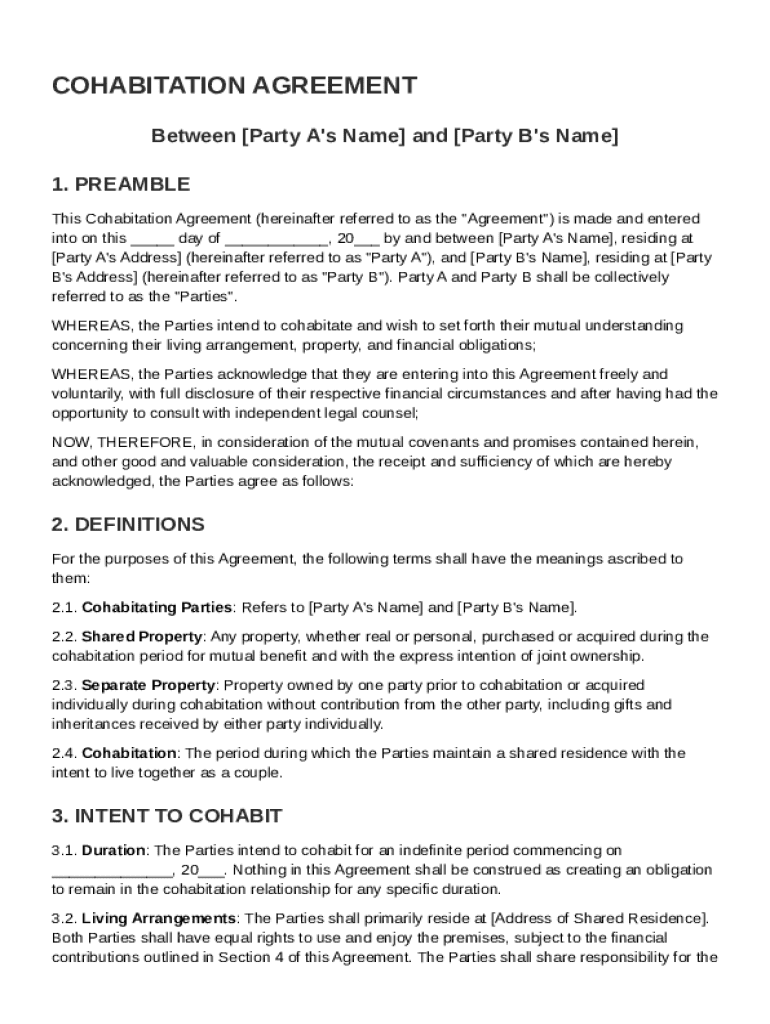
A Cohabitation Agreement Template is a structured document used by individuals who choose to live together without getting married. It outlines the mutual understanding regarding living arrangements, property rights, financial contributions, and the manner in which disputes should be resolved. Such agreements can define both shared and separate property, provide detailed provisions on financial responsibilities like rent and utilities, and guide the division of property upon ending the relationship. Importantly, this template encourages the voluntary participation of both parties, each having the option to seek legal advice to ensure their rights and interests are fully protected.
How to Use the Cohabitation Agreement Template
The Cohabitation Agreement Template can be utilized effectively by following a systematic approach:
-
Download and Review: Acquire the template from a trustworthy source, such as DocHub, and go through the sections to understand the stipulations covered.
-
Customize the Template: Modify the template to fit the specific needs of both parties involved in the cohabitation arrangement. This may involve detailing financial responsibilities or property rights specific to the participants.
-
Consult Legal Counsel: It is advisable for both parties to seek separate legal counsel to review the agreement to ensure it aligns with legal standards and meets individual needs.
-
Finalize and Execute: After adjustments and consultations, both parties should finalize the document and provide a legally binding signature.
-
Store Safely: Once signed, store the document securely where both parties can access it if needed.
Steps to Complete the Cohabitation Agreement Template
Completing a Cohabitation Agreement Template involves a series of practical steps:
-
Identify Parties: Clearly state the names and contact information of both cohabitating individuals.
-
Define Objectives: Outline the purpose of the agreement, detailing specific living arrangements and shared goals.
-
List Assets and Liabilities: Precisely document each party's assets and liabilities, clearly differentiating between individual and shared properties.
-
Address Financial Contributions: Specify how expenses such as rent, utilities, and maintenance will be divided among parties.
-
Settle on Dispute Resolution: Include methods for resolving disagreements, such as mediation or arbitration.
-
Determine Termination Procedures: Specify how assets will be divided and the process for handling joint liabilities if the cohabitation ends.
-
Legal Review and Signatures: Engage legal professionals to review and then both parties sign the document for enforceability.
Legal Use of the Cohabitation Agreement Template
The legal use of a Cohabitation Agreement involves several considerations:
-
Contractual Validity: For the agreement to be legally binding, it must meet standard contract laws, such as mutual consent and thorough understanding by both parties.
-
Enforceability: Address the enforceability within the jurisdiction — the agreement should comply with state-specific laws which dictate the recognition of cohabitation agreements.
-
Modification and Termination: Provide clauses for how the agreement may be amended or terminated, ensuring both parties understand these processes.
-
Confidentiality Clauses: Include provisions to protect the privacy of the parties and sensitive information detailed within the document.
Key Elements of the Cohabitation Agreement Template
Several key elements should be present in a comprehensive Cohabitation Agreement:
-
Property Rights: Clearly define what constitutes shared vs. separate property, including future acquisitions.
-
Financial Obligations: Detail contributions towards joint expenses and individual financial responsibilities.
-
Responsibilities: Specify each party's responsibilities within the living arrangement, including maintenance and upkeep of shared spaces.
-
Dispute Resolution: Establish a framework for resolving conflicts, to prevent legal disputes.
Who Typically Uses the Cohabitation Agreement Template
Cohabitation Agreements are often used by:
-
Unmarried Couples: Individuals who live together but do not wish to marry, yet want legal protection and clarity regarding their relationship.
-
Roommates: While less common, roommates who invest in shared property may also benefit from outlining cohabitation terms.
-
Couples with Combined Finances: Those who commingle finances and acquire assets together benefit significantly from a formal understanding of their arrangement.


Important Terms Related to the Cohabitation Agreement Template
Understanding key terms is paramount:
-
Joint Tenancy: A form of co-ownership providing equal rights to property and obligations.
-
Separate Property: Assets owned individually, irrespective of the living arrangement.
-
Equitable Distribution: A principle of dividing properties fairly upon relationship termination, which may not mean equal division.
-
Common-law Marriage: Recognition in some states that an unmarried couple may be treated legally as married after long-term cohabitation, which is distinct from mere cohabitation agreements.
State-Specific Rules for the Cohabitation Agreement
Cohabitation Agreements are influenced by state-specific regulations:
-
Recognition Laws: Some states have laws recognizing cohabitation agreements, while others may have limited or no recognition, affecting enforceability.
-
Property Division: Rules regarding the division of joint property and assets can differ, requiring tailored clauses specific to the state in which the parties reside.
-
Legal Consultation: Given these variances, individuals should seek legal advice to ensure their agreement adheres to state law.