01. Edit your dr 0104amt online
Type text, add images, blackout confidential details, add comments, highlights and more.

Type text, add images, blackout confidential details, add comments, highlights and more.

Draw your signature, type it, upload its image, or use your mobile device as a signature pad.

Send it via email, link, or fax. You can also download it, export it or print it out.
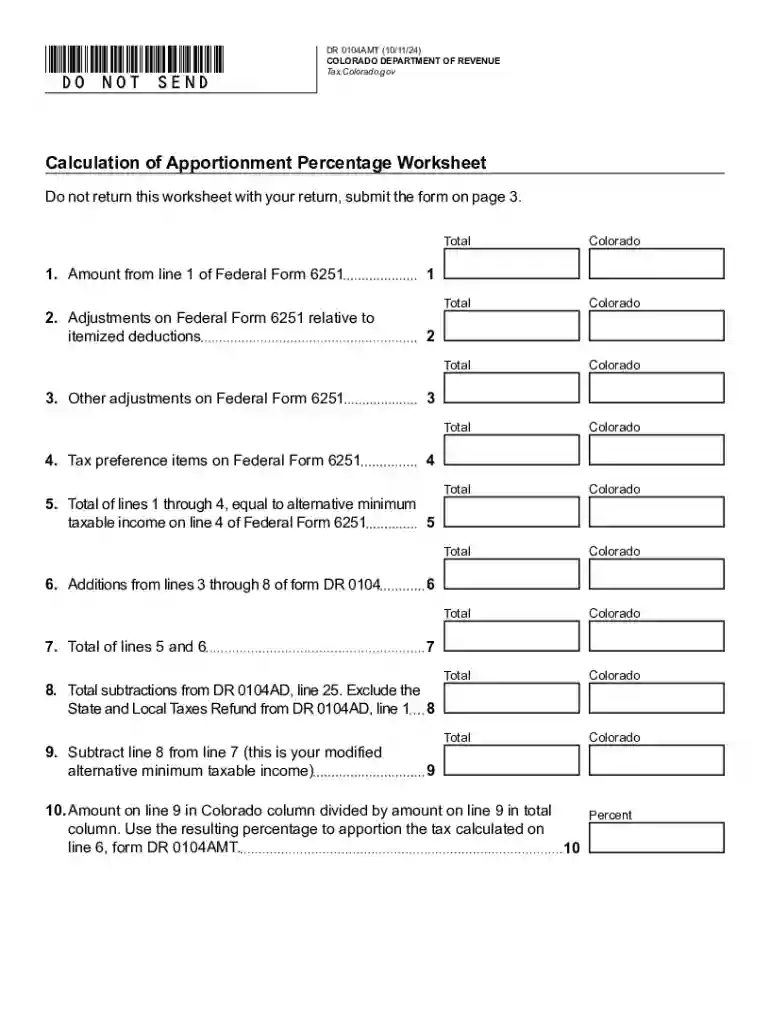
The DR 0104AMT, 2024 Colorado Alternative Minimum Tax Computation Schedule, is a specialized form used to calculate the Alternative Minimum Tax (AMT) for individual taxpayers in Colorado. This form helps determine the Colorado Alternative Minimum Taxable Income (CAMTI), which is essential in adjusting your state tax affairs relative to the federal calculations. Understanding the purpose and function of the DR 0104AMT is critical for Colorado residents to ensure compliance with state tax laws.
To properly use the DR 0104AMT, 2024, you'll need to follow a series of steps aimed at calculating your Colorado AMT obligations accurately.
Determine Your CAMTI: Start by calculating your federal alternative minimum taxable income and then make necessary state-specific adjustments as outlined in the form instructions.
Apportionment for Part-Year and Nonresidents: If you are a nonresident or part-year resident, you must use the accompanying worksheet to apportion your income to Colorado.
Enter Adjustments: List any adjustments for exemptions, standard deductions, and itemized deductions that are specific to Colorado.
Calculate Tax: Use the form to compute the Colorado minimum tax due, based on the CAMTI. Compare this with your regular state income tax to determine what you owe.
Each section of the form provides detailed, step-by-step instructions, enabling an accurate computation of your state tax liability under AMT rules.
Alternative Minimum Taxable Income Adjustment: Adjust your federal AMTI to reflect Colorado-specific tax laws.
Apportionment Worksheet: This crucial section assists part-year and nonresidents in correctly allocating income subject to Colorado tax.
Exemption Adjustments: Consider exemptions and deductions specific to Colorado when computing your alternative minimum income.
Comparison of Regular vs. Alternative Minimum Tax: Determine which tax is higher and, accordingly, ascertain your final state tax liability.
By ensuring each key element is addressed, taxpayers can more effectively calculate their state tax liability while avoiding errors or penalties.
Completing the DR 0104AMT involves several steps, and following these diligently is crucial:
Gather Required Documents: Collect all relevant financial and tax documents, including the federal AMT calculation.
Enter Federal Data: Input the necessary figures from your federal tax forms into the DR 0104AMT.
Perform Adjustments: Make any state-required adjustments to compute the CAMTI.
Finalize the Calculation: Compare the resulting AMT with your Colorado state taxes to determine your total obligation.
Review and Submit: Double-check all entries for accuracy, sign the form, and submit it as per the available submission methods.
Compliance with these steps is important to avoid errors that could lead to penalties or additional taxes owed.
Understanding certain important terms associated with the DR 0104AMT is beneficial:
Knowledge of these terms enhances comprehension and assists in accurately completing the DR 0104AMT.
The DR 0104AMT interacts with IRS guidelines primarily through the relationship between federal and state AMT calculations. While the federal AMTI forms the basis of your state calculations, differences in exemptions, deductions, and credits necessitate adjustments. Understanding these adjustments ensures compliance both federally and at the state level, and helps avoid discrepancies that may invite audits or penalties.
Filing the DR 0104AMT typically aligns with the state income tax deadline in Colorado, which adheres to federal due dates.
Awareness of these dates is important to ensure timely filing and avoid late fees or interest charges.
To successfully complete the DR 0104AMT, several documents are needed:
Having these documents ready streamlines the form completion process and reduces the risk of errors.
We've got more versions of the dr 0104amt form. Select the right dr 0104amt version from the list and start editing it straight away!
At DocHub, your data security is our priority. We follow HIPAA, SOC2, GDPR, and other standards, so you can work on your documents with confidence.