
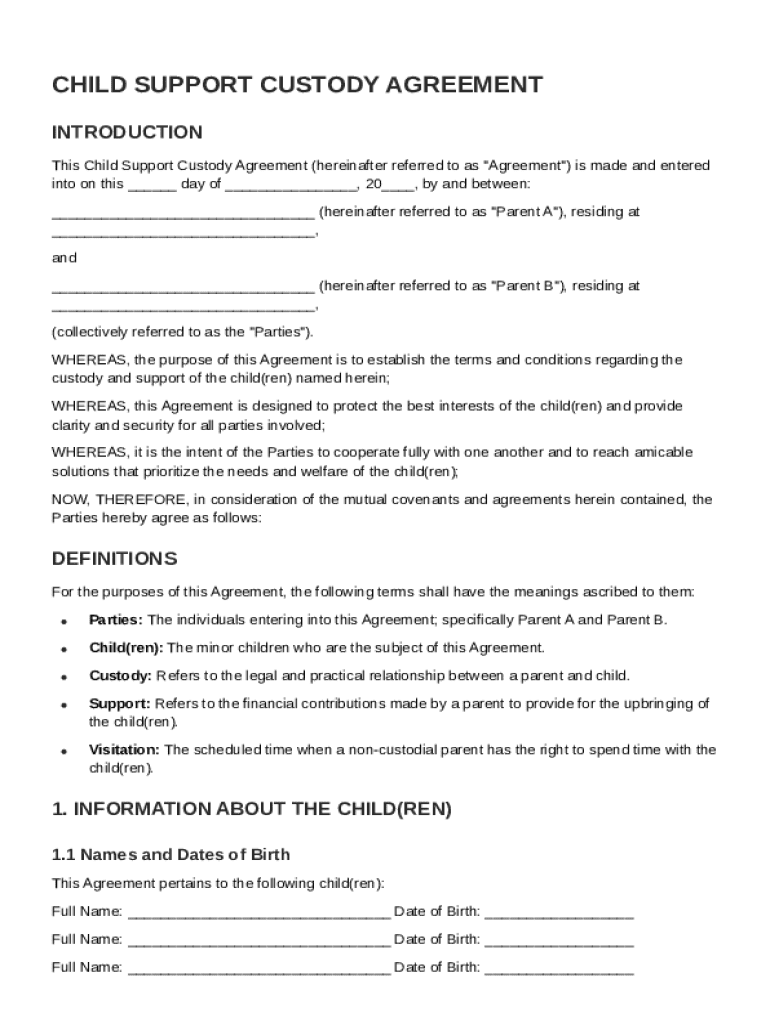







Definition & Meaning
A Child Support Custody Agreement is a legal document that outlines the responsibilities and arrangements regarding the care and financial support of children when parents are separated or divorced. It specifies legal and physical custody arrangements, child support obligations, visitation rights, and guidelines for parental communication. The primary goal is to ensure that the child’s best interests are prioritized while maintaining clarity and cooperation between the parents.
Key Components
- Custody Arrangements: Differentiates between legal custody (decision-making authority) and physical custody (where the child resides).
- Child Support Obligations: Determines the financial support one parent must provide to the other for child-rearing expenses.
- Visitation Rights: Establishes a schedule for when the non-custodial parent spends time with the child.
- Communication Guidelines: Provides rules for how parents will communicate regarding their child.
- Modification Processes: Details the circumstances and processes under which the agreement can be modified.
How to Use the Child Support Custody Agreement Template
Utilizing the Child Support Custody Agreement Template involves accurately completing sections that pertain to your specific circumstances. The template aids in structuring the agreement in a legally sound manner.
Practical Steps
- Review the Template: Familiarize yourself with all sections and understand the requirements.
- Fill in Personal Information: Include details about both parents and the children involved.
- Customize Custody Arrangements: Specify legal and physical custody details.
- Define Financial Details: Clearly state child support arrangements and responsibilities.
- Outline Visitation Schedules: Agree upon a visitation plan that suits both parties.
- Set Communication Rules: Establish guidelines for ongoing parental communication.
Customization Options
- Add Specific Clauses: Include unique arrangements or considerations specific to your situation.
- Consider Professional Guidance: It’s prudent to consult with a legal professional to ensure all terms are compliant with state laws.
Steps to Complete the Child Support Custody Agreement Template
Completing this template requires attention to detail to ensure all necessary information is accurately captured and correctly formatted.
Detailed Steps
- Collect Necessary Information: Gather information about both parents, including personal and contact details.
- Draft Custody Details: Specify who will have legal and physical custody, and outline any visitation schedules.
- Detail Support Obligations: Calculate and document the financial support amount based on state guidelines or mutual agreement.
- Review Terms and Conditions: Ensure all other terms, including communication and potential modifications, are agreed upon.
- Seek Legal Review: Have the draft reviewed by a legal professional to ensure compliance with relevant laws.
Common Challenges
- Agreement on Terms: Parents may face difficulties agreeing on certain aspects of custody or financial support.
- State Laws: Variations in state laws require that the agreement is aligned with specific regional regulations.
Key Elements of the Child Support Custody Agreement Template
The template encompasses several key elements that must be included to form a comprehensive agreement.
Essential Sections
- Identification of Parties: Full names and addresses of both parents.
- Description of Custody: Detailed explanation of custody arrangements, whether joint or sole.
- Financial Support: Clearly outlined financial responsibilities, including payment schedules and methods.
- Visitation Arrangements: Comprehensive visitation rights, including holidays and vacations.
Additional Elements
- Conflict Resolution: Procedures for handling disputes or breaches.
- Amendment Procedures: Steps required to alter the agreement in the future.
Legal Use of the Child Support Custody Agreement Template
This template is a legally significant document that should be prepared with accuracy and in alignment with state laws.
Legal Considerations
- State Compliance: Align the agreement with the child support guidelines and legal standards of your state.
- Signatures: Signatures from both parents are required for the document to be legally binding.
- Certifications: If needed, notarization can add an additional layer of legal reliability.
Professional Advice
- Legal Counsel: Engage a family law attorney to review your agreement, ensuring that all legalities and interests are adequately protected.
Important Terms Related to Child Support Custody Agreement Template
Understanding key legal terms is crucial for interpreting and drafting a Child Support Custody Agreement.
Glossary
- Sole Custody: One parent has exclusive physical and legal custody rights.
- Joint Custody: Both parents share in physical or legal custody.
- Non-Custodial Parent: The parent who does not have primary care, custody, or control of the child.
- Visitation Rights: The non-custodial parent’s right to spend time with their child.
Contextual Importance
- Legal Terminology: Familiarity with these terms aids in clear communication and understanding of the agreement’s stipulations.
State-Specific Rules for the Child Support Custody Agreement Template
While the core elements of the template remain unchanged, various states have unique requirements that must be followed.
Understanding Regional Differences
- State Guidelines: Each state has its guidelines for determining child support amounts and custody arrangements.
- Court Procedures: Some states may require the submission of agreements for court approval.
Examples of State Variations
- California: Emphasizes guidelines to ensure fairness in support amounts.
- Texas: May have specific regulations regarding custody terminology and visitation frequency.
Practical Steps
- Research: Investigate state-specific requirements and integrate them into the agreement.
- Legal Consultation: Consider a legal expert familiar with your state's family law.
Examples of Using the Child Support Custody Agreement Template
Practical scenarios help illustrate how this template can be used effectively to finalize custody arrangements.
Case Studies
- Amicable Divorce: A couple mutually agrees upon visitation schedules, seamlessly integrating these into the template.
- Complex Custody: Parents navigating shared holidays and special occasions find structure using the template’s visitation planning section.
Practical Application
- Streamlining Discussions: Transform abstract discussions into actionable agreements by using clear template sections.
- Ensuring Compliance: Use the template to ensure all state-mandated documentation is completed.
In-depth understanding, strategic customization, and professional validation are essential in crafting a Child Support Custody Agreement that meets legal standards and personal circumstances.




