Definition & Meaning
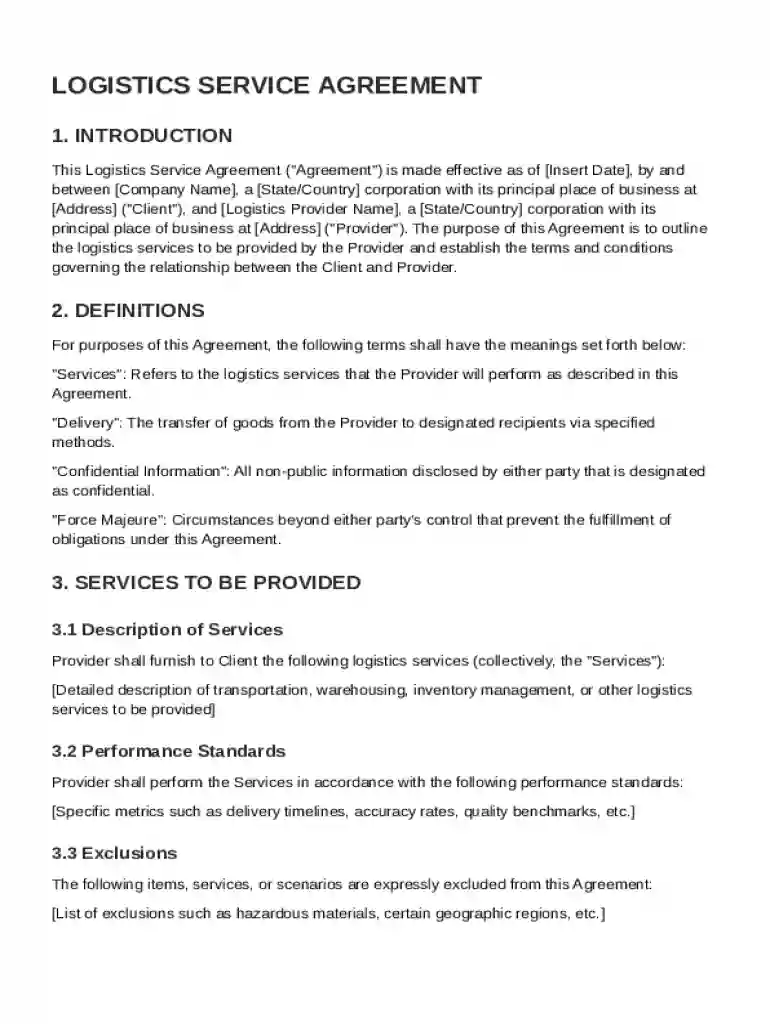
A Logistics Service Agreement Template is a standardized document used to outline the terms and conditions between a client and a logistics provider. This agreement establishes the framework for various logistics services such as transportation, warehousing, and distribution, ensuring both parties have a clear understanding of their roles, responsibilities, and expectations. It encompasses detailed descriptions of services, performance standards, compensation, confidentiality obligations, and termination conditions. Logistics service agreements are critical for mitigating risks, enhancing operational efficiencies, and ensuring compliance with legal requirements, thereby protecting the interests of both parties involved.
Key Elements of the Logistics Service Agreement Template
Service Descriptions
- Detailed explanations of the specific logistics services to be provided.
- Include transportation, storage, handling, and value-added services.
- Specify the scope, frequency, and duration of each service.
Performance Standards
- Establish benchmarks for quality, timeliness, and efficiency.
- Define criteria for evaluating service performance.
- Outline consequences for failing to meet agreed-upon standards.
Compensation Details
- Clear and concise information on the payment structure.
- Include payment terms, methods, and schedules.
- Discuss any potential surcharges, penalties, or incentives.
Confidentiality Obligations
- Terms that ensure the protection of sensitive and proprietary information.
- Outline the responsibilities for safeguarding data.
- Define the duration of confidentiality obligations post-agreement termination.
How to Use the Logistics Service Agreement Template
Initial Setup
- Review all sections of the template to understand its structure and contents.
- Customize sections to reflect the specific needs of the parties involved.
- Consult with legal counsel to ensure compliance with applicable laws and regulations.
Personalization
- Tailor descriptions to match the specific logistics services being provided.
- Include unique operational or business requirements.
- Define specific roles and responsibilities for each party.
Finalization
- After customization, review the agreement with all involved parties.
- Make necessary revisions based on feedback from stakeholders.
- Execute the agreement through signatures from authorized representatives.
Legal Use of the Logistics Service Agreement Template
Compliance Considerations
- Ensure the document adheres to federal and state laws.
- Verify that all terms align with industry regulations and standards.
- Include clauses for amendments and dispute resolution.
Binding Nature
- Emphasize the legal binding nature of the agreement once signed.
- Highlight the enforceability of electronic signatures per the ESIGN Act.
- Discuss the implications of contract breaches and remedy options.
Important Terms Related to the Logistics Service Agreement Template
Indemnification Clauses
- Protects parties against legal claims arising from each other's actions.
- Specify the extent of liability and conditions for indemnification.
- Include examples of scenarios requiring indemnification.
Termination Conditions
- Conditions under which the agreement may be terminated.
- Include notice periods, grounds for termination, and transition plans.
- Detail the process for handling outstanding obligations upon termination.
Governing Law and Jurisdiction
- Identify the legal jurisdiction governing the agreement.
- Discuss the implications of selected jurisdiction on legal disputes.
- Offer examples of how jurisdictional clauses affect enforcement.
Steps to Complete the Logistics Service Agreement Template
Document Preparation
- Gather all necessary information related to the logistics services.
- Obtain details on both parties, including contact and address information.
Template Completion
- Fill in each section accurately, reflecting the agreed-upon terms.
- Pay attention to detail to avoid inaccuracies or omissions.
Verification and Execution
- Verify the completeness and accuracy of the information.
- Collect signatures from authorized representatives in accordance with legal requirements.
- Securely store signed agreements for future reference.
Businesses
- Companies looking for logistics and supply chain services.
- Useful for manufacturers, retailers, and distributors.
- Facilitates partnerships between small businesses and third-party logistics providers.
Logistics Providers
- Firms offering transportation, warehousing, and supply chain solutions.
- Enhances clarity and efficiency in service delivery.
- Supports accountability and service quality assurance.
Examples of Using the Logistics Service Agreement Template
Real-world Scenarios
- A retailer partnering with a logistics provider for nationwide distribution.
- A manufacturer outsourcing warehousing and handling functions to a third-party provider.
- A startup leveraging logistics services to manage high-volume e-commerce shipments.
Case Studies
- Scenario analysis of successful logistics partnerships enhanced by a clear agreement.
- Illustrate the benefits of structured service agreements in mitigating disputes and enhancing collaboration.
State-specific Rules for the Logistics Service Agreement Template
Variations by Jurisdiction
- Different states may have unique requirements for contractual agreements.
- Importance of understanding state-specific logistics regulations.
- Examples of variations in contract laws that could impact agreement terms and enforcement.
By including these sections, the content extensively covers all aspects of a Logistics Service Agreement Template, ensuring comprehensive understanding and effective application for users.