






Definition and Purpose of a Legal Custody Agreement
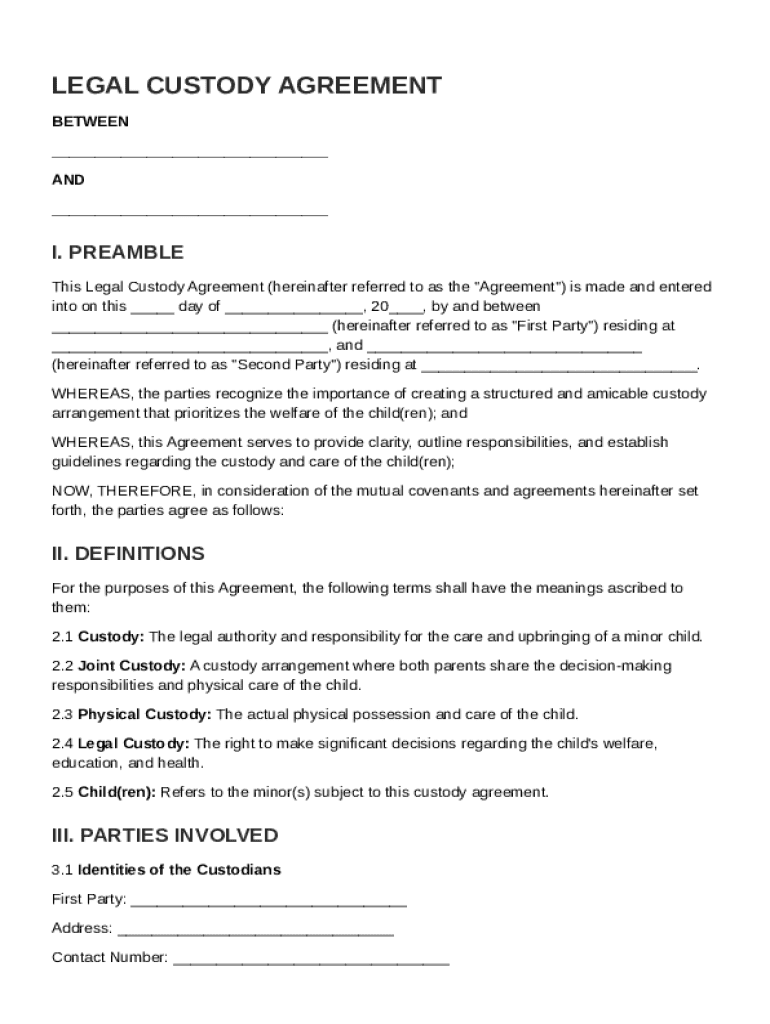
A Legal Custody Agreement outlines the terms and conditions regarding the legal and physical custody of a child or children between two parties, often parents. This document is fundamental in family law as it helps to clearly establish each party's rights and responsibilities concerning the upbringing and welfare of the minor(s). Typically, the agreement includes comprehensive definitions of custody types—legal and physical—along with detailed arrangements about visitation, education, and healthcare decision-making. It serves to minimize conflict by setting clear expectations and enables the smooth handling of various parenting aspects.
Types of Custody Defined
- Legal Custody: Refers to the right and obligation to make major decisions regarding the child’s life, such as education, health care, and religious upbringing.
- Physical Custody: Pertains to with whom the child will live on a day-to-day basis. It dictates the child's residency and the logistics of everyday activities.
Practical Scenarios
A typical scenario might involve one parent having sole legal custody, which grants them the authority to make major decisions about the child's education and medical care, whereas physical custody could be shared, allowing the child to spend alternate weeks with each parent.
How to Use the Legal Custody Agreement Template
To effectively use a Legal Custody Agreement Template, users should first understand the needs and circumstances concerning the children involved. The template should be tailored to reflect the specific arrangement agreed upon by both parties. Using an online document editing tool like DocHub can simplify this process by allowing you to fill out the template and make necessary customizations.
Practical Steps for Usage
- Review Definitions: Familiarize yourself with the legal terminology and ensure mutual understanding between parties.
- Complete Party Details: Accurately fill in the names, addresses, and details of both parties.
- Specify Custody Arrangements: Clearly outline who has legal and/or physical custody.
- Define Visitation Schedules: Use the template to create a detailed visitation plan.
- Address Special Needs: Include any unique requirements such as healthcare or educational needs.
Steps to Complete the Legal Custody Agreement Template
Completing this template requires a systematic approach to ensure all sections are covered comprehensively. Utilizing an organized method can prevent future disputes or misunderstandings.
- Gather Information: Collect vital information regarding the child(ren) involved and both parties.
- Access the Template: Download or duplicate the template using DocHub or another document editing service.
- Fill Out Personal Details: Insert the personal information of the parties involved.
- Specify Custody Details: Clearly state which type of custody each party will have.
- Outline Financial Responsibilities: Note any child support arrangements and insurance obligations.
- Sign and Date: Parties should electronically or physically sign and date the document for it to be effective.
Key Elements of the Legal Custody Agreement Template
A robust Legal Custody Agreement Template should encompass certain core elements to cover all bases legally and practically. These elements help ensure clarity and efficiency in the co-parenting arrangement.
Fundamental Components
- Contact Information: Details of both parents or guardians.
- Custody Detail Sections: Specifics about legal and physical custody types.
- Issue Resolution Methods: Procedures for resolving disagreements.
- Parental Roles and Responsibilities: Duties and rights of each party in day-to-day matters.
- Communication Guidelines: Protocols for how parents will communicate regarding the child.
Special Provisions
- Emergency Procedures: Define steps for quick decisions in emergencies.
- Modification Clause: Terms under which the agreement can be modified as circumstances change.
Important Terms Related to the Legal Custody Agreement Template
Understanding the terminology within a Legal Custody Agreement Template is crucial for effective use and helps prevent misinterpretations that could lead to conflicts.
Key Terminology
- Joint Custody: When both parents share custody and decision-making responsibilities.
- Sole Custody: When only one parent has full custody rights, often inclusive of decision-making and physical stay.
Legal Consequences
Failure to adhere to the agreement can lead to legal consequences, including court-ordered adjustments or penalties. Hence, familiarity with terms such as “mediation,” “arbitration,” and “compliance” can be vital.
State-Specific Rules for the Legal Custody Agreement Template
Legal Custody agreements can vary significantly on a state-by-state basis in the United States. Each state may have specific requirements for custody arrangements, mandating variations in how agreements are drafted and enforced.
Notable State Variations
- California: Prioritizes the best interest of the child; frequent mediation may be required.
- Texas: Often grants joint managing conservatorship, which encourages shared parental responsibilities.
- New York: Requires a detailed parenting plan acceptable to both parties, reflecting joint efforts in decision-making.
Importance of Local Legal Insights
Understanding and incorporating state-specific laws ensures that the custody agreement is enforceable and aligns with local regulations. Consulting a family law attorney within your state is advisable to ensure compliance.
Legal Use of the Legal Custody Agreement Template
The Legal Custody Agreement Template serves as a legal document once properly executed. It provides a clear framework to facilitate parenting responsibilities and is often necessary to gain legal recognition in family courts.
Appropriate Legal Contexts
This template is essential during separations or divorces where children are involved. It can be used proactively to set the groundwork for healthy co-parenting and legally mitigate potential disputes.
Judicial Use
Courts may use the details in the agreement for ruling on disputes and ensuring compliance with agreed terms. In cases of violation, this document serves as an evidential basis.
Examples of Using the Legal Custody Agreement Template
Practical examples showcase how these agreements are applied in real-world scenarios, offering insights into their utility and functionality.
Real-World Application Examples
- Separating Couples: When parents decide to live apart, detailing custody ensures clarity for custody logistics.
- Unmarried Parents: Offers a formal structure to manage parenting roles and responsibilities without marriage.
- Modification in Custody: When a parent's or child's circumstances change needing adjustments in living arrangements or visitation schedules.
These examples emphasize the flexibility of legal custody agreements to adapt to varying familial situations while ensuring the child's welfare remains the central focus.