Care advance directive form 2026

Get Form
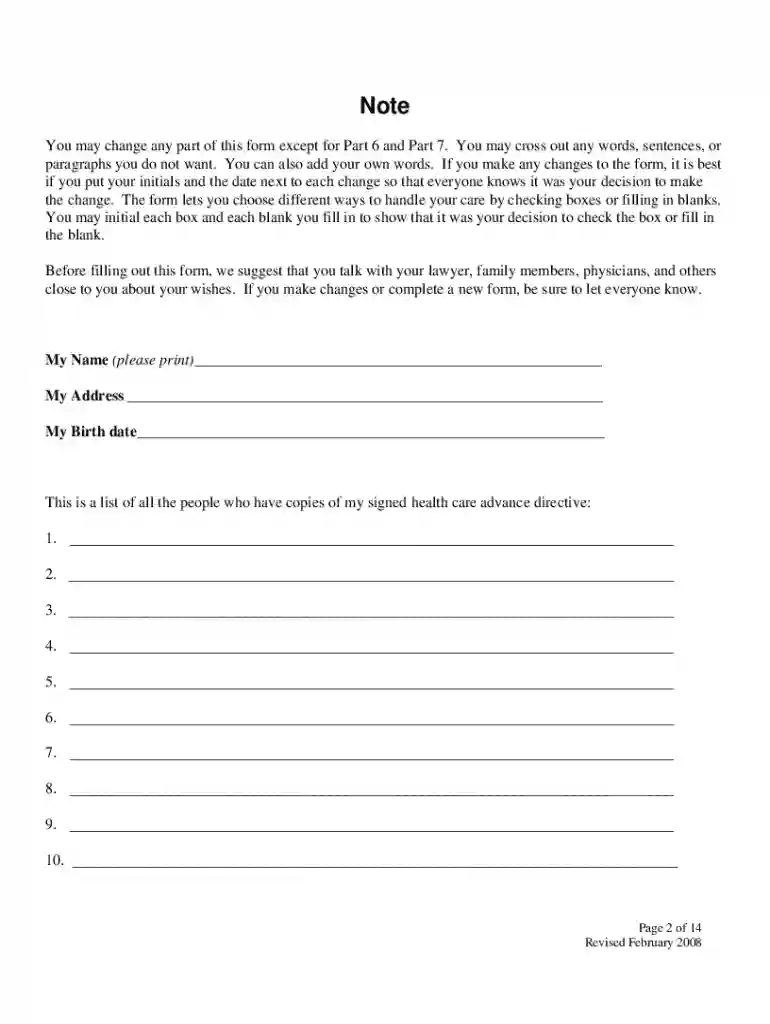
maine health care advance Preview on Page 1

Here's how it works

01. Edit your maine health care advance online
Type text, add images, blackout confidential details, add comments, highlights and more.

02. Sign it in a few clicks
Draw your signature, type it, upload its image, or use your mobile device as a signature pad.

03. Share your form with others
Send state form 44589 via email, link, or fax. You can also download it, export it or print it out.

How to use or fill out care advance directive form with our platform

Form edit decoration
9.5
Ease of Setup
DocHub User Ratings on G2
9.0
Ease of Use
DocHub User Ratings on G2
  1. Click ‘Get Form’ to open the care advance directive form in the editor.
  2. Begin with Part 1, where you can designate an agent for your health care decisions. Fill in your name and the agent's details, ensuring you choose someone you trust.
  3. In Part 2, specify any special instructions regarding your treatment preferences. You can check boxes to indicate whether you want to be kept alive under certain conditions.
  4. Part 3 allows you to name your primary physician. This is optional but recommended for clarity in your health care wishes.
  5. If you wish to donate organs or tissues after death, complete Part 4 with your preferences.
  6. In Part 5, outline any funeral or burial arrangements you'd like followed.
  7. Finally, sign and date the form in Part 6. Ensure two witnesses sign at the same time; they cannot be your agent.

Start using our platform today to easily fill out and manage your care advance directive form online for free!

See more care advance directive form versions

We've got more versions of the care advance directive form form. Select the right care advance directive form version from the list and start editing it straight away!
Versions Form popularity Fillable & printable
2008 4.8 Satisfied (267 Votes)
be ready to get more

Complete this form in 5 minutes or less

Get form

Got questions?

We have answers to the most popular questions from our customers. If you can't find an answer to your question, please contact us.
Contact us
Types of Advance Directives The living will. Durable power of attorney for health care. POLST (Physician Orders for Life-Sustaining Treatment) Do not resuscitate (DNR) orders. Organ and tissue donation.
The two most common advance directives for health care are the living will and the durable power of attorney for health care.
An advance care directive can include two different types of statements: a values directive, and/or an instructional directive. In a values directive, you can record general statements about your priorities and preferences for medical treatment to help guide your future health care.
Each state has different rules about advance directives, but most include the same types of documents: a living will, a healthcare power of attorney, and a Medical Orders for Scope of Treatment (MOST) form.
A digital advance directive is one that exists entirely online. It is filled out, docHubd if necessary, and stored online. A paper version may or may not exist. Digital advance directives are convenient as they may be downloaded anywhere the internet can be accessed.

Security and compliance

At DocHub, your data security is our priority. We follow HIPAA, SOC2, GDPR, and other standards, so you can work on your documents with confidence.

Learn more
ccpa2
pci-dss
gdpr-compliance
hipaa
soc-compliance
be ready to get more

Complete this form in 5 minutes or less

Get form

People also ask

You do not need an attorney to complete the form. The form also does not have to be docHubd. You do need a disinterested witness. You can find the form for the Utah Advance Healthcare Directive and instructions for completing it at .
Do I need a notary to create an advance directive? Except for optional forms, the forms do not require the use of a notary. An additional optional form called a witnesses affidavit that is included among the forms in this booklet requires a notary public or a lawyer to verify the signature of the witnesses.
The Three Most Common Types of Advance Directives Living Will. A Living Will is a document that specifies what kind of medical treatment you do or do not want if you become terminally ill or permanently unconscious. Durable Power of Attorney for Healthcare (Healthcare Proxy) Do Not Resuscitate (DNR) Order.

Related links