




01. Edit your form online
Type text, add images, blackout confidential details, add comments, highlights and more.

Type text, add images, blackout confidential details, add comments, highlights and more.

Draw your signature, type it, upload its image, or use your mobile device as a signature pad.

Send it via email, link, or fax. You can also download it, export it or print it out.
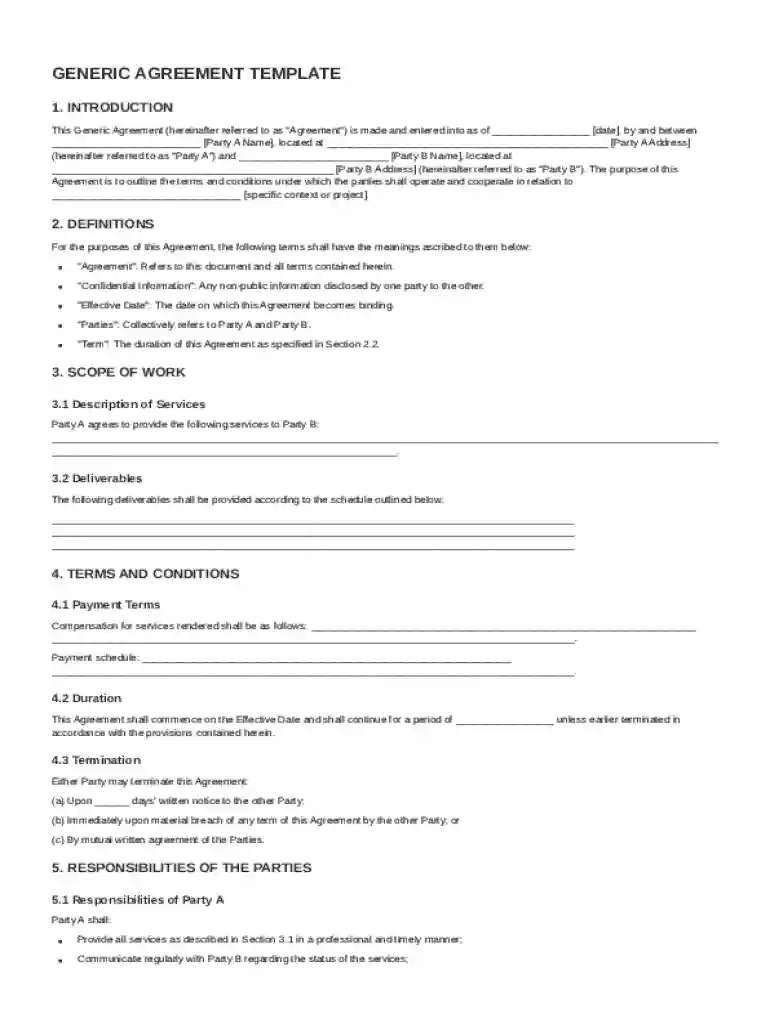
A Generic Agreement Template is a foundational legal document used to formalize the terms and conditions of cooperation between two parties, commonly referred to as Party A and Party B. It includes crucial sections such as definitions, scope of work, payment terms, responsibilities, confidentiality obligations, dispute resolution procedures, governing law, and miscellaneous provisions. This template helps structure the relationship and set clear expectations for the parties involved in a specific project or context.
Review the Template: Begin by reading through the entire document to understand its framework and identify any areas that require customization to fit the specific agreement between the parties.
Fill in the Details: Input necessary details such as the names of the parties, effective dates, and specific responsibilities. Adjust sections to accurately reflect the scope of work and payment terms agreed upon.
Customize Provisions: Tailor the confidentiality, dispute resolution, and governing law clauses to meet state-specific regulations and the preferences of the parties involved.
Consult with Legal Counsel: Have a lawyer review the customized template to ensure it complies with legal requirements and sufficiently protects the interests of both parties.
Finalize and Distribute: After making revisions and validations, save the final version of the agreement. Distribute copies to both parties for their records and ensure all parties sign the document where necessary.
Definitions: Clearly defines key terms used throughout the agreement, ensuring both parties have a mutual understanding of the language.
Scope of Work: Outlines the specific duties and obligations each party agrees to perform, serving as a roadmap for the project.
Payment Terms: Specifies the methods, amounts, and schedules of payments, minimizing potential disagreements regarding compensation.
Responsibilities: Details the duties of each party, highlighting their roles in fulfilling the agreement's objectives.
Confidentiality Obligations: Ensures that both parties agree to protect sensitive information shared during the collaboration.
Dispute Resolution: Provides methods for resolving conflicts, such as mediation or arbitration, minimizing potential legal battles.
Governing Law: Indicates which state's laws will govern the agreement, crucial for enforcing the terms in case of disputes.
Standard Template: A basic agreement used in general business contexts without specific modifications.
State-Specific Versions: Adjusted templates that include provisions to comply with the legal requirements of individual states.
Industry-Specific Templates: Tailored agreements that incorporate terms and conditions relevant to specific industries, such as technology or healthcare.
The Generic Agreement Template serves as a legally binding document when both parties sign it. It ensures that the terms agreed upon are enforceable in a court of law. The template adheres to legal standards as outlined in the United States, ensuring compliance with applicable state and federal laws. It's important the agreement accurately captures the intentions and consent of both parties to ensure its enforceability.
DocHub supports various file formats, allowing users to edit the Generic Agreement Template seamlessly. Users can import the template in DOC, PDF, or other formats directly from cloud storage services like Google Drive or Dropbox. Editing can be done on both desktop and mobile web browsers, providing flexibility and convenience for users. Integrated tools within DocHub help maintain the document's formatting while enabling easy modifications.
Consulting Services: Used by consulting firms when setting the terms of service delivery with their clients.
Freelancing Projects: Independent contractors employ this template to outline their engagement with clients for specific projects.
Business Partnerships: Companies enter into agreements using this template to establish joint ventures or partnerships for mutual benefit.
Parties: The entities involved in the agreement, usually referred to as Party A and Party B.
Terms and Conditions: The detailed provisions that outline rights, duties, and obligations of the parties involved.
Breach of Contract: An instance where one of the parties fails to fulfill their responsibilities as outlined in the agreement.
Effective Date: The date from which the terms of the agreement are applicable and enforceable.
Failure to adhere to the terms outlined in the Generic Agreement Template can lead to legal repercussions. Penalties may include monetary damages, specific performance, or injunctive relief, depending on the contract terms and the governing law stipulated within the agreement. It is crucial for the involved parties to fully comply with all sections to avoid these outcomes.
Small and Medium Enterprises (SMEs): Utilize the template to formalize their dealings with suppliers, customers, or partners efficiently.
Startups: Startups leverage the template to establish clear terms with investors and service providers during early-stage operations.
Freelancers and Independent Contractors: Use the template to define their roles, tasks, and compensation with clients, ensuring professional engagements.
At DocHub, your data security is our priority. We follow HIPAA, SOC2, GDPR, and other standards, so you can work on your documents with confidence.


You can start with our free template on Contract AI Platforms RFP template and tailor it to your environment. If you want, compare LEGALFLY againstRead more
Templates and Forms Agency Funds Agreement Art Commissioning Agreement HIPAA Business Associate Agreement Educational Experience Affiliation AgreementRead more


