




01. Edit your form online
Type text, add images, blackout confidential details, add comments, highlights and more.

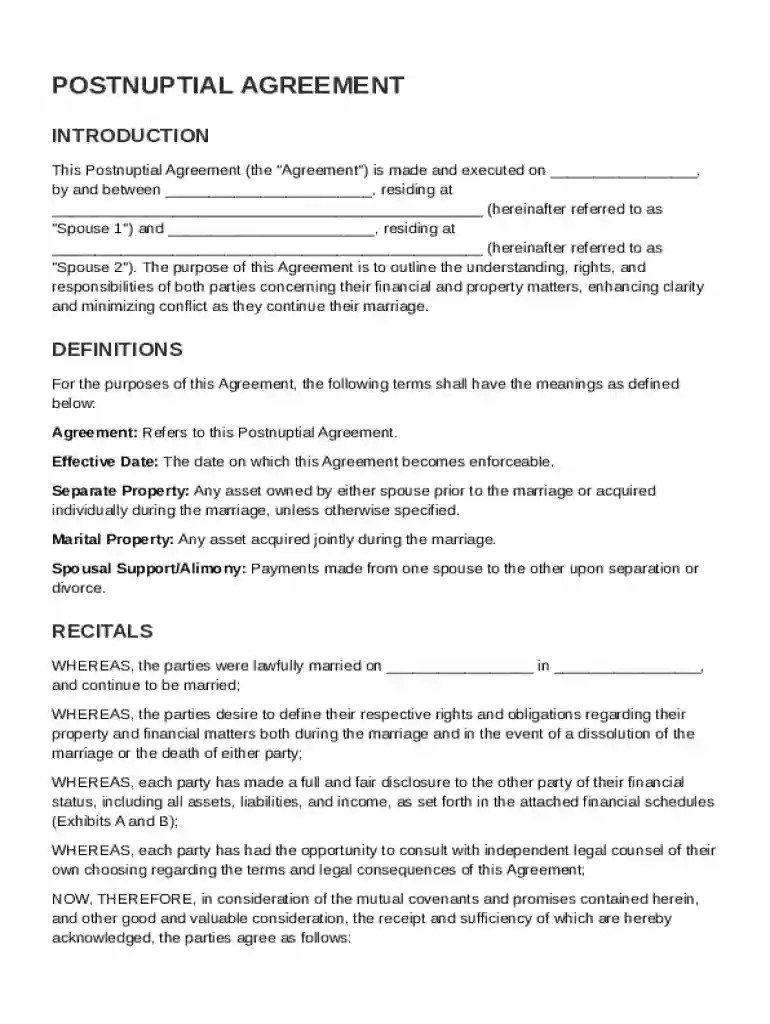
Type text, add images, blackout confidential details, add comments, highlights and more.

Draw your signature, type it, upload its image, or use your mobile device as a signature pad.

Send it via email, link, or fax. You can also download it, export it or print it out.
A postnuptial agreement, often referred to as a postnup, is a legal contract entered into by spouses after their marriage has already commenced. This agreement outlines the financial and property rights and responsibilities of each spouse during the marriage and in the eventuality of separation or divorce. It serves to clearly define marital and separate property, ensuring mutual understanding and reducing potential disputes over assets in the future. Through this agreement, spouses can also set terms for spousal support, debt responsibilities, and confidentiality clauses, promoting transparency and financial security in the marriage.
Using a postnup agreement template effectively involves understanding its sections and customizing it to fit your and your spouse's unique circumstances. Begin by reviewing the template thoroughly to familiarize yourself with the required information and legal language. You should tailor the template to accurately reflect your intentions regarding asset division, spousal support, and other financial arrangements. Make sure to consult a legal professional to ensure compliance with state laws and prevent nullification due to improper execution. Consider including specific clauses that address unique aspects of your marriage, such as business interests or special investments.
Postnup agreements are composed of various essential elements that ensure their comprehensiveness and legality. These elements include the identification of parties involved, the definition of marital and separate property, clauses on asset division, spousal support agreements, debt responsibility, confidentiality, dispute resolution mechanisms, and any general provisions such as governing law and conditions for modifications.
Understanding the key terms used within a postnuptial agreement is vital for both comprehension and implementation. These terms include "marital property," referring to assets acquired together during the marriage, and "separate property," which designates items owned by one spouse individually. "Spousal support" describes any financial assistance given from one spouse to another following separation, while "equitable distribution" pertains to the fair division of property as agreed upon in the postnup.
The legal use of a postnup agreement centers on establishing clear financial arrangements and protecting the interests of both spouses, especially in jurisdictions that recognize such agreements. A legally binding postnup requires full disclosure of financial circumstances by both parties, mutual agreement on the terms, and signatures in front of a notary. Failure to adhere to state-specific rules can invalidate the agreement, so legal consultation is advised.
State-specific rules play a significant role in the enforceability of postnuptial agreements. Some states may require additional disclosures or specific language to be included. For example, community property states may have different standards for asset division compared to equitable distribution states. Understanding these variations is crucial, and couples should seek legal guidance to ensure their agreement adheres to the applicable state laws.
Postnuptial agreements provide practical solutions in various scenarios. For instance, if one spouse starts a business during the marriage, the agreement can protect that business as separate property. Similarly, if one spouse anticipates a substantial inheritance, a postnup can designate those funds as separate. Another example is when spouses wish to set specific terms for future spousal support to prevent lengthy legal battles in the event of divorce.
At DocHub, your data security is our priority. We follow HIPAA, SOC2, GDPR, and other standards, so you can work on your documents with confidence.




postnuptial agreements are valid and enforceable and generally must comply with contract principles.
Mar 3, 2023 A postnuptial agreement is similar to a prenuptial agreement in that it identifies which assets are to remain outside of the marriage and what


