




01. Edit your form online
Type text, add images, blackout confidential details, add comments, highlights and more.

Type text, add images, blackout confidential details, add comments, highlights and more.

Draw your signature, type it, upload its image, or use your mobile device as a signature pad.

Send it via email, link, or fax. You can also download it, export it or print it out.
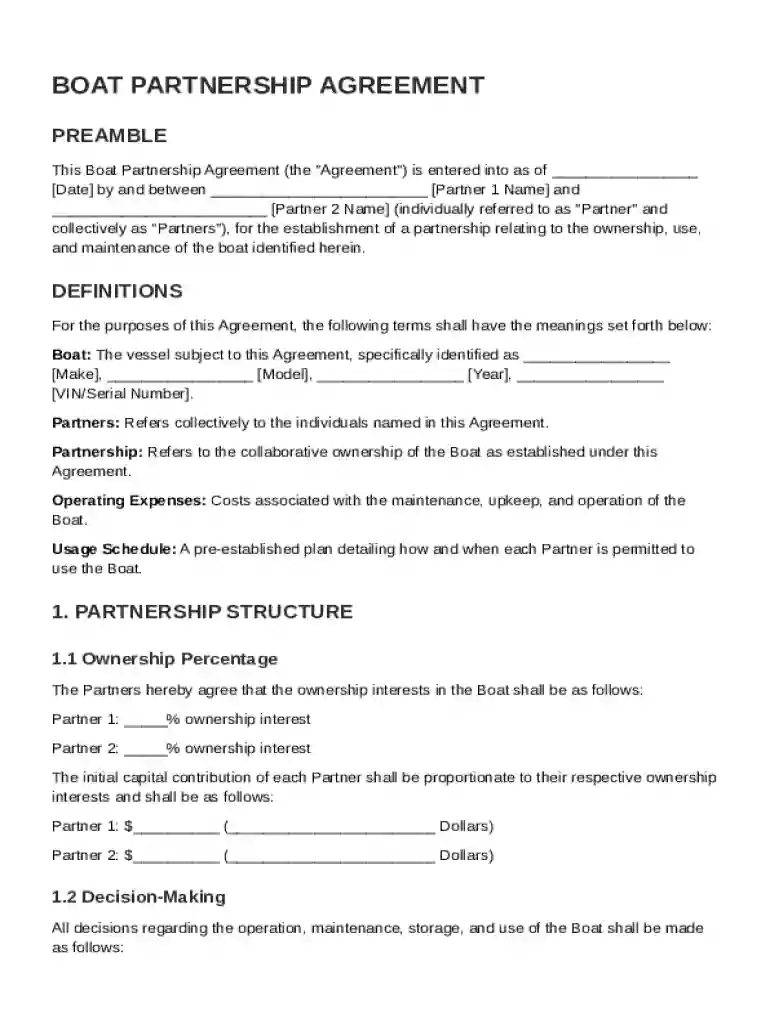
A Boat Partnership Agreement Template is a legal document that establishes the terms and conditions for a partnership concerning the ownership, use, and maintenance of a specific boat. It serves as a foundational contract to delineate the rights and responsibilities of each partner involved in the boat's usage. Essential components typically include outlines of ownership percentages, financial contributions, and decision-making processes. The agreement is crucial to prevent misunderstandings between parties and to promote clear communication and accountability.
The Boat Partnership Agreement Template should cover essential elements to ensure clarity and mutual understanding between all parties.
Ownership and Title Interests: Clearly define the ownership breakdown, including the specific percentage of interest each partner holds. This clarification aids in preventing disputes related to control and benefits derived from the boat.
Financial Arrangements: Detail the financial responsibilities, such as initial purchase costs, routine maintenance, unexpected repairs, and insurance premiums. Clearly outline who will contribute what percentage of funds to these areas.
Operating Costs: List ongoing expenses, such as fuel, docking fees, and licensing, ensuring there's a plan for sharing these day-to-day costs.
Conflict Resolution: Include mechanisms for resolving any disputes, such as mediation or arbitration processes, to avoid escalation to litigation.
Filling out a Boat Partnership Agreement Template involves several important steps to guarantee accuracy and fulfillment of all necessary inclusions.
Identify the Partners: Begin by listing all parties entering into the partnership. Include full names, addresses, and contact information to ensure that the agreement is legally binding.
Define the Boat: Accurately describe the boat involved, including make, model, year, and identification numbers. This specification solidifies which asset the agreement governs.
Outline Terms of Ownership: Clearly specify ownership percentages and responsibilities concerning the boat. Ensure that each partner's share of the boat is documented.
Specify Financial Contributions: Account for each partner’s financial obligations, such as initial investment, continued upkeep, and proportional responsibility for repairs.
Determine Use Schedule: Set a clear and fair schedule regarding the usage of the boat, preventing conflicts over who has access and when.
Designate Responsibilities: Assign duties for maintenance and legal compliance to prevent gaps in accountability.
Develop an Exit Strategy: Explain policies for selling the boat or a partner's share, preventing complications if someone wishes to exit the agreement.
Understanding key legal terms within the Boat Partnership Agreement Template is essential for clarity and effectiveness.
The Boat Partnership Agreement Template serves a crucial role in legal contexts, acting as both a protective tool and a framework for cooperation.
Real-world scenarios illustrate the practical application of the Boat Partnership Agreement Template in resolving common partnership issues.
Example 1: Two family members purchase a boat together. They use the agreement to define shared costs and a usage schedule, which helps avert conflicts during peak usage seasons.
Example 2: A friend group jointly owns a boat for recreational fishing. They establish an agreement specifying maintenance duties, preventing disputes when repairs are needed.
Example 3: In scenarios where business partners also align boat ownership with their commercial activities, the agreement delineates company versus personal usage, reducing the risk of asset misuse.
Exploring different versions or alternatives of the Boat Partnership Agreement Template can be beneficial for addressing specific needs or preferences.
Recognizing state-specific legal contexts can influence the drafting and implementation of a Boat Partnership Agreement.
Registration and Titling: Each state may have unique requirements for boat registration and co-ownership titling. It's crucial to ensure compliance with these local specifics to avoid legal issues.
Tax Implications: Some states may have specific tax obligations for jointly owned boats, which should be clarified within the terms of the agreement.
At DocHub, your data security is our priority. We follow HIPAA, SOC2, GDPR, and other standards, so you can work on your documents with confidence.





by LB Jacobson 1982 That is, it must define the liability of the partners to third parties, specifically, to creditors. A written agreement can define the extent toRead more
Contract Templates. Services Agreements Interagency Cooperation Contracts Interlocal Cooperation Contracts Hotel Agreement Speaker AgreementsRead more


