
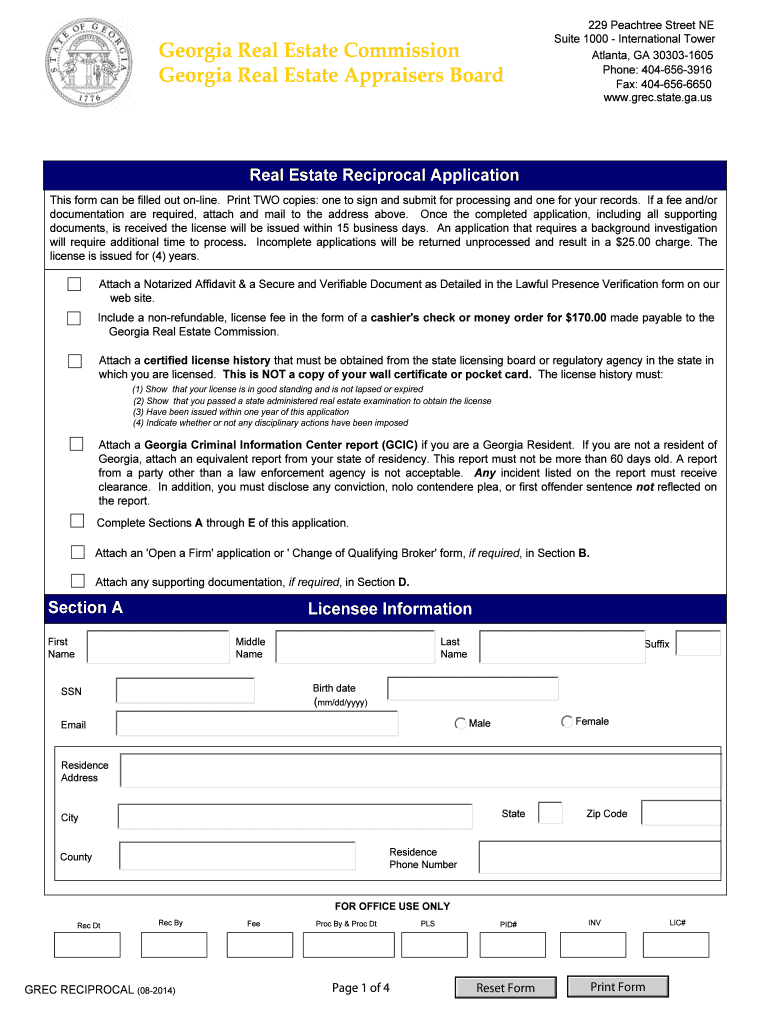







Definition & Meaning of the Real Estate Reciprocal Application
The Real Estate Reciprocal Application is a form used by real estate professionals seeking to obtain licensure in a new state, based on their current licensure in another jurisdiction. This process, often referred to as "reciprocity," allows agents and brokers to practice real estate across different states without undergoing a full requalification process. This is particularly useful for professionals who work near state borders or who are expanding their business into new territories. The application ensures that the agent's credentials and real estate practices align with the standards and regulations of the new state.
How to Use the Real Estate Reciprocal Application
Using the Real Estate Reciprocal Application involves several key steps to ensure proper submission and compliance with state regulations. First, identify the state where you wish to obtain the reciprocal license. Each state has specific requirements and procedures, so it's important to consult the relevant real estate commission for detailed guidelines. After obtaining the form, gather all necessary documents, which may include your current real estate license, proof of residency, and any state-specific disclosures. Fill out the form, providing accurate details as required.
- Assemble supporting documents, such as:
- License verifications
- Educational transcripts
- Personal identification
- Ensure all sections of the application are completed accurately to prevent delays or rejections.
Steps to Complete the Real Estate Reciprocal Application
Completing the Real Estate Reciprocal Application requires meticulous attention to detail. Here’s a step-by-step guide:
- Download the Form: Access the official real estate commission website of the target state to find the correct form.
- Read Instructions Carefully: Each state may have unique instructions; ensure you understand all requirements before filling out the form.
- Gather Documentation: Collect all necessary paperwork, including proof of current licensure and any state-specific documentation required.
- Complete the Application: Fill in all requested information accurately. Double-check for any errors or omissions.
- Submit the Application: Depending on state rules, this could be via mail, in-person, or online through the state’s official website.
Why You Should Use the Real Estate Reciprocal Application
The Real Estate Reciprocal Application streamlines the process for licensed real estate professionals to expand their practice beyond their current state. This is especially beneficial in regions where real estate markets overlap state lines, allowing agents to serve a larger client base. It reduces the complexity of acquiring a new license, as full examinations or coursework might be waived. Furthermore, utilizing this application can result in significant time and cost savings, making it preferable for those looking to broaden their operational geography without unnecessary redundancies.
Important Terms Related to the Real Estate Reciprocal Application
Understanding the terminology surrounding the Real Estate Reciprocal Application is essential:
- Reciprocity: Agreement between states to recognize each other’s real estate licenses.
- Jurisdiction: The state or area where the real estate professional is initially licensed.
- Verification of Licensure: A document confirming the agent’s current licensure status.
- Reciprocal State: The state into which the professional seeks to obtain licensure via reciprocity.
- Continuing Education (CE): Courses that may need to be completed as part of the application process to meet state-specific requirements.
State-Specific Rules for the Real Estate Reciprocal Application
Different states enforce varying rules concerning reciprocal real estate applications. For example, Georgia requires proof of active licensure in the home state and submission of any criminal background checks conducted. While some states might require state-specific coursework or exams for full reciprocity, others might offer full reciprocity without additional requirements. Understanding these nuances is imperative for professionals when navigating the application process, as failure to adhere to these rules can result in denied applications or delays.
Required Documents for the Real Estate Reciprocal Application
Applicants must submit several critical documents along with their Real Estate Reciprocal Application:
- Current Real Estate License: Verification of an active and in-good-standing license from the original state.
- Background Check Results: Most states require a recent background check to accompany the application.
- Proof of Identification: Such as a driver’s license or passport.
- Professional Endorsements: Sometimes needed from fellow real estate professionals or brokers.
- Educational Transcripts: Especially for any continuing education completed.
Application Process and Approval Time
The application process and approval time for the Real Estate Reciprocal Application can vary. Once the form is submitted along with all required documents, the typical review period ranges from a few weeks to several months, depending on state-specific processing speeds and current workload. Applicants are advised to check in frequently with the issuing authority to receive updates on their application status. Furthermore, having all documents prepared and correctly submitted from the onset can significantly minimize waiting periods and facilitate a smoother approval process.
Digital vs. Paper Version of the Real Estate Reciprocal Application
Applicants have the choice between submitting a digital or paper version of their Real Estate Reciprocal Application. Many states are moving towards digital submissions to streamline the process, reduce paper waste, and allow for easier tracking of the application's status. However, there are still some jurisdictions where paper submissions are required or preferred. For digital submissions, ensure that all documents are in compatible formats, such as PDF, and appropriately encrypted if needed. For paper submissions, double-check for any postal specific requirements to ensure timely receipt.
Examples of Using the Real Estate Reciprocal Application
Let's consider some scenarios to better understand the practical use of the Real Estate Reciprocal Application:
- Border Town Agents: An agent licensed in New York seeks a reciprocal license in Connecticut to expand their service area to a broader client base.
- Relocation: A broker moving from Illinois to Indiana wants to continue their career without a significant interruption from retaking exams or additional courses.
- Multi-State Operations: A large real estate firm operating in California wishes to employ agents licensed in nearby states like Nevada and Oregon, enhancing their business reach across state lines.




