Construction Service Level Agreement Template 2026

Get Form
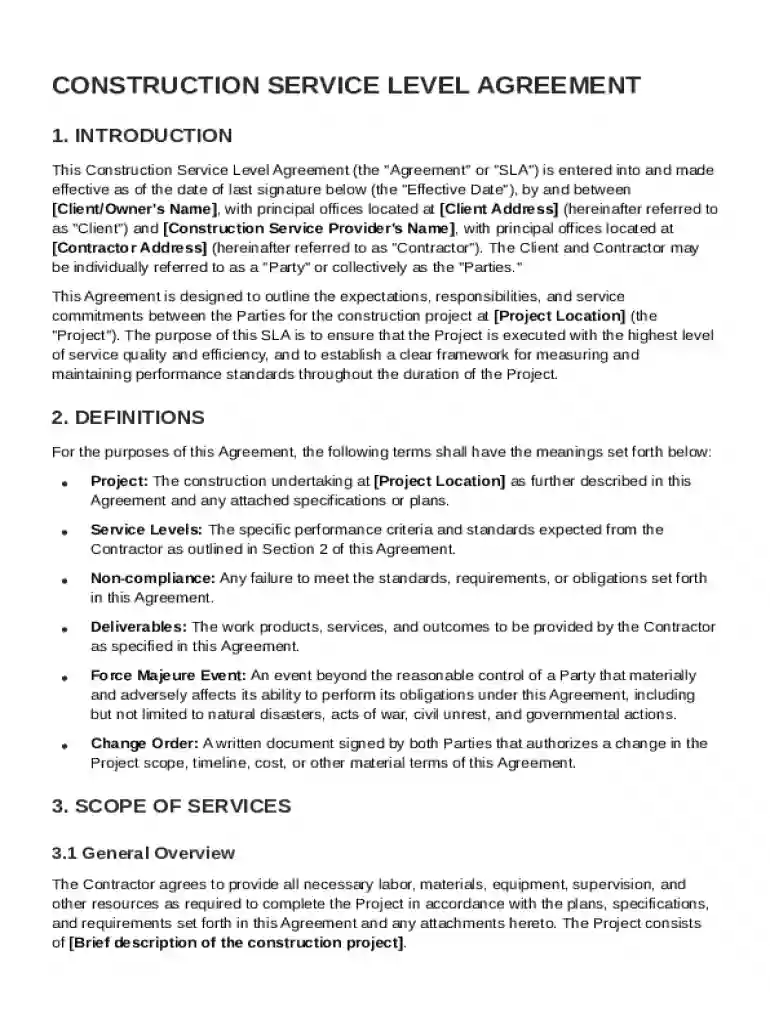
Construction Service Level Agreement Template Preview on Page 1

Here's how it works

01. Edit your form online
Type text, add images, blackout confidential details, add comments, highlights and more.

02. Sign it in a few clicks
Draw your signature, type it, upload its image, or use your mobile device as a signature pad.

03. Share your form with others
Send it via email, link, or fax. You can also download it, export it or print it out.

Definition & Meaning

A Construction Service Level Agreement (SLA) is a formal document that outlines the commitments between a client and a contractor in a construction project. The primary purpose of such an agreement is to define the responsibilities, expectations, and performance standards required to ensure the project is completed satisfactorily. The SLA includes detailed sections on the scope of services, defining what is expected from both parties, as well as standards for performance, which may cover quality, timelines, and budget constraints. By establishing clear communication protocols, the agreement aids in reducing misunderstandings and provides a framework for resolving disputes, should they arise.

Key Elements of the Construction Service Level Agreement Template

To effectively use a Construction Service Level Agreement Template, it's crucial to understand its essential components. Key elements generally include:

  • Scope of Services: Clearly describes the range of tasks to be completed. This may involve construction, maintenance, repair, or advisory functions necessary for the project.
  • Performance Standards: Outlines expected levels of quality and timeliness that contractors must adhere to.
  • Responsibilities of Parties: Lists high-level duties of both the client and contractor.
  • Communication Protocols: Defines how information will be exchanged, including formats, frequency, and channels of communication.
  • Problem Resolution Mechanisms: Specifies procedures for resolving disputes or disagreements.
  • Termination Conditions: Statements about how and under what conditions the contract may be ended.

Incorporation of these elements helps in preparing a comprehensive and useful SLA that serves the interests of all parties involved.

How to Use the Construction Service Level Agreement Template

Using the Construction Service Level Agreement Template effectively involves a series of strategic steps. Initially, users need to download or access the template from a reputable source, like DocHub, which allows streamlined editing and customization. Following this, tailor each section according to your specific project requirements, ensuring that all elements of the agreement are applicable and relevant to the situation at hand. Customize sections such as scope, standards, and responsibilities, adapting them to fit the project needs and expectations. After customization, it is critical to review the agreement to catch any discrepancies before finalization. Collaborative review by all parties involved ensures that everyone is aligned with the terms declared in the SLA.

Steps to Complete the Construction Service Level Agreement Template

Completing a Construction Service Level Agreement Template involves several methodical steps:

  1. Access the Template: Download or obtain the agreement template from a trusted source.
  2. Identify Project Details: Clearly state all necessary project specifics, including timeline and location.
  3. Define Responsibilities: Explicitly outline duties and obligations for both parties involved in the document.
  4. Set Performance Standards: Describe the benchmarks for completing tasks to specified quality levels.
  5. Include Problem Resolution Terms: Detail methodologies for addressing and managing disputes.
  6. Review and Revise: Ensure thorough review of the document by all parties to confirm agreement on all terms before signing it.

Following these steps ensures that the template is filled out accurately and thoroughly.

Important Terms Related to Construction Service Level Agreement Template

The use of a Construction Service Level Agreement Template involves understanding various critical terms, including:

  • Contractor: The entity or individual responsible for executing construction services.
  • Client: The individual or organization commissioning the construction work.
  • Service Levels: Predefined conditions under which services are to be provided.
  • Breach of Contract: A violation of one or more agreed-upon terms or clauses in the agreement.
  • Liability: Legal responsibility for any damages or losses sustained during the project.

Familiarity with these terms enhances comprehension and ensures accurate use of the agreement.

Who Typically Uses the Construction Service Level Agreement Template

A wide range of stakeholders within the construction industry utilizes the Construction Service Level Agreement Template. Typical users include:

  • Project Managers: Responsible for overseeing the entire construction project and ensuring successful completion.
  • Contractors and Subcontractors: Tasked with performing the construction work as specified in the SLA.
  • Clients or Property Owners: Individuals or organizations who commission the construction work.
  • Legal Advisors: Support parties in both drafting and finalizing the agreement to ensure it's legally binding.

These stakeholders rely on SLAs to establish clear expectations and responsibilities in construction projects.


decoration image ratings of Dochub

Legal Use of the Construction Service Level Agreement Template

The Construction Service Level Agreement Template not only guides project execution but also holds legal significance. It is drafted to be legally binding as it specifies the roles, responsibilities, and obligations of the parties involved. Ensuring legal compliance is essential and frequently involves:

  • Legal Review: Consulting with a lawyer or legal expert to ensure the document adheres to local, state, and federal laws.
  • Compliance: Aligning the SLA with industry standards and guidelines to avoid potential disputes.
  • Documentation: Properly documenting all agreements to provide a basis for enforcement in case of legal disputes.

Legally sound SLAs protect both the client and contractor by providing a framework for dispute resolution.

Examples of Using the Construction Service Level Agreement Template

Real-world examples demonstrate the use of Construction Service Level Agreement Templates in similar contexts:

  • Residential Development: A property developer and a construction company agree upon an SLA to guide the construction of a housing estate.
  • Commercial Buildings: An agreement between a company and a contractor to establish an office building, setting standards and resolving expectations.
  • Infrastructure Projects: Governments or municipalities may enter into SLAs with construction firms for large-scale public works, such as road or bridge construction.

These scenarios highlight the template's applicability in diverse construction projects, each requiring specific terms and standards.

be ready to get more

Complete this form in 5 minutes or less

Get form

Got questions?

We have answers to the most popular questions from our customers. If you can't find an answer to your question, please contact us.
Contact us
How to write a service level agreement in 5 steps Agreement overview. A list of stakeholders. The goals of all stakeholders. A description of services. Service levels. A list of services excluded from the agreement. Conditions of cancellation. A plan if goals arent docHubed.
How to write a Service Agreement Information about the service. First, specify how long services are needed (e.g., for a single job, a fixed term, or indefinitely) and where the work will be done (as this affects the laws that apply to your contract). Party details. Payment. Terms and conditions. Final details.
SLAs can be binding contracts but are often used by public sector bodies to set out their relationship in a given project without the intention to create legal relations.
P1, P2, P3, and P4 SLAs refer to different levels of priority assigned to specific issues or incidents. P1 SLAs are the highest priority, typically indicating critical system failures that require immediate attention, while P4 SLAs are lower priority issues that can be addressed within a longer timeframe.
A Service Level Agreement (SLA) in a construction project is a formal document that outlines the expected level of service between the contractor and the client. It sets clear standards for aspects such as quality of work, response times, deadlines, and maintenance tasks both during and after construction.

Security and compliance

At DocHub, your data security is our priority. We follow HIPAA, SOC2, GDPR, and other standards, so you can work on your documents with confidence.

Learn more
ccpa2
pci-dss
gdpr-compliance
hipaa
soc-compliance

People also ask

Service availability is the amount of time that a providers service is available for use. This is sometimes measured in a time slot. For example, your SLA might specify that a providers service will be available for a minimum of 99.5% capacity for a specific 12-hour window each day.

Related links