






Definition & Meaning
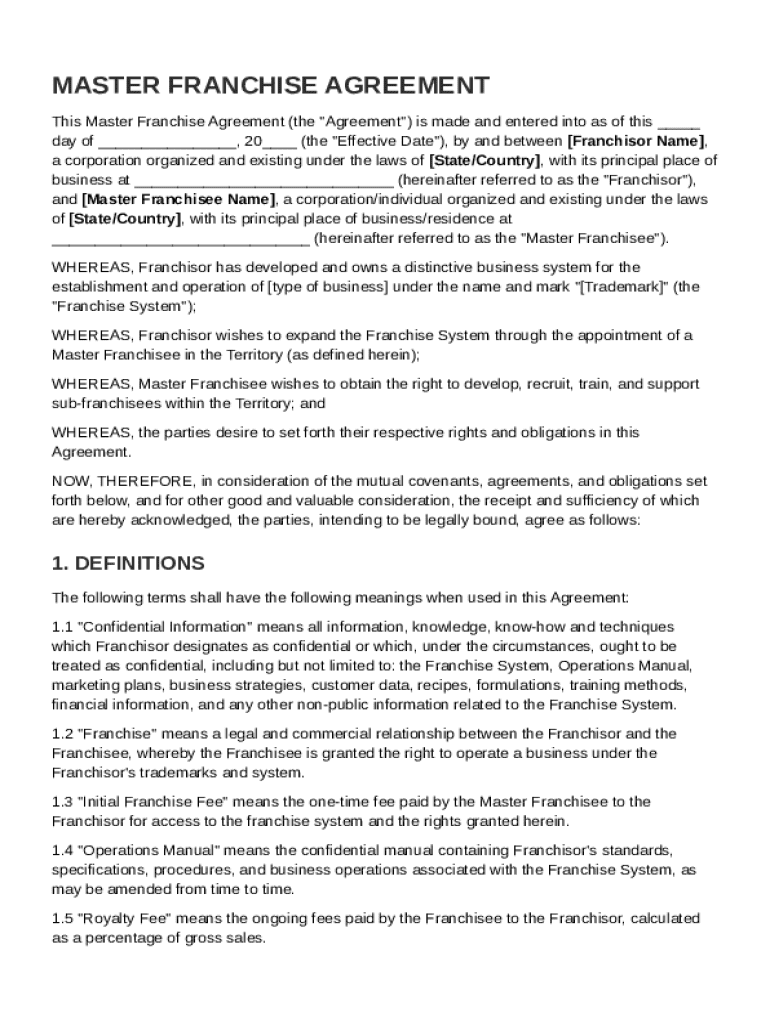
A Master Franchise Agreement Template is a structured legal document that establishes the terms and conditions between a Franchisor and a Master Franchisee. This agreement grants the Master Franchisee the rights to develop and manage sub-franchises within a certain geographic territory. The contractual conditions typically cover aspects such as exclusive territory rights, training obligations, and operational support. These agreements are crucial in expanding a business's footprint while maintaining consistent standards across different locations.
The contract elaborates on specific roles and responsibilities, which include the recruitment, training, and continuous support of sub-franchisees. The Master Franchise Agreement is designed to facilitate the growth and scalability of the franchise operation by delegating responsibilities to a trusted partner under a unified system.
How to Use the Master Franchise Agreement Template
Using the Master Franchise Agreement Template effectively involves a series of steps to tailor the document to fit the specific needs of the franchisor and master franchisee. Start by reviewing the template comprehensively to understand the clauses and terms included:
-
Customize Terms and Conditions: Adjust the clauses to reflect the specific duties, financial arrangements, and geographic areas pertinent to your franchise agreement.
-
Input Detailed Information: Include precise details about the franchisor, the master franchisee, and any sub-franchisees involved in the agreement.
-
Define Financial Obligations: Clearly outline the fees payable under the agreement and methods of payment, ensuring transparency and agreement adherence.
-
Review with a Legal Team: Before finalization, have the document reviewed by legal professionals to ensure compliance with local laws and regulations.
This approach provides both parties clarity and helps establish a framework for a successful franchising relationship.
Legal Use of the Master Franchise Agreement Template
In the context of U.S. law, a Master Franchise Agreement Template must adhere to federal and state-specific regulations governing franchise operations. These laws are designed to ensure fair practices and protect both franchisors and franchisees.
-
Compliance with FTC Franchise Rule: The template should comply with the Federal Trade Commission's (FTC) requirements, which include providing a Franchise Disclosure Document (FDD).
-
State-specific Franchise Registrations: Some states require franchises to register the agreement or obtain approval from the state regulator before launching operations.
-
Legal Protections: Incorporate clauses related to intellectual property rights, including brand usage and proprietary systems, to safeguard the franchisor's interests.
Ensuring the agreement is compiled legally strengthens the enforceability of the contract and protects both parties involved.
Key Elements of the Master Franchise Agreement Template
The template is structured to include core elements that legally define the relationship and operational guidelines for franchising:
-
Territory Rights: Specific geographic locations where the Master Franchisee is allowed to operate.
-
Training and Support: Detailed provisions on the training, support, and resources the franchisor will provide to the Master Franchisee and their sub-franchisees.
-
Financial Arrangements: Clarity on initial fees, royalties, and revenue sharing models between the franchisor and master franchisee.
-
Duration and Termination: Define the timeframe of the agreement and the conditions under which either party may terminate the contract.
By detailing these elements, the agreement ensures both parties have a clear understanding of their rights and duties.
State-Specific Rules for the Master Franchise Agreement Template
Franchise laws vary widely across different states, impacting how a Master Franchise Agreement Template must be constructed and implemented:
-
Registration Requirements: States like California and New York require franchise offerings to be registered and subject to approval by state agencies.
-
Franchise Relationship Laws: Certain states, including Illinois and Wisconsin, have specific relationship laws regulating aspects such as termination and renewal.
-
Disclosure Requirements: States can impose additional disclosure requirements that expand upon the federal minimums, ensuring greater transparency.
Understanding these variations is crucial for tailoring the template to be compliant with all applicable jurisdictional requirements.
Business Entities That Benefit Most from a Master Franchise Agreement Template
Certain types of business entities can gain significant advantages by using a Master Franchise Agreement Template:
-
Restaurant Chains: These businesses benefit from scaling operations while maintaining quality and consistency across locations.
-
Educational Services: Tutors or educational services can expand their reach while adapting their programs through local master franchisees.
-
Retail Operations: Retail franchises can grow brand presence and manage operations efficiently by leveraging local entrepreneurs.
Utilizing the template allows such entities to expand strategically without losing operational control or brand identity.
Steps to Complete the Master Franchise Agreement Template
Completing a Master Franchise Agreement Template involves careful inclusion of precise information and formalization:
-
Collect Basic Information: Gather all essential details about the franchisor, master franchisee, and involved stakeholders.
-
Customize Contractual Clauses: Adjust various sections such as territory, financials, and obligations to fit the unique context of the agreement.
-
Include Dispute Resolution Processes: Specify predetermined methods for resolving potential disagreements, such as mediation or arbitration.
-
Obtain Mutual Consent: Review and agree upon the document with the involved parties, ensuring mutual understanding and consent.
-
Legal Review and Signing: Finalize with a legal review, followed by signing to formally establish the agreement.
These steps provide a structured approach to completing the template, setting a solid foundation for future franchising agreements.
Digital vs. Paper Version
Master Franchise Agreements can be executed in both digital and paper formats, each with its distinct advantages.
-
Digital Format: Facilitates easy distribution, editable features, and paperless signing processes, aligning with modern digital workflows and eco-friendly practices.
-
Paper Format: Provides a physical copy that some organizations may prefer for traditional record-keeping and archiving.
Regardless of format, it is crucial to ensure document security, proper signatures, and legal compliance to maintain agreement validity and enforceability.