






Definition and Meaning
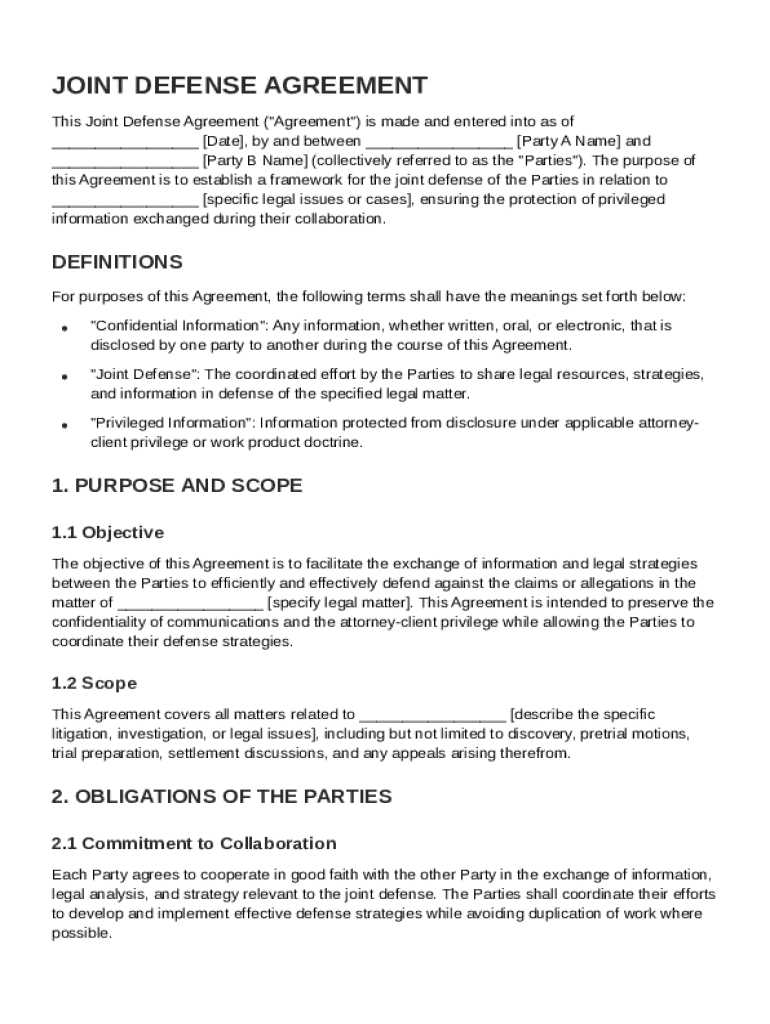
A Joint Defense Agreement (JDA) is a legal arrangement between two or more parties involved in similar or related legal proceedings. Its primary purpose is to facilitate collaboration while maintaining confidentiality of shared information. The JDA allows these parties to share resources, such as legal counsel and case strategies, without waiving legal privileges like attorney-client or work-product protections. This agreement is crucial in complex legal scenarios where joint efforts can lead to more efficient defense strategies.
Key Legal Concepts
- Joint Defense Privilege: Protects communications between parties and their legal counsels within the parameters of the agreement.
- Attorney-Client Privilege: Ensures that communications between an attorney and their client remain confidential.
- Work Product Doctrine: Shields materials prepared in anticipation of litigation from discovery by opposing parties.
Key Elements of the Joint Defense Agreement Template
The Joint Defense Agreement Template outlines several critical components that detail the scope and operation of the agreement between involved parties.
Essential Components
- Introduction: Identifies the parties involved and outlines the purpose of the agreement.
- Definitions: Clarifies key terms used throughout the document to ensure mutual understanding.
- Scope of Collaboration: Defines the specific legal matters, transactions, or issues the JDA covers.
- Confidentiality Obligations: Details the confidentiality requirements for all shared information among the parties.
- Retention of Privileges: Specifies how legal privileges will be maintained during the collaboration.
- Termination Conditions: Describes how and under what circumstances the agreement can be terminated.
How to Use the Joint Defense Agreement Template
To effectively utilize the Joint Defense Agreement Template, users should follow a structured process to ensure all elements of the agreement are accurately and precisely applied.
Step-by-Step Process
- Identify Participants: Clearly state the names and roles of all parties entering the agreement.
- Define Legal Issues: Explicitly outline the legal matters for which the agreement is being formed.
- Clarify Responsibilities: Detail the roles and responsibilities of each party concerning shared information.
- Draft Confidentiality Clauses: Establish clear rules to safeguard shared data from unauthorized disclosure.
- Outline Communication Protocols: Specify methods and channels for communication among parties.
- Review and Finalize: Validate the document with legal counsel and obtain necessary signatures from all parties.
Legal Use of the Joint Defense Agreement Template
The legal use of a Joint Defense Agreement is focused on maintaining collective defense capabilities without compromising individual parties' legal rights or privileges.
Legal Considerations
- Judicial Recognition: Ensure the agreement is structured in compliance with laws recognized by the relevant judicial authorities.
- State Regulations: Verify adherence to state-specific rules that may impose additional requirements.
- Litigation Contexts: Employ the template primarily in scenarios where multiple parties are facing similar litigation challenges.
Who Typically Uses the Joint Defense Agreement Template
Different entities and individuals may utilize a Joint Defense Agreement, especially those involved in litigation processes where shared defense strategies provide a tactical advantage.


Common Users
- Corporations: Companies facing class-action lawsuits or regulatory investigations.
- Law Firms: Legal counsels coordinating defense strategies for multiple clients.
- Joint Ventures: Business entities engaging in collective legal defenses for shared interests.

State-Specific Rules for the Joint Defense Agreement Template
While the Joint Defense Agreement Template is broadly applicable, certain states may impose specific rules or requirements.
Variations by State
- California: May require additional provisions to protect privacy under state laws.
- Texas: Could stipulate distinct disclosure requirements associated with oil, gas, or environmental litigation.
- New York: Might necessitate unique procedural adaptations for multi-district litigation.
Important Terms Related to Joint Defense Agreement Template
Familiarizing oneself with important terms related to the JDA is crucial for proper execution and understanding.
Terminology Explained
- Co-Defendants: Individuals or entities jointly accused or involved in a legal action.
- Information Sharing: The process of exchanging relevant data or strategies among parties within the agreement.
- Privilege Logs: Documentation that lists privileged documents withheld from discovery.
Examples of Using the Joint Defense Agreement Template
Applying the Joint Defense Agreement Template in real-life scenarios can illustrate its utility in complex legal settings.
Practical Applications
- Antitrust Litigation: Large corporations join forces to defend against antitrust claims by sharing economic data and research while preserving confidentiality.
- Intellectual Property Disputes: Competing companies collaborate on a defense strategy against a common patent infringement claim.
- Environmental Cases: Various stakeholders unite to challenge regulatory actions impacting multiple businesses across different states.