01. Edit your form online
Type text, add images, blackout confidential details, add comments, highlights and more.

Type text, add images, blackout confidential details, add comments, highlights and more.

Draw your signature, type it, upload its image, or use your mobile device as a signature pad.

Send it via email, link, or fax. You can also download it, export it or print it out.
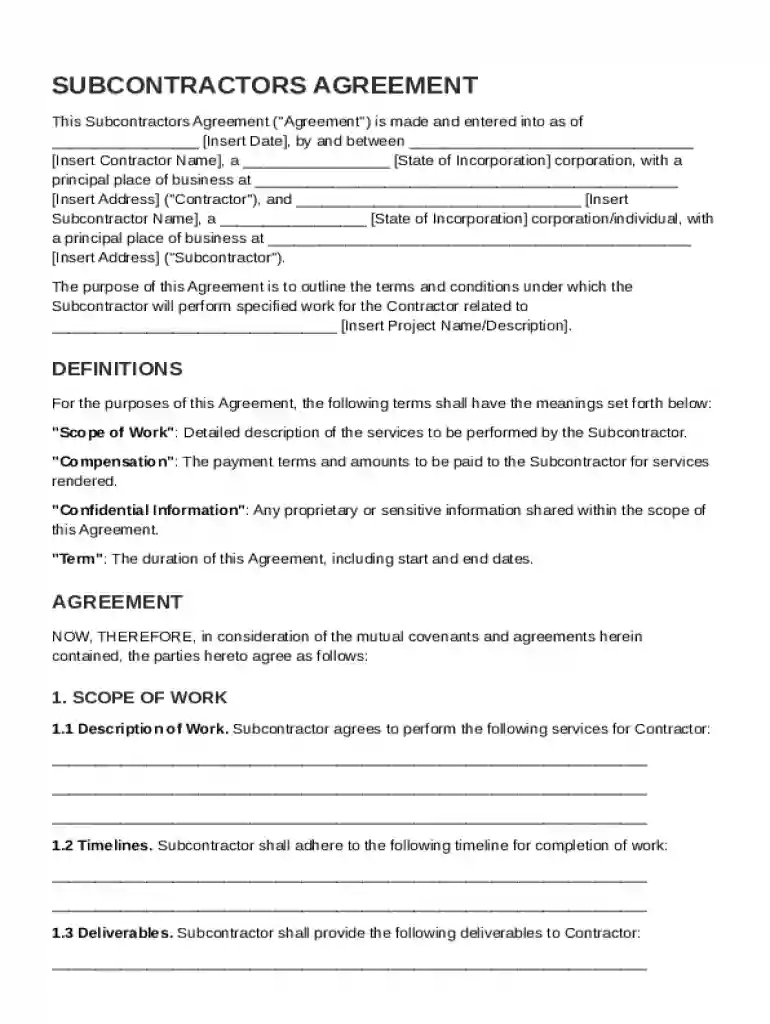
The Subcontractors Agreement is a formal, legal document that outlines the contractual terms between a contractor and a subcontractor. This agreement specifies the scope of work that the subcontractor is responsible for, alongside the compensation and general responsibilities of both parties involved. By clearly defining these elements, the Subcontractors Agreement helps protect all stakeholders, ensuring clarity and alignment on deliverables. This legal framework is essential for managing collaboration and maintaining confidentiality, particularly when it comes to intellectual property and sensitive project information.
In the U.S., subcontractor agreements must comply with federal and state laws governing contracts. It's important for these agreements to be drafted in accordance with local regulations to be considered legally enforceable. This not only includes having a clear mutual understanding documented between the parties but also ensuring the contract is willingly signed by both parties. Moreover, specific sectors such as construction might have additional statutory requirements that need to be incorporated.
Each state may have variations in laws governing contractual agreements. For example, some states may have unique provisions concerning the classification of subcontractors vs. employees, which can impact tax and labor law considerations. It's critical for parties to consult relevant state laws or legal counsel to ensure their subcontractors agreement conforms to state-specific requirements.
Consider a general contracting company building a new office complex. They might hire an electrical subcontractor to handle all electrical work. Using the Subcontractors Agreement Template, they can outline tasks such as wiring, panel installation, and inspections, as well as terms for payment upon completion of these tasks, protection of proprietary project plans, and handling of any disputes if they arise.
Businesses operating in industries such as construction, IT services, manufacturing, and event management frequently utilize subcontractor agreements. Companies in these fields often rely on specialized services provided by subcontractors to meet project requirements efficiently and may need to safeguard sensitive information through comprehensive subcontract agreements.
At DocHub, your data security is our priority. We follow HIPAA, SOC2, GDPR, and other standards, so you can work on your documents with confidence.