




01. Edit your form online
Type text, add images, blackout confidential details, add comments, highlights and more.

Type text, add images, blackout confidential details, add comments, highlights and more.

Draw your signature, type it, upload its image, or use your mobile device as a signature pad.

Send it via email, link, or fax. You can also download it, export it or print it out.
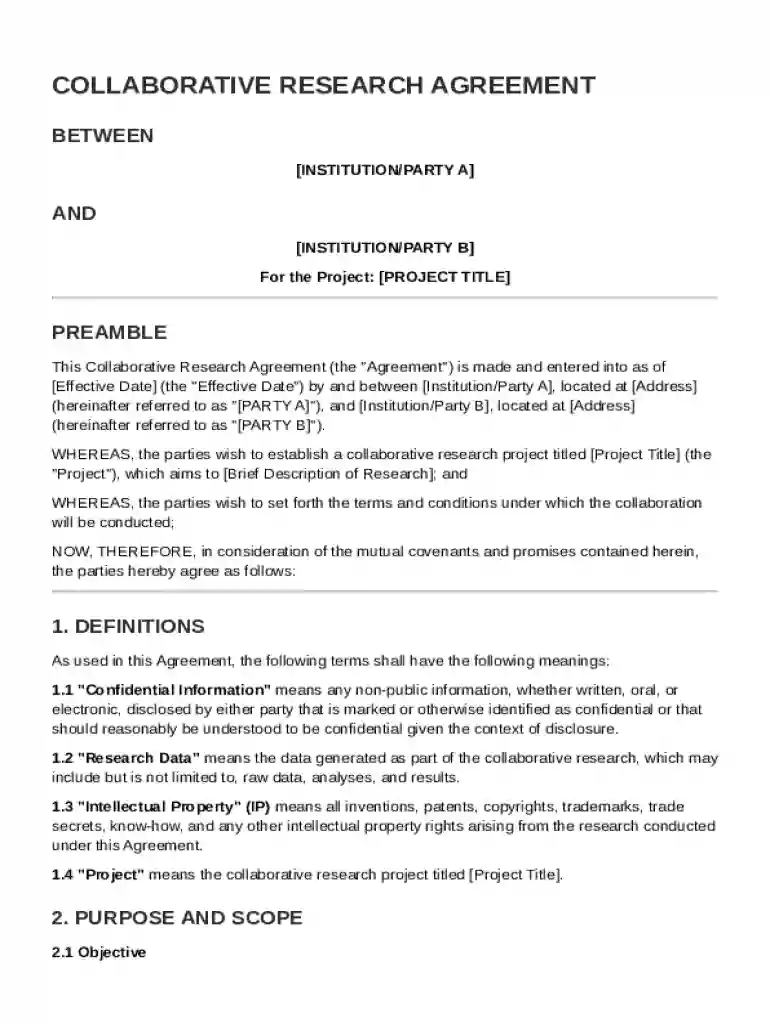
A Collaborative Research Agreement Template outlines the essential components necessary to formalize a partnership between two parties undertaking a joint research project. This document serves as a framework to establish mutual expectations and obligations concerning various aspects of the collaboration. The key elements typically include:
Definitions of Key Terms: Establishing precise definitions for technical terms, roles, and specific language used within the agreement to prevent misunderstandings.
Objectives: Clearly outlining the research goals, aims, and expected outcomes to ensure both parties are aligned on the project's purpose.
Roles and Responsibilities: Detailed delineation of each party's duties, contributions, and accountability throughout the research process.
Funding Contributions: Specifying each party's financial input, including how funds will be allocated, managed, and reported.
Confidentiality Obligations: Terms to protect sensitive information shared during the project, including non-disclosure clauses.
Data Management and Ownership Rights: Guidelines on how data will be collected, stored, shared, and who will hold ownership of the research findings.
Intellectual Property Provisions: Arrangements concerning the creation, use, and ownership of any intellectual property generated through the collaboration.
Dispute Resolution Mechanisms: Procedures for resolving disagreements that may arise during the project's duration, promoting amicable and efficient conflict resolution.
Termination Clauses: Conditions under which the agreement can be dissolved, including any ramifications for early termination.
General Provisions: Additional terms that outline governing laws, amendment processes, and other legal formalities.
Utilizing the Collaborative Research Agreement Template involves a systematic approach to ensure all aspects of the collaboration are comprehensively addressed. The following steps can guide you through the process:
Initial Review: Thoroughly examine the template to understand its structure and components. Identify sections requiring customization to fit the specific context of your collaborative project.
Customizing Objectives and Scope: Tailor the document to reflect the precise objectives, scope, and specific conditions of the research endeavor.
Assigning Roles and Responsibilities: Collaboratively determine and document each party's roles, ensuring clarity and mutual consent on duties.
Budgeting and Funding Arrangements: Define and agree on the budgeting structure, specifying financial commitments, timelines, and conditions for fund releases.
Establishing Confidentiality Measures: Incorporate clauses to safeguard proprietary information and ensure compliance with applicable confidentiality standards.
Drafting Intellectual Property Terms: Negotiate and include terms that address ownership and rights over intellectual assets resulting from the research.
Setting Up Dispute and Termination Protocols: Draft detailed provisions for dispute resolution and agreement termination to help mitigate potential conflicts.
Final Review and Execution: Conduct a comprehensive final review with all parties and legal advisors, then proceed to formalize the agreement through signatures.
Understanding specific terminologies related to the Collaborative Research Agreement Template is crucial, as these terms can define the legal and operational framework of the document. Key terms often include:
Principal Investigator (PI): The lead researcher responsible for the academic and operational aspects of the project.
Co-Investigator: Other researchers who contribute significant expertise and involvement in the project.
Subcontractor: Third-party organizations or individuals engaged to perform specific tasks within the project.
Indemnification: A clause ensuring one party compensates the other for certain damages or liabilities that occur under specified circumstances.
Arbitration: An alternative dispute resolution process that parties may choose for handling conflicts outside of court.
Foreground IP: Intellectual property created during the course of the project.
Background IP: Existing intellectual property owned by a party before the agreement that is used in the project.
The legal application of a Collaborative Research Agreement Template involves understanding and adhering to the relevant legal frameworks and compliance requirements. Key considerations include:
Legally Binding Nature: Ensuring the document meets the statutory requirements to be considered enforceable in a court of law.
ESIGN Act Compliance: Incorporation of electronic signatures in accordance with the Electronic Signatures in Global and National Commerce Act, which legally equates electronic signatures to handwritten ones.
Governing Laws: Specifying which jurisdiction's laws will oversee the agreement, which is crucial for interpreting terms and resolving disputes.
Compliance with Research Ethics: Adhering to ethical standards and legal obligations specific to research activities, such as those involving human or animal subjects.
Completing the template is a collaborative task requiring attention to detail and coordination among all involved parties. Follow these steps for an effective completion process:
Assemble a Skilled Team: Include legal advisors, project managers, and participating researchers in the drafting process to cover all necessary perspectives.
Draft Initial Terms: Begin by filling in preliminary project details such as objectives, roles, and funding agreements.
Negotiate Terms: Collaboratively discuss to reconcile differing interests or expectations, revising the draft as necessary for agreement.
Detail IP and Confidentiality: Clearly document the specifics of intellectual property rights and confidentiality obligations.
Review and Refine: Continuously review the evolving document for clarity and consistency, making modifications as needed.
Seek Legal Review: Have legal professionals evaluate the agreement to ensure compliance with applicable laws and regulations.
Obtain Signatures: Secure official signatures from authorized representatives of each party to finalize the agreement.
The Collaborative Research Agreement Template can be employed in an array of research collaborations, including:
University-Industry Partnerships: Facilitating joint ventures between academic institutions and corporations to develop new technologies or products.
Government-Sponsored Research Programs: Agreements between government agencies and research institutions to address public interest topics such as health, environment, or technology.
Non-Profit Research Collaborations: Partnerships among non-profit organizations aiming to conduct studies for charitable or societal advancement purposes.
Cross-Border Research Initiatives: Collaborative agreements that involve international partners, fostering global cooperation on scientific challenges.
The Collaborative Research Agreement Template is particularly advantageous for specific business types, where collaboration plays a pivotal role in innovation:
Biotechnology Firms: Often involved in research partnerships with universities and clinical institutions, this template helps formalize such collaborations.
Pharmaceutical Companies: Engages in numerous joint research projects with academic and clinical organizations for drug development.
Technology Startups: Work with larger firms or research institutions to leverage synergies and expedite product development.
Automotive Sector: Collaborates with universities and tech companies to research advancements in automotive technologies and alternative energies.
While there is a standard legal framework governing collaborative research agreements, individual states may impose additional regulations or requirements that should be considered:
California: Has specific statutes regarding the protection and management of intellectual property arising from university research collaborations.
Massachusetts: Known for its extensive research community, offers distinct guidelines for privacy and data security in research agreements.
New York: Requires particular disclosure requirements for research endeavors receiving state funding.
Texas: Provides unique provisions under state law for the management of technology transfer agreements, impacting collaborative research agreements.
Understanding these state-specific rules is crucial to ensure compliance and smooth execution of collaborative research agreements.
At DocHub, your data security is our priority. We follow HIPAA, SOC2, GDPR, and other standards, so you can work on your documents with confidence.




Collaborative Research Agreement Template. Posted January 26, 2021. Collaborative Research Agreement TemplateRead more
May 8, 2026 NGO-business partnerships ➜ Definition meaning ✔️ Implementation action plan ✔️ Drivers barriers✔️ Examples case studies


