




01. Edit your form online
Type text, add images, blackout confidential details, add comments, highlights and more.

Type text, add images, blackout confidential details, add comments, highlights and more.

Draw your signature, type it, upload its image, or use your mobile device as a signature pad.

Send it via email, link, or fax. You can also download it, export it or print it out.
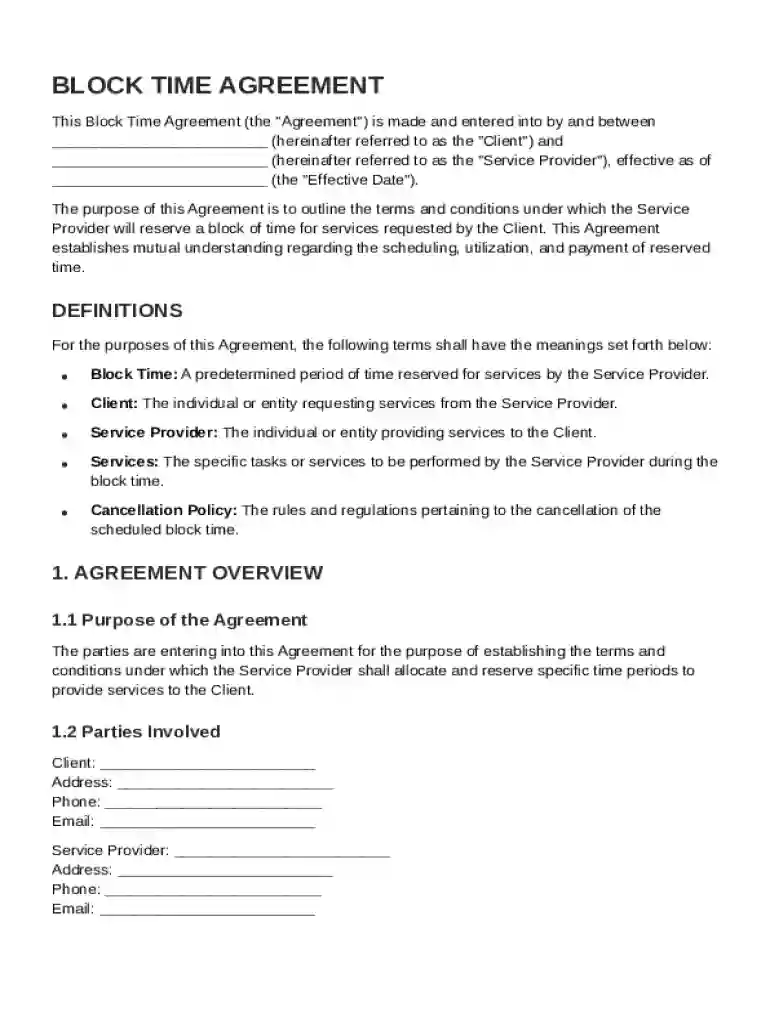
A Block Time Agreement is a contractual arrangement between a Client and a Service Provider that establishes the terms for reserving a specified block of time for services. This template aids in defining the responsibilities, scope, and timeframes related to the services being rendered. It typically comprises various essential elements aimed at ensuring clarity and reducing potential conflicts.
Key Elements:
Real-world Example: A freelance graphic designer uses a Block Time Agreement to book ten hours per month with a client, ensuring ongoing work and pre-arranged compensation.
Utilizing the Block Time Agreement Template involves several clear steps, each designed to ensure the contract aligns with both parties' expectations. This process often requires collaboration and clarity in communication.
Example Scenario: An IT firm uses the template to outline a monthly maintenance contract with a long-standing client, tailoring it to specific network maintenance tasks.
The Block Time Agreement Template provides numerous advantages, chiefly reducing misunderstandings and protecting both parties' interests. It serves as a structured way to outline agreed expectations.
Scenario: A marketing agency frequently uses the template to define project timelines and expectations when hiring freelancers to ensure all client demands are met.
The Block Time Agreement Template encompasses several crucial sections that safeguard both client and service provider interests. These key elements ensure that each important aspect of the engagement is addressed comprehensively.
Scenario: An architect uses these elements to ensure that clients provide all necessary documentation on time, enabling projects to proceed smoothly without delays.
Completing the Block Time Agreement Template involves a structured process to ensure all relevant information is captured accurately. This step-by-step approach assures clarity and completeness.
Practical Tip: A web development firm working on retainer often follows these steps to formalize agreements for ongoing website updates.
Ensuring that the Block Time Agreement is legally enforceable involves adhering to certain legal principles and best practices. This ensures that the document upholds in court if necessary.
Example: A digital marketing agency uses the template aligned with the ESIGN Act, facilitating electronic signatures that are legally binding.
Understanding key terms within the Block Time Agreement is vital for both parties to fully comprehend their roles and responsibilities within the service arrangement.
Example: A healthcare consultant referencing the "Service Period" ensures there is mutual understanding on the duration over which consultancy services will be provided.
Some businesses inherently benefit more from using Block Time Agreement Templates due to the nature of their services and client engagements. This template is particularly useful in industries where services are rendered over specific periods.
Case Study: A digital marketing firm uses block time agreements to establish monthly SEO consultations, providing predictable revenue and workload planning.
At DocHub, your data security is our priority. We follow HIPAA, SOC2, GDPR, and other standards, so you can work on your documents with confidence.





TIME OF ESSENCE. Time is of the essence in Contractors performance of this Agreement. Page 5. Judicial Council of California Agreement No. @# withRead more
Nov 1, 2023 Review the comprehensive terms and conditions governing Adyens payment processing and related services updated November 2023.
May 22, 2026 Learn more about processing hospitality contracts for group meetings, events, team building, trainings, or room blocks.


