Definition & Meaning
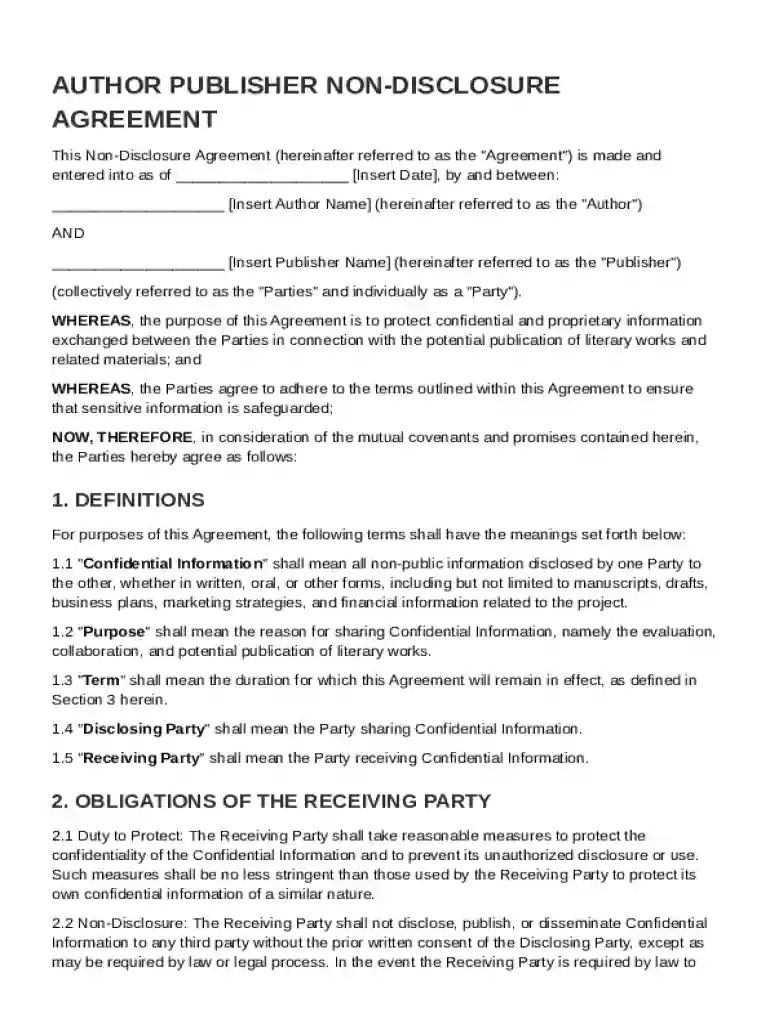
A Non-Disclosure Agreement (NDA) between an author and a publisher is a legal contract intended to protect confidential and proprietary information exchanged during the potential publication of literary works. This NDA ensures that sensitive information remains confidential and establishes the framework for its use. It defines the obligations of parties involved and sets terms for maintaining the confidentiality of proprietary insights, concepts, and draft contents pivotal to the publishing process.
Key Elements of the Author Publisher Non-Disclosure Agreement Template
The NDA template between authors and publishers comprises several essential components:
- Confidential Information: Specifies what constitutes confidential data, including unpublished manuscripts, creative concepts, and marketing strategies.
- Obligations: Details the duties of the receiving party to maintain confidentiality and avoid unauthorized disclosure.
- Exclusions: Lists what information is not subject to confidentiality obligations, such as publicly available data or information already known to the publisher.
- Term and Termination: Outlines the duration of the agreement and conditions under which it can be terminated.
- Governing Law: Indicates which jurisdiction’s laws will govern the agreement.
How to Use the Author Publisher Non-Disclosure Agreement Template
The process of using the NDA template is straightforward:
- Download Template: Obtain the template from a trusted document management platform like DocHub.
- Review and Customize: Carefully read through the template and make necessary modifications to fit the specific needs of the author and publisher.
- Fill in Details: Add pertinent information such as names, project description, and specific confidential information.
- Sign and Execute: Both parties must sign the agreement to ensure it is legally binding. DocHub facilitates electronic signatures that comply with legal standards.
Steps to Complete the Author Publisher Non-Disclosure Agreement Template
Completing the NDA template involves several steps:
- Identify Parties: Clearly state the complete names of the author and publisher involved.
- Define Confidential Information: Specify what information is considered confidential.
- Outline Obligations: Clearly list the responsibilities of the receiving party concerning confidentiality.
- Include Exclusions: Make detailed notes on what information is excluded from the confidentiality agreement.
- State the Term: Define how long the NDA will be in effect.
- Sign the Agreement: Utilize electronic signatures for convenience.
Why Should You Use the Author Publisher Non-Disclosure Agreement Template
Using an NDA template is crucial for several reasons:
- Protection of Intellectual Property: Safeguard unpublished manuscripts and creative concepts.
- Trust in Collaboration: Establish trust between authors and publishers by setting clear expectations regarding confidentiality.
- Legal Recourse: Provide legal recourse if confidential information is misused or disclosed without authorization.
Legal Use of the Author Publisher Non-Disclosure Agreement Template
The NDA serves legal purposes by:
- Defining Legal Boundaries: Establish clear legal parameters for what is considered confidential.
- Providing Evidence: Serve as documented proof of understanding between parties regarding confidentiality obligations.
- Deterring Breaches: Act as a deterrent against unauthorized disclosures due to the legal implications involved.
Important Terms Related to the Author Publisher Non-Disclosure Agreement Template
Understanding certain key terms is essential, including:
- Proprietary Information: Refers to any business or technical information not generally known.
- Breach: Any unauthorized disclosure or misuse of confidential information.
- Indemnification: A clause that ensures compensation for damages resulting from breach of confidential obligations.
Examples of Using the Author Publisher Non-Disclosure Agreement Template
Real-world applications include:
- Authors negotiating with Publishers: An author submits a manuscript to a publisher under an NDA to protect potential commercial interests.
- Collaborative Writing Projects: Multiple authors working on a project might use NDAs to restrict sharing of their collective work.
- Pre-publication Reviews: Publishers reviewing manuscripts before official release sign NDAs to maintain confidentiality within review panels and stakeholders.
State-Specific Rules for the Author Publisher Non-Disclosure Agreement Template
While the NDA template is generally consistent across states, there are variations in:
- Enforceability of Penalty Clauses: Some states may have specific statutes affecting the application of penalty clauses.
- Statutes of Limitations: The time frame within which a breach can be legally contested may differ.
- Governing Law Provisions: The jurisdiction mentioned in the NDA should align with where the parties operate or are located.
By taking these state-specific rules into account, users ensure that their NDAs are valid and enforceable in their jurisdiction.