




01. Edit your form online
Type text, add images, blackout confidential details, add comments, highlights and more.

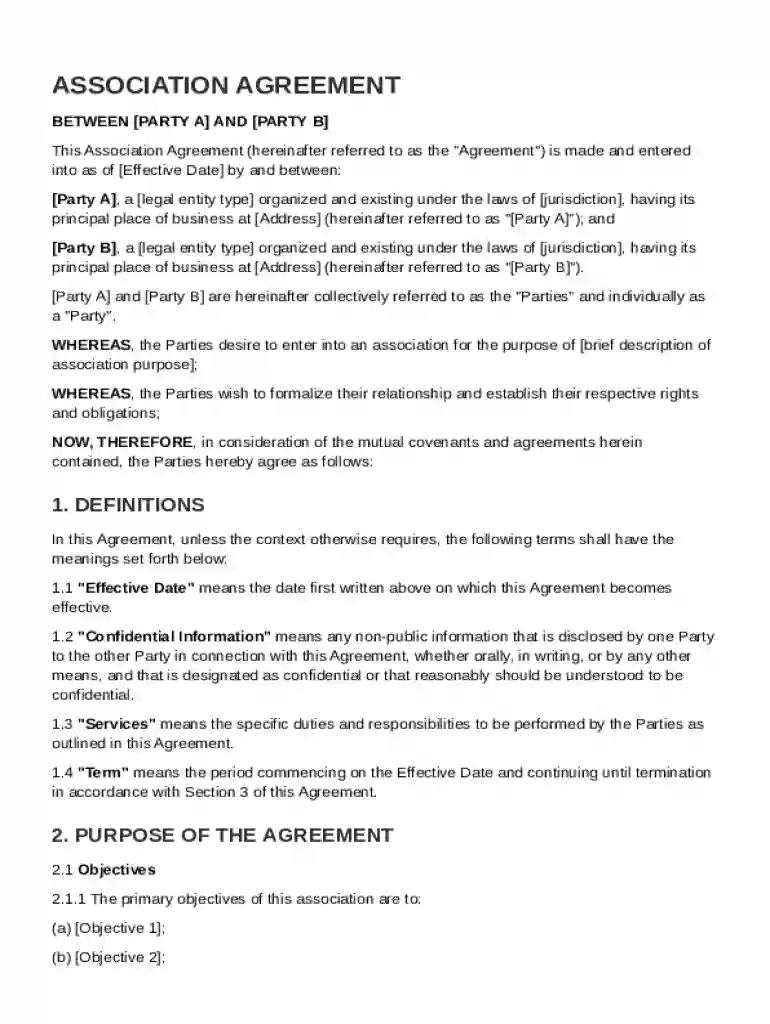
Type text, add images, blackout confidential details, add comments, highlights and more.

Draw your signature, type it, upload its image, or use your mobile device as a signature pad.

Send it via email, link, or fax. You can also download it, export it or print it out.
The Association Agreement Template serves as a foundational document designed to formalize the partnership or collaboration intentions between two parties. It outlines the mutual goals and objectives the parties aim to achieve together. By establishing clear terms, it helps prevent misunderstandings and ensures all participants are aligned with the agreed purposes.
In a typical association agreement, key elements such as responsibilities, timelines, and expectations are clearly defined. For instance, if Party A is responsible for providing certain resources, while Party B handles marketing, each role would be distinctly detailed in the template. This clarity not only aids the participating entities but also provides a structured framework that can be referred back to if disputes arise.
Utilizing the Association Agreement Template is straightforward once you understand its structure and components. Start by identifying and clearly stating the involved parties, their intentions, and the scope of the collaboration. The template typically includes several standard sections that need customization to suit the specific agreement.
Identify the Parties: Clearly list the names and, if applicable, the business titles of the entities involved. This minimizes ambiguity over who the agreement binds.
Define the Purpose: Clearly articulate the reason for the collaboration. Whether it's for a joint venture or a temporary project, specifying the primary goal sets the tone.
Outline Responsibilities: Allocate roles and tasks to each party. This section should include details on the duties each party agrees to undertake.
Specify Financial Arrangements: Include details about any monetary obligations, funding sources, or profit-sharing agreements to avoid future conflicts.
By customizing these sections to fit the parties' requirements, users can create a robust agreement that supports a smooth working relationship.
The Association Agreement Template contains several critical components that should be understood and thoughtfully completed:
Key Terms and Definitions: This section provides clarity on the terminology used throughout the agreement. For example, terms related to proprietary technology should be clearly outlined to avoid any legal ambiguities.
Duration of the Agreement: It should specify the agreement's start and end dates. If the agreement is renewable, include conditions for renewal.
Confidentiality Obligations: Establishes the boundaries for sharing proprietary or sensitive information. Typically, it includes non-disclosure clauses to protect each party.
Dispute Resolution Processes: Outlines how disputes will be managed. Commonly, this would involve mediation or arbitration before any litigation is considered.
These components ensure that both parties are aware of their rights and responsibilities, ultimately protecting their interests throughout the collaboration.
Legal compliance is a central aspect of any agreement. The Association Agreement Template is designed to meet various legal standards to ensure enforceability. As part of U.S. law, agreements must align with federal and state statutes.
Federal Compliance: Ensure adherence to regulations such as the ESIGN Act if electronic signatures are utilized, as they must be legally binding.
State-Specific Laws: Some states have unique requirements for business agreements. Research these differences, as they may affect terms related to employment, confidentiality, and data protection.
Consulting with a legal professional can be invaluable when crafting an association agreement to ensure that all legal aspects are appropriately addressed.
To effectively complete the Association Agreement Template, follow a systematic approach:
Review the Entire Template: Familiarize yourself with all sections and requirements before inputting any details.
Collect Necessary Information: Gather all relevant information and documentation needed for the agreement, such as identification details for all parties involved, financial details, and deadlines.
Input Custom Data: Insert specific data into the template’s placeholders, ensuring all sections are fully completed and accurately reflect the intended agreement.
Review and Revise: Before finalizing, review the document thoroughly to check for errors or omissions. Engage stakeholders and legal advisors in this review process.
Signature and Finalization: Once all parties are satisfied with the content, each must sign the agreement to make it official.
Taking these steps not only expedites the process but also ensures accuracy and legal compliance.
Understanding the terms used within the Association Agreement Template is crucial for all parties involved. Common terms and their meanings:
Party A and Party B: The entities entering into the agreement. Always define these clearly to avoid ambiguities.
Intellectual Property Rights: Who holds ownership of work produced under the agreement and what terms apply.
Non-Compete Clause: Limitations on the parties from engaging in similar business efforts that might conflict with the partnership.
These terms form the building blocks of the agreement and must be explicitly defined to prevent misinterpretation.
Real-world examples can provide context and insight into how the Association Agreement Template is used:
Case Study: Technology Collaboration: Two tech companies partnering to develop a new software product used an association agreement to define intellectual property rights, research responsibilities, and profit-sharing structures.
Example: Joint Marketing Effort: Two retail brands collaborated for a holiday season marketing campaign. The association agreement detailed the contribution from each party, shared costs, and strategies for profit allocation.
These examples demonstrate the flexibility of the template in various contexts and industries, highlighting its utility in aligning diverse business interests.
The Association Agreement Template is employed by a diverse range of entities:
Small to Medium Enterprises (SMEs): Often use this template when entering partnerships to extend market reach or pool resources.
Non-Profits: Collaborate on initiatives for community impact, where formal agreements are necessary to manage joint operations.
Government Agencies and Contractors: Forge alliances for infrastructure projects or service delivery, defining responsibilities and compliance measures.
This template is versatile, serving the needs of entities varying in size and sector, each with unique requirements for collaboration.


State regulations can influence how association agreements are crafted and executed:
California: Stringent privacy laws mean agreements must have well-defined confidentiality clauses to comply with the California Consumer Privacy Act (CCPA).
Texas: Enforcements of non-compete clauses may differ, impacting agreements that involve service-level or ongoing operational metrics.
Understanding these distinctions is crucial when forming agreements involving parties in different states, ensuring all sections align with relevant legislation.
At DocHub, your data security is our priority. We follow HIPAA, SOC2, GDPR, and other standards, so you can work on your documents with confidence.


Each agreement is tailored to meet the needs of the local community and represents the specific activities the core partners have agreed to implement.Read more
Sample Partnership Agreement. THIS PARTNERSHIP AGREEMENT is made this day of . 2XXX , by and between Partner 1 and Partner 2Read more


