






Definition & Meaning
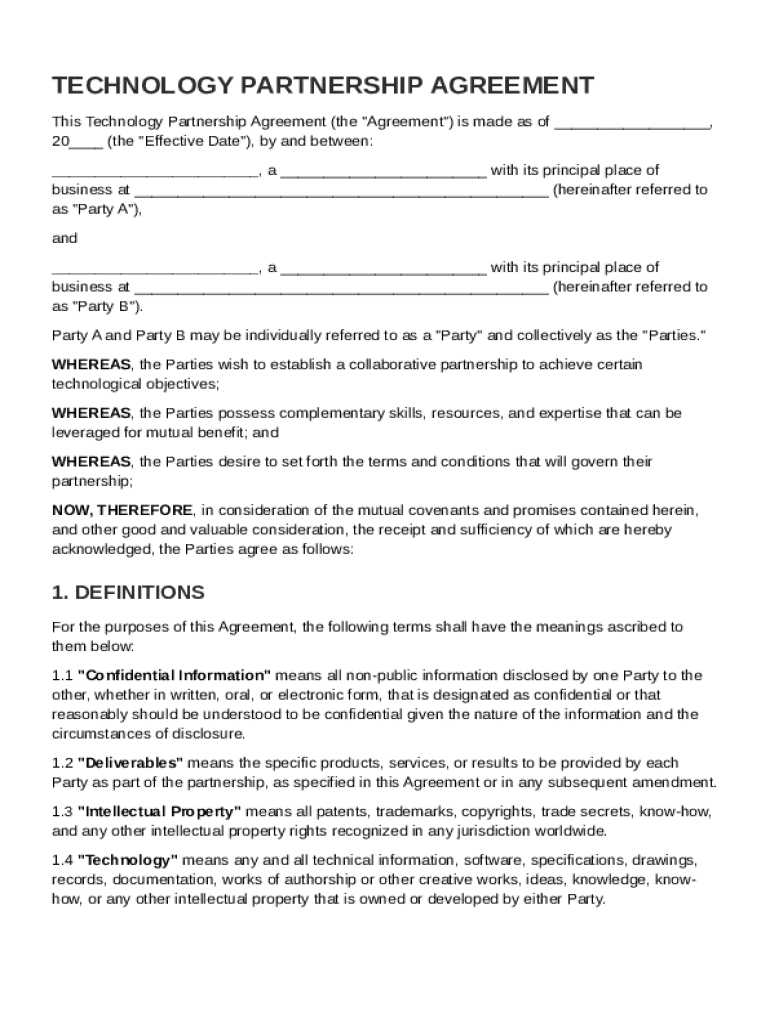
A Technology Partnership Agreement Template is a structured document that outlines the framework for a collaboration between two entities, typically referred to as Party A and Party B, seeking to work together on technological projects. This document details key aspects such as the purpose of the collaboration, terms and conditions, and roles and responsibilities of each party. It encompasses essential elements including Confidential Information, Deliverables, and Intellectual Property rights. The agreement also sets guidelines for Collaborative Objectives, ensuring both parties are aligned on the technological goals and expected outcomes.
Key Elements of the Technology Partnership Agreement Template
A comprehensive Technology Partnership Agreement must include several critical components that facilitate a smooth partnership process:
-
Confidentiality Provisions: These clauses ensure that sensitive information shared during the collaboration is protected. Both parties agree on what is considered confidential and how it should be handled.
-
Intellectual Property Rights: Defines the ownership of existing and newly developed IP as a result of the collaboration. This section is crucial in preventing disputes over proprietary information or technology.
-
Roles and Responsibilities: Clearly outlines the responsibilities of each party, including specific duties, tasks, and contributions. This ensures accountability and clarity.
-
Financial Arrangements: Details the financial commitments, payment terms, and the budget required for the partnership. It might also specify revenue-sharing models if applicable.
-
Dispute Resolution Mechanisms: Provides methods for resolving disagreements, such as mediation or arbitration, to maintain a cooperative relationship and avoid litigation.
-
Termination Conditions: Conditions under which the agreement may be terminated, including breach of contract or completion of objectives.
Steps to Complete the Technology Partnership Agreement Template
-
Identify the Parties Involved: Begin by clearly naming and defining the parties—Party A and Party B—along with their respective roles in the agreement.
-
Define the Collaboration Purpose: Clearly articulate the goals, expected outcomes, and the scope of the technological collaboration.
-
Outline Financial Terms: Detail all financial aspects, including budgets, funding sources, and compensation structures.
-
Draft Confidentiality Clauses: Ensure there are standard confidentiality provisions to protect shared or proprietary information.
-
Address Intellectual Property: Clearly outline the ownership and use of existing and any newly developed intellectual property assets.
-
Set Dispute Resolution Protocols: Define the processes and mechanisms for resolving disputes that may arise during the partnership.
-
Review Termination Clauses: Ensure both parties understand the terms under which the agreement might be terminated.
-
Final Review and Signatures: Conduct a thorough review by legal experts from both parties and finalize the agreement with signatures from authorized representatives.
Why Use the Technology Partnership Agreement Template
Utilizing a Technology Partnership Agreement Template offers several advantages:
-
Clarity and Consistency: The template ensures all critical areas are covered consistently, providing clear expectations and responsibilities for both parties.
-
Legal Compliance: Adhering to legal standards and practices minimizes risks and mitigates potential conflicts.
-
Efficiency: Using a template streamlines the process of drafting agreements, saving time and resources that would otherwise be spent starting from scratch.
-
Protection of Interests: Safeguarding intellectual property and confidential information through pre-designed clauses helps protect the interests of all involved parties.
Who Typically Uses the Technology Partnership Agreement Template
This template is widely used across various sectors:
-
Tech Companies and Startups: Often employed when two tech companies collaborate on a new product or service.
-
Research Institutions and Universities: Utilized when sharing research findings or developing new innovations with external partners.
-
Government Agencies: Occasionally used for public-private technology initiatives or development projects with tech companies.
-
Consultancy Firms: When providing expertise or services that require detailed collaboration outlines.


Examples of Using the Technology Partnership Agreement Template
Real-world scenarios where this template can be employed include:
-
Joint Development Projects: Two software companies come together to create a new application, sharing resources and expertise.
-
Research Collaboration: A tech company partners with a university to develop innovative solutions using advanced research.
-
Supply Chain Technological Enhancements: Manufacturers collaborating with a tech company to integrate new technologies into their supply chains.
-
Public-Private Partnerships: Tech firms working with government entities to boost technological infrastructure development.
Legal Use of the Technology Partnership Agreement Template
Legal considerations for the use of this template include:
-
Confidentiality Compliance: Ensuring any shared confidential information is adequately protected from unauthorized disclosure.
-
Regulatory Compliance: Adhering to relevant laws and regulations, particularly those related to data protection and intellectual property.
-
Contractual Validity: Ensuring the agreement is legally binding, aligns with state and federal laws, and is signed by authorized representatives from both parties.
State-Specific Rules for the Technology Partnership Agreement Template
While the general framework of the agreement remains consistent, certain state-specific regulations may apply, such as:
-
Data Protection and Privacy Laws: Vaguely differ by state, necessitating adjustments to sections dealing with data handling and protection.
-
Intellectual Property Rights: State laws may influence specific clauses related to ownership and licensing of technology and content.
-
Enforcement and Dispute Resolution: The preferred or legal methods for handling disputes might be influenced by state regulations, often requiring adaptation to reflect local mandates.
Understanding these state variations can ensure the partnership agreement is both effective and compliant across different jurisdictions.