




01. Edit your form online
Type text, add images, blackout confidential details, add comments, highlights and more.

Type text, add images, blackout confidential details, add comments, highlights and more.

Draw your signature, type it, upload its image, or use your mobile device as a signature pad.

Send it via email, link, or fax. You can also download it, export it or print it out.
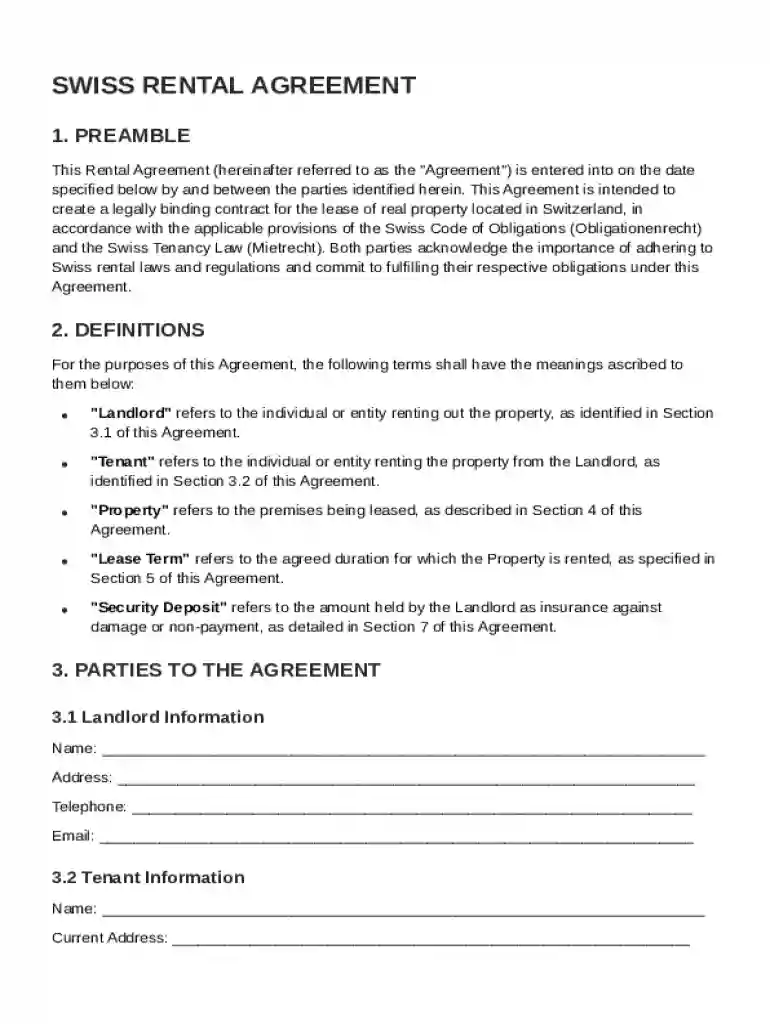
The "Swiss Rental Agreement Template" serves as a foundational document that outlines the terms and conditions for leasing real estate in Switzerland. This template is designed to conform with Swiss rental laws and ensures a legally binding contract between the landlord and tenant. It provides clarity on various aspects such as the property in question, responsibilities of the involved parties, and the financial terms of the arrangement. Utilizing such a template helps both parties understand their rights and obligations, reducing the potential for disputes.
Typically, the agreement will include sections detailing the property description, the duration of the lease, and any special conditions that may apply. Definitions within the document clarify terms to prevent ambiguity, ensuring both landlord and tenant have a mutual understanding of their agreement.
The Swiss Rental Agreement Template contains several vital components that must be understand for successful execution:
Property Description: This section provides a detailed account of the rental property, including its exact address and any specific features or furnishings included in the lease.
Parties Involved: Clearly delineates information about both the landlord and tenant, including contact details and any representatives acting on their behalf.
Lease Term: Specifies the duration for which the property is being leased. This includes both the start and end dates of the tenancy agreement.
Rent Payment Details: Outlines the monthly rent amount, due dates, acceptable payment methods, and consequences of late payment.
Security Deposit Requirements: Details the amount required as a security deposit, its purpose, and the conditions under which it may be returned or forfeited.
Rights and Obligations: Enumerates the duties of each party, including maintenance responsibilities and property usage regulations.
Termination Conditions: Describes the protocol for ending the lease, including the notice period and any penalties for early termination.
Governing Law: Asserts that Swiss law will govern the agreement, stating the jurisdiction in which disputes will be resolved.
Additional Provisions: Any other agreements or peculiarities specific to the rental arrangement not covered in standard clauses.
Completing a Swiss Rental Agreement Template involves several straightforward steps that ensure accuracy and legal adherence:
Review the Template: Familiarize yourself with the entire document to understand what information is required.
Enter Property Details: Fill in the exact address and description of the property. Accuracy here is crucial to avoid misunderstandings.
Identify the Parties: Clearly list the names and contact details of both the landlord and tenant, including any representatives if applicable.
Specify the Lease Term: Indicate the start and end dates of the lease. Check local regulations to ensure the term complies with Swiss rental norms.
Define Rent Payments: Clearly outline the rental amount, due dates, and payment methods to set clear expectations for financial transactions.
Outline Security Deposit Terms: Specify the amount, usage, and return conditions to protect both parties' financial interests.
State Rights and Duties: Clearly articulate the obligations of each party concerning property maintenance and conduct within the premises.
Include Termination Clauses: Detail the procedure for lease termination, including required notice periods and financial or legal penalties.
Legally, the Swiss Rental Agreement renders the lease contractually binding, offering protection under Swiss laws for both tenants and landlords.
Compliance: Ensures compliance with Swiss federal and cantonal regulations, providing a legal framework that backs the lease terms.
Enforcement: The document can be used in legal proceedings to enforce terms, should disputes arise.
Adaptability: While the template serves as a starting point, customization is necessary to adapt to specific agreements without violating legal requirements.
Being mindful of Swiss tenancy laws ensures that the agreement holds weight in legal contexts, thereby safeguarding the interests of all parties involved.
Utilizing a Swiss Rental Agreement Template offers multiple advantages that can facilitate smoother interactions between landlords and tenants:
Efficiency: Streamlines the drafting process, saving time and reducing the chance of overlooking critical elements.
Clarity: Provides a clear, structured format that both parties can understand, reducing the risk of disputes arising from misinterpretations.
Legal Assurance: Aligns with Swiss laws, offering legal protection and mitigating potential risks associated with informal agreements.
Convenience: Pre-designed templates require minimal modification and can be tailored to specific situations, ensuring applicability across varied rental scenarios.
In essence, the use of this template simplifies the leasing process while ensuring legal compliance and providing clarity for all parties involved.
Obtaining a Swiss Rental Agreement Template can be done through various channels:
Online Legal Platforms: Numerous websites offer downloadable templates designed to comply with Swiss laws.
Legal Advisors: Consulting a Swiss property lawyer can provide tailored templates, ensuring all legal standards are met.
Real Estate Agencies: Many agencies provide templates as part of their service offerings, often included in their standard leasing packages.
Having access to this template facilitates uniformity and fairness in rental agreements, ensuring a smooth and legally compliant leasing process.
The Swiss Rental Agreement Template is utilized by various individuals and entities involved in real estate transactions:
Landlords: Property owners use the template to formalize their leasing terms, ensuring they comply with legal standards.
Tenants: Prospective tenants use it to understand and negotiate their lease terms before signing.
Real Estate Agents: Professionals in real estate utilize it to streamline transactions and ensure both parties have a clear understanding of their agreement.
Property Managers: Those overseeing residential or commercial properties use the template to maintain consistency in property leases.
In each context, the template serves to protect interests and provide a clear structure for property leasing.


At DocHub, your data security is our priority. We follow HIPAA, SOC2, GDPR, and other standards, so you can work on your documents with confidence.


