




01. Edit your form online
Type text, add images, blackout confidential details, add comments, highlights and more.

Type text, add images, blackout confidential details, add comments, highlights and more.

Draw your signature, type it, upload its image, or use your mobile device as a signature pad.

Send it via email, link, or fax. You can also download it, export it or print it out.
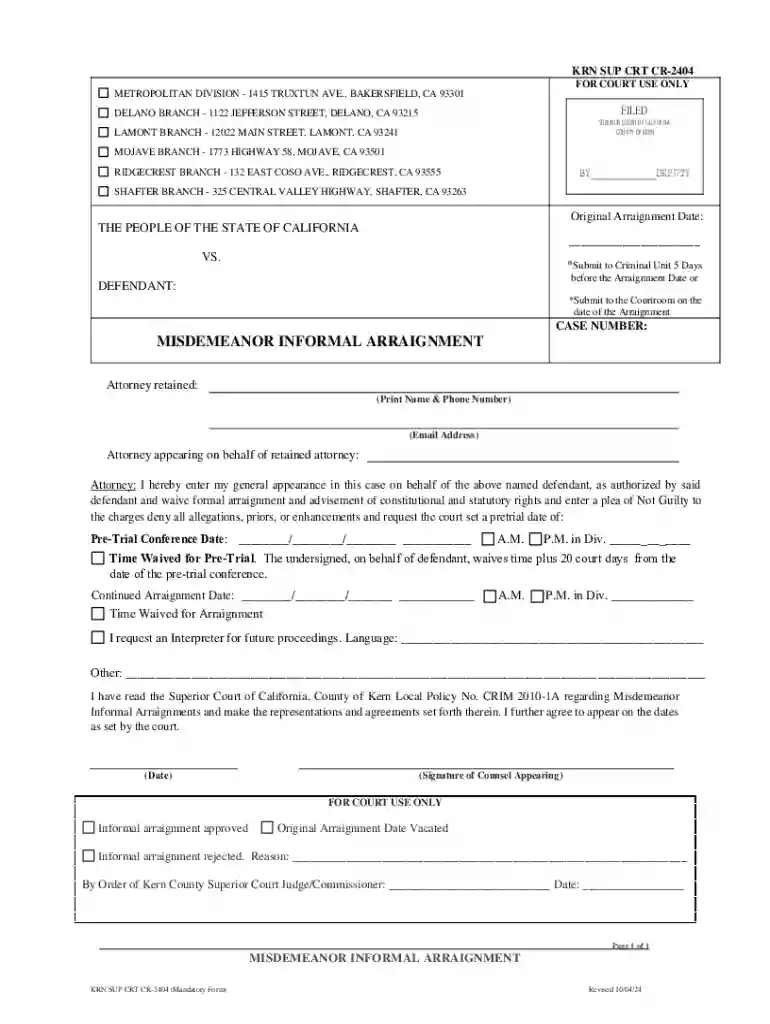
An informal arraignment by a defendant attorney represents a preliminary court proceeding where a defendant, through legal representation, addresses charges brought against them. This proceeding occurs in misdemeanor cases within the state's judicial system. It is vital in ensuring the defendant's right to understand the charges, the legal process ahead, and allows the attorney to advise the client on optimal plea options. Significantly, this process highlights the legal nuances tailored to individual cases, where attention to detail is critical for developing a sound defense strategy.
Review Charges: Begin by thoroughly reviewing the charges outlined in the document. Understanding the allegations is crucial for determining the appropriate legal strategy.
Plea Entry: Decide whether to plead guilty, not guilty, or no contest. This decision should be based on a comprehensive analysis of the situation, legal advice, and potential consequences.
Schedule Pre-Trial Conferences: Work with the court to schedule pre-trial conferences, which are pivotal for discussing case details and potential resolutions with the prosecutor.
Waive Time if Necessary: Decide whether you need more time for case preparation. Waiving time for arraignment and pre-trial can help in strategically planning defense mechanisms.
Request an Interpreter if Required: For non-native English speakers, requesting an interpreter ensures clear communication throughout the legal proceedings.
Defendant’s Personal Information: Including full name, contact details, and legal representation details, ensuring accurate identification in legal records.
Charge Details: List of misdemeanor charges faced by the defendant, which must be understood thoroughly for effective legal representation.
Legal Representation Declaration: An acknowledgment that the defendant has chosen to proceed with legal counsel, fundamental for courtroom advocacy.
Plea Options and Entry: Outlines the available pleas, facilitating informed decisions with legal guidance.
Time Waiver Options: Options for waiving specific timelines, allowing the defense to adequately prepare for the forthcoming legal process.
The informal arraignment serves several legal purposes. It ensures that defendants are informed of their rights and charges, offers opportunities to enter a plea, and initiates the legal process efficiently. In jurisdictions like California, this step respects the legal rights afforded to defendants, maintaining a balance between judicial efficiency and individual rights.
In California, informal arraignments in misdemeanor cases follow specific rules unique to the state’s judicial framework. Legal practitioners must comprehend local guidelines, which may include particular document formats, filing requirements, and time constraints. Understanding these nuances is vital for compliance and strategic planning.
This form is primarily utilized by legal professionals representing clients in misdemeanor cases. Defendants with appointed or hired attorneys will engage in this process, seeking to address legal challenges efficiently. The form is a critical tool for defendants in addressing charges through informed legal representation, guiding decision-making, and interacting strategically with the judicial system.


Consider a case where a defendant is charged with a misdemeanor crime, such as petty theft. During the arraignment, the attorney might review the charges and evidence, discuss plea options with the client, and determine whether additional preparation time is required. The attorney could waive time strategically, allowing for evidence collection and witness interviews, thus influencing the case outcome positively.
We've got more versions of the Informal Arraignment by Defendant Attorney form. Select the right Informal Arraignment by Defendant Attorney version from the list and start editing it straight away!
| Versions | Form popularity | Fillable & printable |
|---|---|---|
| 2024 | 4.7 Satisfied (50 Votes) |
At DocHub, your data security is our priority. We follow HIPAA, SOC2, GDPR, and other standards, so you can work on your documents with confidence.



Defense attorneys must carefully craft arguments that uphold their client?s innocence, counteract the spouse?s guilt, and respect ethical boundaries. Meanwhile,Read more
Typically, the prosecution gives the defense lawyer the initial discovery at the arraignment. It often includes the police report along with other materialsRead more


