






Definition & Meaning
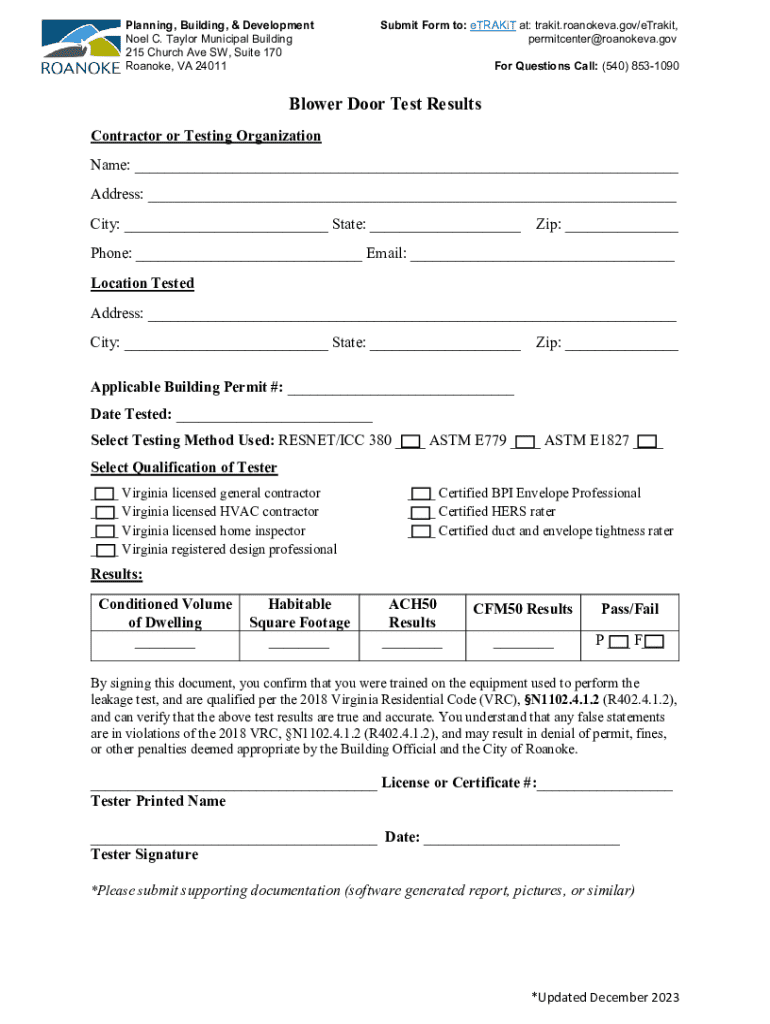
Blower Door Test Results for Roanoke, VA are documents that capture the outcomes of a blower door test conducted on a building to assess its air infiltration levels. The test measures the building's airtightness and is critical in determining energy efficiency and identifying potential improvements. Typically, these tests are a requirement for ensuring compliance with the 2018 Virginia Residential Code. The results provide a detailed analysis of the air leakage rate and highlight areas where sealing may be necessary.
Key Elements of the Blower Door Test Results Roanoke, VA
The Blower Door Test Results document consists of several crucial components:
- Building Information: Includes details like the address, building type, and size.
- Test Equipment Used: Notes about the model and calibration of the blower door equipment.
- Testing Conditions: Environmental conditions during the test such as wind speed, temperature, and humidity.
- Air Leakage Measurements: Data on air changes per hour at a specific pressure (usually 50 Pascals).
- Compliance Indication: Shows if the building meets the standards set by the 2018 Virginia Residential Code.
How to Use the Blower Door Test Results Roanoke, VA
Upon receiving the Blower Door Test Results, building owners or contractors can:
- Review Air Leakage Rates: Assess the detailed readings to understand the extent of any air leaks.
- Identify Problem Areas: Use the results to pinpoint areas that may need additional sealing or insulation.
- Plan for Improvements: Formulate a strategy to enhance energy efficiency based on identified issues.
- Confirm Compliance: Ensure that readings meet or exceed the regulatory criteria established by local building codes.
Steps to Complete the Blower Door Test Results Roanoke, VA
- Setup: Install the blower door equipment according to manufacturer instructions to ensure accurate measurements.
- Pre-Test Inspection: Conduct a walkthrough to close all exterior openings and interior doors.
- Perform the Test: Execute the test by adjusting the fan to create a specific pressure difference.
- Record Results: Document readings of air changes per hour and other relevant data.
- Analyze Data: Evaluate the results to determine the building’s airtightness.
- Finalize Documentation: Complete the Blower Door Test Results form with all gathered information.
- Review for Compliance: Ensure test results are compliant with state codes and standards.
Who Typically Uses the Blower Door Test Results Roanoke, VA
The results of a blower door test are utilized by:
- Contractors: To verify workmanship and ensure buildings meet energy efficiency standards.
- Homeowners: Looking to improve their property's energy efficiency.
- Energy Auditors: For conducting energy assessments and issuing efficiency recommendations.
- Regulatory Bodies: To verify compliance with building codes and standards.


Legal Use of the Blower Door Test Results Roanoke, VA
Legally, blower door test results can be a requirement in Roanoke, VA under the local enforcement of the 2018 Virginia Residential Code. They verify:
- Compliance: Demonstrating that a building meets all relevant energy efficiency requirements.
- Certification: Providing proof to certification bodies for energy efficiency ratings or labels.
State-Specific Rules for the Blower Door Test Results Roanoke, VA
Virginia mandates specific conditions under which blower door tests must be carried out, such as:
- Regulatory Guidelines: Following the stipulations of the 2018 Virginia Residential Code.
- Professional Qualifications: Ensuring that only certified professionals conduct these tests.
- Documentation Standards: Submission of precise and fully completed test results for regulatory review.
Examples of Using the Blower Door Test Results Roanoke, VA
Example scenarios might include:
- Pre-Purchase Inspections: Buyers requesting tests to ensure the home meets energy standards.
- Renovations: Contractors using tests to assess changes after insulating or sealing the property.
- Code Compliance Checks: Builders requiring results to sign off on new constructions.
Required Documents
When preparing for a blower door test, the following documents are essential:
- Building Plans: For reference during the inspection.
- Calibration Certificates: To authenticate the accuracy of testing equipment.
- Previous Test Results: If applicable, for comparison and continuity.
Form Submission Methods (Online / Mail / In-Person)
The Blower Door Test Results can generally be submitted through:
- Online Portals: Many jurisdictions offer electronic submissions for faster processing.
- Mail: Traditional submission through postal services if digital options are unavailable.
- In-Person: Physical handover for immediate questions or confirmations with local authorities.