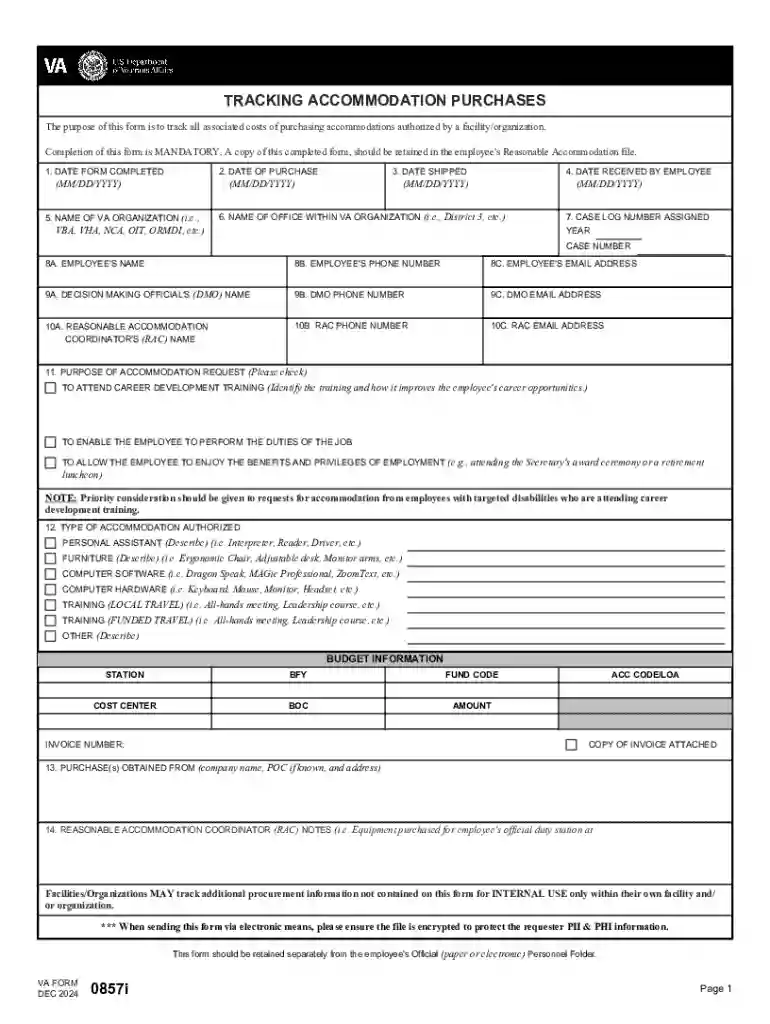
Tracking Accommodation Purchases 2026

Get Form
Tracking Accommodation Purchases Preview on Page 1

Here's how it works

01. Edit your form online
Type text, add images, blackout confidential details, add comments, highlights and more.

02. Sign it in a few clicks
Draw your signature, type it, upload its image, or use your mobile device as a signature pad.

03. Share your form with others
Send it via email, link, or fax. You can also download it, export it or print it out.

Definition and Purpose of Tracking Accommodation Purchases

Tracking Accommodation Purchases is a comprehensive form used by facilities or organizations to meticulously document all expenses related to authorized accommodation purchases. This form is essential for maintaining a transparent record of financial transactions tied to providing accommodations, often in a workplace setting. By tracking these purchases, organizations ensure compliance with financial regulations and equitable allocation of resources. The form typically includes sections for purchase details, employee information, and authorization by decision-making officials. This documentation is critical, especially for prioritizing accommodations for employees with targeted disabilities, ensuring equitable and justified support.

How to Use the Tracking Accommodation Purchases Form

Effectively utilizing the Tracking Accommodation Purchases form requires a structured approach:

  1. Collect Relevant Information: Gather all necessary details, including purchase dates, types of accommodations, involved personnel, and purchase receipts.
  2. Document Employee Information: Enter the names, positions, and relevant identifiers of employees requesting or receiving accommodations.
  3. Record Purchase Details: Capture specific information regarding the accommodation type, cost, and provider details to ensure thorough documentation.
  4. Authorization: Ensure the form is reviewed and signed by authorized officials to validate the purchase and maintain compliance with organizational policies.
  5. Secure and Store: After completion, store the form in the employee’s Reasonable Accommodation file, ensuring easy access for future reference or audits.

This systematic approach helps organizations maintain comprehensive records and optimize their accommodation processes.

Steps to Complete the Tracking Accommodation Purchases

Completing the Tracking Accommodation Purchases form involves several critical steps:

  1. Preparation of Documentation: Before beginning, gather all invoices, receipts, and authorization letters related to the accommodation purchase.
  2. Filling Out the Form:
    • Employee Details: Enter full names, roles within the organization, and employee identification numbers.
    • Purchase Description: Provide clear details about the accommodation purchased, including model numbers or specifications if applicable.
    • Cost Details: Log each item’s cost and total expenditure for the purchase.
  3. Approval Process:
    • Decision-Maker Authorization: Obtain signatures from officials who authorized the initial purchase to confirm their approval.
    • Review by Supervisors: Ensure that supervisors verify the requests and compliance with allocation policies.
  4. Finalizing: Double-check for completeness and accuracy before submitting the document for record-keeping.

By following these steps, organizations can efficiently complete the form, ensuring clarity and accuracy.

Key Elements of the Tracking Accommodation Purchases

Each Tracking Accommodation Purchases form must incorporate specific key elements to ensure its effectiveness:

  • Employee Information: Identification details of the employee requiring accommodation, including their department and position.
  • Accommodation Details: Specifics about the type of accommodation, its intended use, and necessity.
  • Cost and Vendor Information: Comprehensive details on the vendor providing the accommodation and the total cost involved.
  • Authority Confirmation: Signature blocks for decision-making officials who authorize and approve the purchase.
  • Compliance Checkpoints: Sections ensuring that the purchase aligns with legal and organizational guidelines, particularly focusing on disability accommodations.

These elements not only enhance the form's completeness but also streamline the financial tracking process.

Importance of Tracking Accommodation Purchases

Utilizing the Tracking Accommodation Purchases form is crucial for several reasons:

  • Transparency: Offers a detailed audit trail for all accommodation-related expenses, promoting financial transparency.
  • Budget Management: Assists in monitoring and controlling budget allocations for employee accommodations.
  • Legal Compliance: Ensures that the organization complies with relevant laws, particularly related to disability rights, by substantiating that accommodations are provided fairly and equitably.
  • Prioritizing Needs: Helps prioritize accommodations, especially for employees with targeted disabilities, ensuring that resources are allocated to those in most need.

By fulfilling these roles, the form is indispensable for responsible management and accountability in workplace accommodations.

Who Typically Uses the Tracking Accommodation Purchases

The Tracking Accommodation Purchases form is generally employed by:

  • Human Resources Departments: HR teams use this form to manage and document employee accommodation needs and related expenses.
  • Financial Officers: Officials responsible for budgeting and expenditures use the form to ensure accountability and transparency in financial practices.
  • Compliance Teams: Ensures that workplace accommodations meet legal requirements and organizational policies.
  • Employee Supervisors: Supervisors may engage with the form to validate and approve accommodations for team members.

These departments work collaboratively using the form to maintain a balanced and fair approach to workplace accommodations.


decoration image ratings of Dochub

Legal Use and Compliance with Tracking Accommodation Purchases

Ensuring legal compliance is a critical aspect of using the Tracking Accommodation Purchases form:

  • Adherence to Regulations: The form must align with U.S. laws governing workplace accommodations, such as the Americans with Disabilities Act (ADA).
  • Document Retention: Organizations are required to maintain thorough records, helping in audits concerning the allocation of accommodations.
  • Verification by Legal Teams: Legal departments should regularly review completed forms to ensure ongoing compliance with statutory requirements.
  • Implementing Controls: Regular checks and balances must be in place to prevent misuse or misallocation of accommodation resources.

Legal compliance is vital not only for adherence to regulations but also for fostering an inclusive work environment.

Examples of Using the Tracking Accommodation Purchases

Consider practical scenarios to understand the application of the Tracking Accommodation Purchases form:

  • Employee with a Disability: A company purchases an ergonomic chair for an employee with a back condition. The form records the purchase details, cost, and authorization, ensuring the accommodation is prioritized.
  • Remote Work Setup: An employee requiring remote work capabilities due to a medical condition might need specialized equipment that is meticulously documented using the form.
  • Adaptive Technology: Purchasing screen readers or voice recognition software for employees with vision impairments involves detailed recording of purchases in the form, ensuring the organization's commitment to accessibility.

These examples illustrate how the form supports diverse accommodation needs within a structured framework.

be ready to get more

Complete this form in 5 minutes or less

Get form

Got questions?

We have answers to the most popular questions from our customers. If you can't find an answer to your question, please contact us.
Contact us
In this chapter, accommodations are organized into four categories: Presentationhow students receive information, Respondinghow students show what they know, Settinghow the environment is made accessible for instruction and assessment, and Schedulinghow time demands and schedules may be adjusted.
Accommodations are typically grouped into four categories: presentation, response, setting, and timing and scheduling. The table below summarizes the relationship between barriers related to learning and the corresponding accommodation categories, and it also provides examples of accommodations for each category.
0:14 0:58 And they will constrict. So lets see if we can get this captured on film. So Im staring at theMoreAnd they will constrict. So lets see if we can get this captured on film. So Im staring at the object. Its far its an arms length. Away.
Commonly Utilized Accommodations Electronic copies of notes, handouts, overheads, or chalkboard notes. Use of a scribe or note taker. Seating locations (close to the chalkboard or screen) Tape-recorded lectures. Taped textbooks. Alternate test format: oral, Braille, or large print.
Accommodations and modifications are types of adaptations that are made to the environment, curriculum, instruction, or assessment practices in order for students with disabilities to be successful learners and to actively participate with other students in the general education classroom and in school- wide activities

Security and compliance

At DocHub, your data security is our priority. We follow HIPAA, SOC2, GDPR, and other standards, so you can work on your documents with confidence.

Learn more
ccpa2
pci-dss
gdpr-compliance
hipaa
soc-compliance