






Definition & Meaning
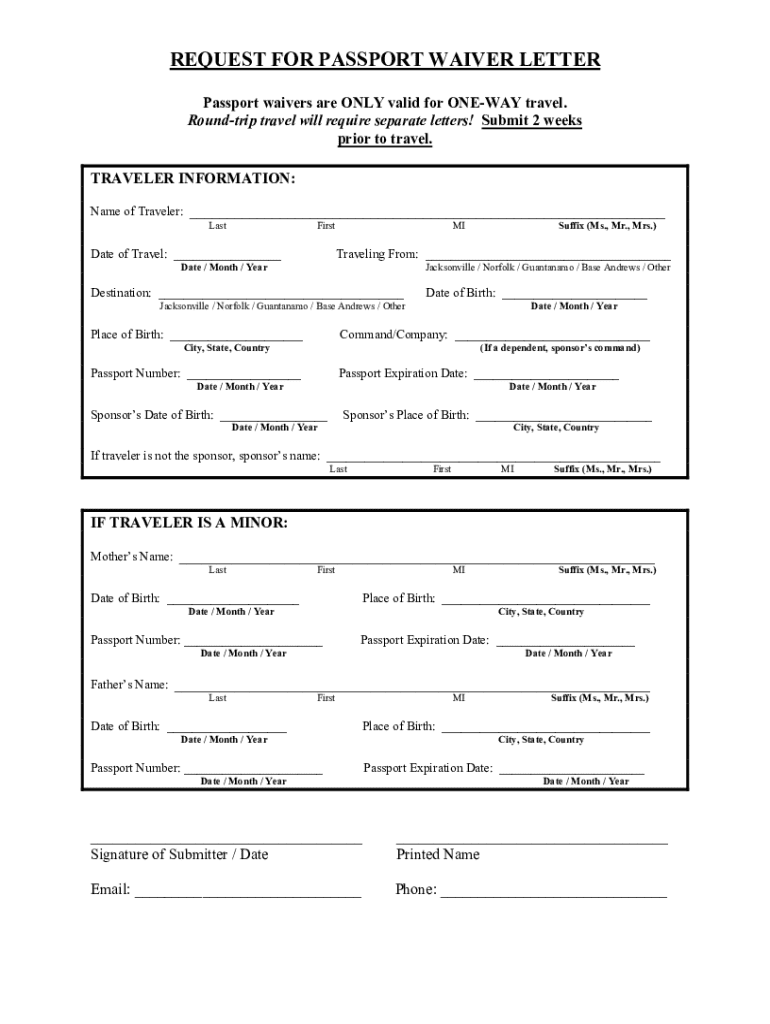
The "Request for Passport Waiver Letter" is a formal document primarily used for cases where standard passport requirements may be waived for specific travel situations. Typically, this document is relevant for individuals who cannot obtain a passport in the usual manner but must undertake international travel, usually one-way. The waiver is not a substitute for a passport but allows travel under special circumstances, often needing endorsement by valid authorities.
In practical terms, the form serves as an official statement requesting an exemption from standard passport requirements, often tied to emergency or extraordinary circumstances. When this document is accepted by the relevant authorities, it authorizes the applicant to travel without a traditional passport, acknowledging that the situation justifies such an exemption.
Who Typically Uses the Request for Passport Waiver Letter
The primary users of this waiver form include individuals who face difficulties acquiring a passport. This may include:
- Minors: Children who cannot obtain a passport due to complex custody situations.
- Emergency Travelers: Individuals needing to travel urgently due to family emergencies, medical reasons, or other unforeseen events.
- Military Personnel: Service members who require immediate deployment to regions where passports are typically mandatory.
- Sponsored Travelers: Individuals who need urgent travel arrangements facilitated by a sponsor without a passport.
Each category of users will need to provide substantiated reasons and documentation to justify their request for a waiver.


How to Obtain the Request for Passport Waiver Letter
To secure this letter, individuals must typically follow these steps:
- Identify the Need: Clearly establish why a passport cannot be obtained through regular channels and why the waiver is necessary.
- Gather Documentation: Collect supporting documents such as birth certificates, letters from sponsors, or emergency verification documents.
- Contact Relevant Authorities: Reach out to governmental or military authorities that issue such waivers, as requirements may vary.
- Complete Form: Fill in the form with accurate personal details, travel information, and reasons for request.
- Submit with Supporting Documents: Send the completed form and documentation to the relevant authority, ensuring it’s approximately two weeks before travel when possible.
Steps to Complete the Request for Passport Waiver Letter
Completing this form entails several precise steps to ensure all necessary information is provided:
- Personal Information: Fill out details such as name, address, date of birth, and other identification specifics.
- Travel Details: Include dates and destinations of travel, emphasizing the reasons why normal passport processes cannot be followed.
- Sponsor Information: If applicable, provide information about any sponsoring entity, outlining their role and justification for support.
- Additional Information for Minors: If the applicant is a minor, furnish details about parental permissions or custody circumstances.
- Review and Affirmation: Ensure all entered data is correct and sign the form, where necessary, to affirm that information is true and complete.
Required Documents
Several documents are often required to accompany the waiver form:
- Identity Proof: Such as a driver's license or birth certificate.
- Emergency Documentation: Hospital records, affidavits, or letters confirming the urgency.
- Sponsorship Letters: Written agreements or endorsements from sponsors or organizations.
- Parental Consent Forms: In cases involving minors, legal documents proving consent from guardians.
Legal Use of the Request for Passport Waiver Letter
The waiver letter serves a specific legal function, allowing authorized travel under special circumstances where obtaining a passport is not feasible. Legally, this form must be supported by valid documentation and is subjected to scrutiny by the issuing body. Acceptance of the waiver is contingent upon meeting all prescribed guidelines which justify the need for an exception.
Users of the form must ensure they do not misuse it, as legal ramifications can be significant, including rejection of travel permissions and potential penalties.
Form Submission Methods (Online / Mail / In-Person)
Submission of the Request for Passport Waiver Letter can often be done through multiple channels:
- Online Submission: Some agencies might offer digital submission through secure portals, requiring scanned documents.
- Mail Submission: Allows for sending physical copies of the completed form and supporting documents via postal services.
- In-Person Delivery: Submitting the form directly at government or issuing agency offices can sometimes expedite the process, ensuring immediate handling and confirmation of receipt.
Penalties for Non-Compliance
Failure to comply with the requirements of the Request for Passport Waiver Letter can result in several penalties:
- Travel Denial: The most immediate consequence could be the inability to undertake the intended travel.
- Fines: In some cases, if the waiver process is misused or falsified documentation is submitted, fines or legal penalties can apply.
- Ineligibility for Future Waivers: Non-compliance can lead to being barred from requesting waivers in the future, making subsequent travel more challenging.
Key Elements of the Request for Passport Waiver Letter
Certain features are crucial for drafting a comprehensive and appropriate waiver letter:
- Clarity of Purpose: Clearly convey the necessity for travel without a conventional passport.
- Approval Endorsements: Gather necessary consent or support from sponsors or related authorities.
- Factually Accurate: Ensure all provided information is truthful and verifiable.
- Timeliness: Submitting in advance, respecting the timeline of two weeks prior to departure.
Understanding and applying these key elements helps streamline the process and increases the likelihood of obtaining the passport waiver successfully.