6610 Oboe Fingering Worksheet 1 - MrSnell-2026

Get Form
6610 Oboe Fingering Worksheet 1 - MrSnell Preview on Page 1

Here's how it works

01. Edit your form online
Type text, add images, blackout confidential details, add comments, highlights and more.

02. Sign it in a few clicks
Draw your signature, type it, upload its image, or use your mobile device as a signature pad.

03. Share your form with others
Send it via email, link, or fax. You can also download it, export it or print it out.

Definition & Meaning

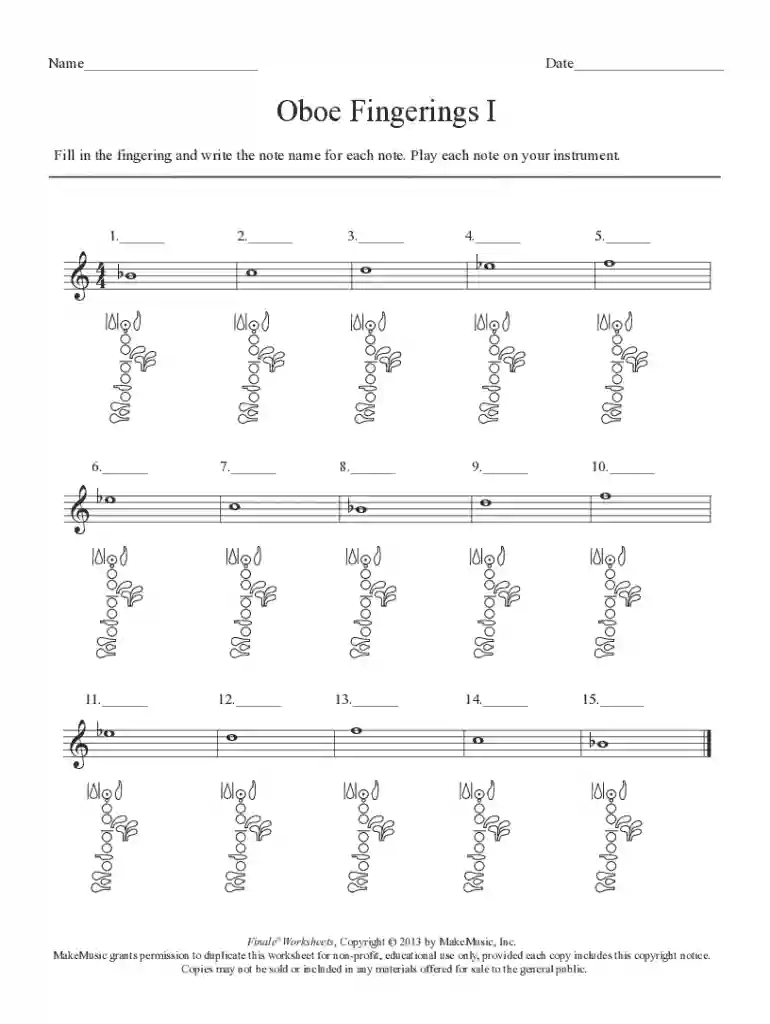
The "6610 Oboe Fingering Worksheet 1 - MrSnell" serves as an educational tool specifically designed for oboe players. Its primary purpose is to assist students in learning and mastering fingerings for various notes on the oboe. The worksheet provides a structured format where learners can fill in the appropriate fingerings and note names as they practice playing them. This resource is essential in developing a comprehensive understanding of how to effectively play the oboe, thereby enhancing both technical skills and musical literacy.

How to Use the 6610 Oboe Fingering Worksheet 1 - MrSnell

To maximize the benefits of this worksheet, users should:

  1. Begin by familiarizing themselves with the oboe and its mechanics.
  2. Carefully fill in each fingering chart with the appropriate information, making sure to verify that the entered fingerings correspond to the correct notes.
  3. As students play the instrument, they should continuously reference the worksheet to ensure accuracy and consistency in finger positioning.
  4. Use the worksheet as a practice guide to track progress and identify areas for improvement.

By integrating this worksheet into daily practice routines, students can solidify their understanding and enhance their performance skills.

Key Elements of the 6610 Oboe Fingering Worksheet 1 - MrSnell

Several crucial components make up this worksheet, each contributing to its effectiveness:

  • Fingering Charts: Detailed sections that require students to fill in fingerings for notes, aiding in the visualization and memory of correct positions.
  • Note Names: Spaces designated for writing out note names alongside their corresponding fingerings, reinforcing the connection between sound and technique.
  • Practice Instructions: Guidelines on how to effectively use the worksheet in personal practice sessions or classroom settings.

These elements collectively help in building foundational skills necessary for proficient oboe playing.

Steps to Complete the 6610 Oboe Fingering Worksheet 1 - MrSnell

  1. Review Basics: Before starting, ensure a solid understanding of basic oboe fingerings.
  2. Fill Out Fingerings: Write in the fingerings for each note carefully, double-checking accuracy.
  3. Play and Validate: Use the oboe to play each note, confirming the correctness of both fingerings and note names.
  4. Self-Assessment: Periodically review the completed worksheet to assess understanding and retention.

Regular completion of these steps will foster gradual improvement and mastery of the oboe.

Who Typically Uses the 6610 Oboe Fingering Worksheet 1 - MrSnell

The primary users of this worksheet are:

  • Beginner Oboe Students: Individuals who are in the initial stages of learning how to play the oboe.
  • Music Instructors: Teachers who use the worksheet as a teaching aid to guide students through learning processes.
  • Music Programs: Schools and educational institutions that incorporate the worksheet into their curriculum to provide structured learning.

This worksheet can significantly enhance learning outcomes for each of these groups.

decoration image ratings of Dochub

Examples of Using the 6610 Oboe Fingering Worksheet 1 - MrSnell

  • Classroom Example: During a music class, a teacher distributes the worksheet to students, guiding them through each step as they learn new scales.
  • Private Lessons: A music tutor uses the worksheet to track a student's progress over many sessions, adjusting lessons according to the student's performance.
  • Self-Study: An independent learner uses the worksheet at home to practice fingerings and memorize note names alongside instructional videos.

These examples demonstrate the worksheet's versatility across different learning contexts.

Software Compatibility

While the "6610 Oboe Fingering Worksheet 1 - MrSnell" is primarily a physical document, it can also be used in conjunction with digital platforms. For instance, students might:

  • Use Digital Formats: Transfer the worksheet into an editable PDF format for use on tablets or computers using document management software like DocHub.
  • Integrate with Music Apps: Pair the worksheet with music learning applications that allow users to input fingerings and notes digitally for practice.

This flexibility enhances accessibility and convenience for modern learners.

Versions or Alternatives to the 6610 Oboe Fingering Worksheet 1 - MrSnell

While this specific worksheet is tailored for introductory oboe instruction, there are variants and alternatives, such as:

  • Advanced Fingering Charts: Designed for more complex scales and advanced oboe techniques.
  • Digital Learning Tools: Interactive software that provides real-time fingering feedback.

These alternatives allow students to transition smoothly from foundational learning to advanced mastery, ensuring continuous musical growth.

be ready to get more

Complete this form in 5 minutes or less

Get form

Got questions?

We have answers to the most popular questions from our customers. If you can't find an answer to your question, please contact us.
Contact us
0:11 1:51 So one two and three thats my left. Hand. Lets go ahead and check that right now make sure thatMoreSo one two and three thats my left. Hand. Lets go ahead and check that right now make sure that you have that down with me. Now for your right hand youre only going to put down first.
The bodily strength and control required to play dynamics and use vibrato on the oboe are well beyond those of other instruments, and only the most dedicated students gain mastery of these skills. Most players of other instruments may gain reasonable control within a few years, but oboists must be very patient.
A students physical build, hand size, and musical background all play a role in how difficult an instrument might feel. That said, most music educators agree that the oboe tops the list. With its double reed, it requires refined breath control, embouchure, and intricate fingerwork all at once.
0:09 0:58 So you have to be sure to resonate. I use the left F when Im coming from a note like D because itMoreSo you have to be sure to resonate. I use the left F when Im coming from a note like D because it uses this right hand third finger. I cant exactly slide to the right.
0:06 0:44 And then for your right finger for your right finger youre going to put down your first. And secondMoreAnd then for your right finger for your right finger youre going to put down your first. And second finger. Plus you have this little sliver key right here youre going to press down.

Security and compliance

At DocHub, your data security is our priority. We follow HIPAA, SOC2, GDPR, and other standards, so you can work on your documents with confidence.
Learn more
ccpa2
pci-dss
gdpr-compliance
hipaa
soc-compliance