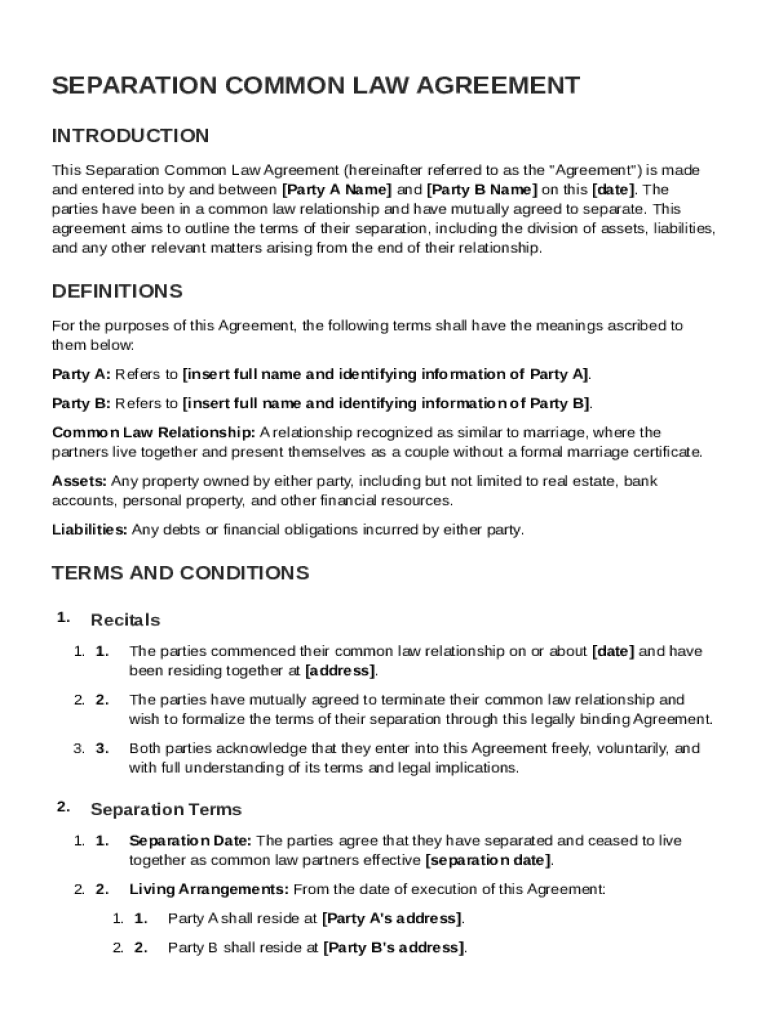







Definition & Meaning
A Separation Common Law Agreement Template is a legal document created for individuals in a common law relationship who are choosing to separate. It functions as a formal agreement that outlines all necessary arrangements and responsibilities such as the division of property and debts, living arrangements, child custody and support, as well as spousal support. It allows both parties to clearly understand their rights and responsibilities post-separation, helping to prevent disputes by ensuring a mutual understanding of the separation terms. The template serves as a valuable guide to ensure both parties conclude their relationship amicably and legally.
Key Elements of the Separation Common Law Agreement Template
This template covers essential components critical for ensuring a comprehensive and legally sound agreement. Key sections typically included are:
-
Division of Assets and Liabilities: This section specifies how the couple’s property, financial accounts, possessions, and debts are divided.
-
Living Arrangements: Details where each party will reside post-separation and ensures clarity to avoid future disputes.
-
Child Custody and Support: Includes schedules for custody, visitation rights, and the calculation of child support payments to ensure the children's welfare.
-
Spousal Support: Outlines any alimony or financial assistance provided to one party, including the amount and duration.
-
Dispute Resolution: Provides steps for resolving disagreements, such as mediation or arbitration, should any issues arise post-separation.
-
Legal Provisions: This section includes the legal terms that both parties agree to abide by, along with any specific jurisdictional requirements.
Steps to Complete the Separation Common Law Agreement Template
Follow these steps to accurately complete the template:
-
Gather Necessary Information: Collect all relevant financial details, asset documents, and personal information needed for the template.
-
Fill in Personal Details: Enter the details of both parties including full names, contact information, and any pertinent legal identifiers.
-
Detail Financial Arrangements: Completely outline asset distribution, debt liabilities, and any spousal or child support details necessary for clarity and fairness.
-
Specify Custody Arrangements: Clearly document custody schedules and visitation rights to prevent future disputes.
-
Review Dispute Resolution Options: Agree upon a preferred method for handling conflicts that may arise.
-
Consult Legal Expertise: It’s advisable for both parties to review the completed agreement with legal counsel to ensure fairness and legality.
-
Sign and Notarize: Both parties should sign the agreement in the presence of a notary public to ensure its authenticity and legality.
Who Typically Uses the Separation Common Law Agreement Template
The template is primarily used by individuals who are in a recognized common law relationship and have decided to separate. This may include:
-
Couples without Legal Marriage: Those who have been living together and sharing domestic responsibilities similar to those in a marital relationship.
-
Same-Sex Couples: In jurisdictions where common law status is recognized irrespective of gender.
-
Co-parents in Cohabitation: Unmarried parents who need to formalize arrangements regarding child custody, support, and shared assets.


Legal Use of the Separation Common Law Agreement Template
The legal standing of a Separation Common Law Agreement Template depends heavily on jurisdiction. In the U.S., common law relationships and related separation agreements are recognized in certain states. The template must:
-
Comply with State Laws: Ensure the document adheres to state-specific laws where the agreement is being executed.
-
Include Legal Terms: Appropriate legal terminology must define the division of assets and custody arrangements to be enforceable in court.
-
Be Mutually Agreeable and Voluntary: Both parties should enter into the agreement freely, without any duress, for it to be legally binding.
Important Terms Related to Separation Common Law Agreement Template
Understanding essential legal terms is crucial when completing this template. Important terms include:
-
Cohabitation: Living together in a relationship akin to marriage without formal matrimony.
-
Equitable Distribution: The fair division of assets and liabilities, which may not necessarily mean equal.
-
Mediation: A non-binding process where a neutral third party assists in resolving disputes.
-
Custodial Parent: The parent with whom the child resides the majority of the time.
State-by-State Differences
Common law recognition and applicable separation agreements can vary between states. Differences include:
-
Recognition of Common Law Relationships: Not all states recognize common law marriages, impacting the applicability of such agreements.
-
Property Division Laws: States may differ on how they mandate the division of property and responsibility for debts.
-
Child Support Guidelines: Each state has particular guidelines dictating how child support is calculated.
-
Enforcement Mechanisms: The methods and ease of legally enforcing a separation agreement can differ by jurisdiction.
Considerations for Spousal and Child Support
A critical aspect of the template involves provisions for ongoing support:
-
Calculation of Spousal Support: Factors include length of the relationship, earnings, and future employment prospects.
-
Child Support Guidelines: State-specific formulas typically account for the income of both parents, custodial arrangement, and specific child needs.
-
Payment Duration: Spousal support often has temporal limits, which should be clearly defined.
-
Modification Clauses: Outlining conditions under which support terms may be revisited ensures adaptability to future changes in circumstances.
By following these guidelines and utilizing the template to its fullest extent, individuals can effectively manage their separation while ensuring legal compliance and minimizing potential conflicts.