







Definition and Meaning
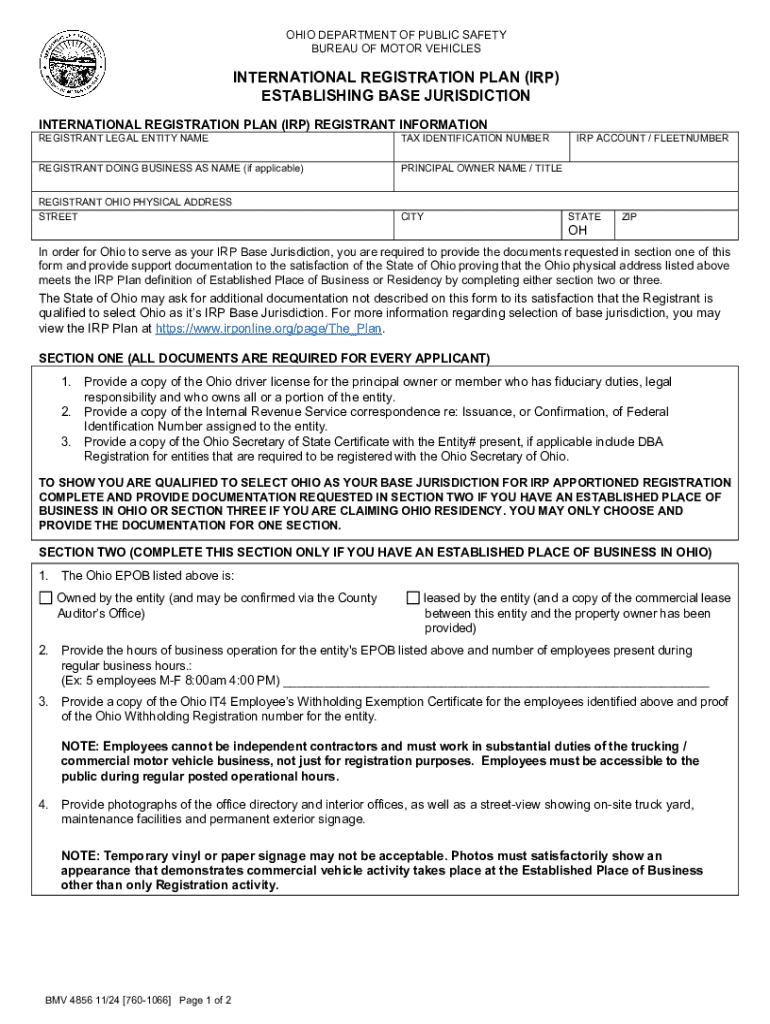
The Bmv 4856 form is an essential document used in Ohio for vehicle-related processes, primarily under the guidance of the Bureau of Motor Vehicles (BMV). This form typically pertains to specific regulatory or administrative procedures concerning vehicle registration or titling. Understanding the purpose and requirements of this form is crucial for individuals or businesses involved in vehicle management or ownership within Ohio.
Context and Purpose
- Vehicle Registration: A core use of the Bmv 4856 form is to aid in the registration process, ensuring compliance with the International Registration Plan (IRP) for commercial vehicles.
- Title Transfers: This form may also facilitate title changes, providing a systematic method to update or change ownership details.
Use Cases
- Commercial Fleets: Businesses operating commercial fleets across state lines need to be familiar with forms like Bmv 4856 to ensure legal operation under the IRP.
- New Registrations: Individuals or businesses seeking initial registration for vehicles in Ohio use this form as part of their documentation.
How to Obtain the Bmv 4856
Securing a Bmv 4856 form involves specific steps, crucial for a seamless registration or vehicle titling process in Ohio. The form can be obtained by visiting the Ohio BMV official website or contacting a local BMV office.
Steps to Acquire
- Online Access: Visit the Ohio BMV website and navigate to downloadable forms.
- In-Person Request: Visit a local Ohio BMV branch to collect a physical copy of the form.
Support and Inquiries
- BMV Helpline: Contact the BMV helpline for assistance in obtaining or understanding the form.
- Online Resources: Utilize online guidance documents and FAQs on the BMV website to facilitate the acquisition process.
Steps to Complete the Bmv 4856
Filling out the Bmv 4856 form accurately is essential to avoid delays or rejections. This process requires detailed attention to each section of the form to ensure all necessary fields are completed correctly.
Detailed Instructions
- Personal Information: Begin with entering your full name, address, and contact information.
- Vehicle Details: Provide comprehensive details about the vehicle, including VIN, make, model, year, and mileage.
- Ownership Information: Clearly state the current and, if applicable, new ownership details.
- Signature and Date: Ensure that the form is signed and dated by the authorized person to validate the information provided.
Common Mistakes to Avoid
- Incomplete Sections: Double-check that no sections are left blank or incomplete unless explicitly stated as optional.
- Incorrect Details: Verify all numbers, especially the VIN and contact details, to prevent processing errors.
Important Terms Related to Bmv 4856
Understanding terminology associated with the Bmv 4856 form clarifies its sections and requirements, aiding in precise completion and submission.
Key Terms
- VIN (Vehicle Identification Number): A unique code used to identify individual motor vehicles.
- IRP (International Registration Plan): A reciprocity agreement among states for the registration of commercial vehicles traveling across multiple jurisdictions.
- Compliance: Ensuring that all vehicle-related legal and regulatory requirements are met.
Application of Terms
- VIN Usage: Always ensure the VIN is recorded accurately, as it is crucial for identification and processing.
- IRP Compliance: Recognize the significance of IRP compliance for vehicles operating across state lines.
Legal Use of the Bmv 4856
The legal implications of the Bmv 4856 are significant, especially for businesses operating fleets. Adherence to legal standards ensures smooth processing and avoids potential fines or penalties.
Regulatory Compliance
- State Requirements: Ensure that your use of the Bmv 4856 aligns with Ohio state-specific regulations and requirements.
- Record Keeping: Maintain accurate records for all documents submitted, as these may be requested for verification or audits.
Consequences of Non-Compliance
- Fines and Penalties: Failure to comply with the legal requirements can lead to fines or suspension of vehicle registration.
- Operational Restrictions: Non-compliance might result in restrictions on vehicle operation within Ohio or interstate.
Key Elements of the Bmv 4856
This section identifies and explains the essential parts of the Bmv 4856 form that must be understood and filled out correctly to avoid processing delays.
Main Components
- Identification Details: Critical for validating the individual or entity submitting the form.
- Vehicle Information: Required to align the vehicle with its legal and registration status.
- Signature Provision: Authenticates the document, proving the legitimacy of the details provided.
Importance of Each Element
- Accuracy in Identification: Provides credibility and ensures there is no mismatch with existing records.
- Vehicle Details Verification: Essential for confirming the vehicle's eligibility for registration or titling.
State-Specific Rules for the Bmv 4856
Ohio has unique requirements for the completion and submission of the Bmv 4856 form, particularly applicable under state law and the IRP.
Ohio-Specific Guidelines
- Proof of Residency: Ohio state may require proof of address or residency as part of the vehicle registration process.
- Additional Documentation: Be prepared to furnish supplementary documentation, such as insurance or emissions certification, depending on the vehicle type and usage.
Implications for Users
- Local Businesses: Ohio-based businesses must understand these regulations to prevent vehicle registration issues.
- Out-of-State Operators: Interstate operators must comply with Ohio-specific requirements if using the Bmv 4856 for registration under the IRP.
Form Submission Methods (Online, Mail, In-Person)
The versatility in submission methods for the Bmv 4856 form ensures accessibility for all applicants, providing convenience and flexibility.
Submission Options
- Online: Submit through the official Ohio BMV portal, ensuring digital convenience and faster processing times.
- Mail: Send the completed form with all necessary attachments to the designated BMV mailing address.
- In-Person: Personally deliver the form to a local BMV office for a more direct submission process.
Benefits of Each Method
- Online: Quick and trackable submission with electronic confirmation.
- Mail: Suitable for those who prefer maintaining physical copies of their submissions.
- In-Person: Allows for immediate assistance and clarifications from BMV staff.
Understanding these aspects of the Bmv 4856 ensures that individuals and businesses can efficiently comply with legal requirements, facilitating smooth operations and avoiding potential disputes with regulatory bodies.




