




01. Edit your form online
Type text, add images, blackout confidential details, add comments, highlights and more.

Type text, add images, blackout confidential details, add comments, highlights and more.

Draw your signature, type it, upload its image, or use your mobile device as a signature pad.

Send it via email, link, or fax. You can also download it, export it or print it out.
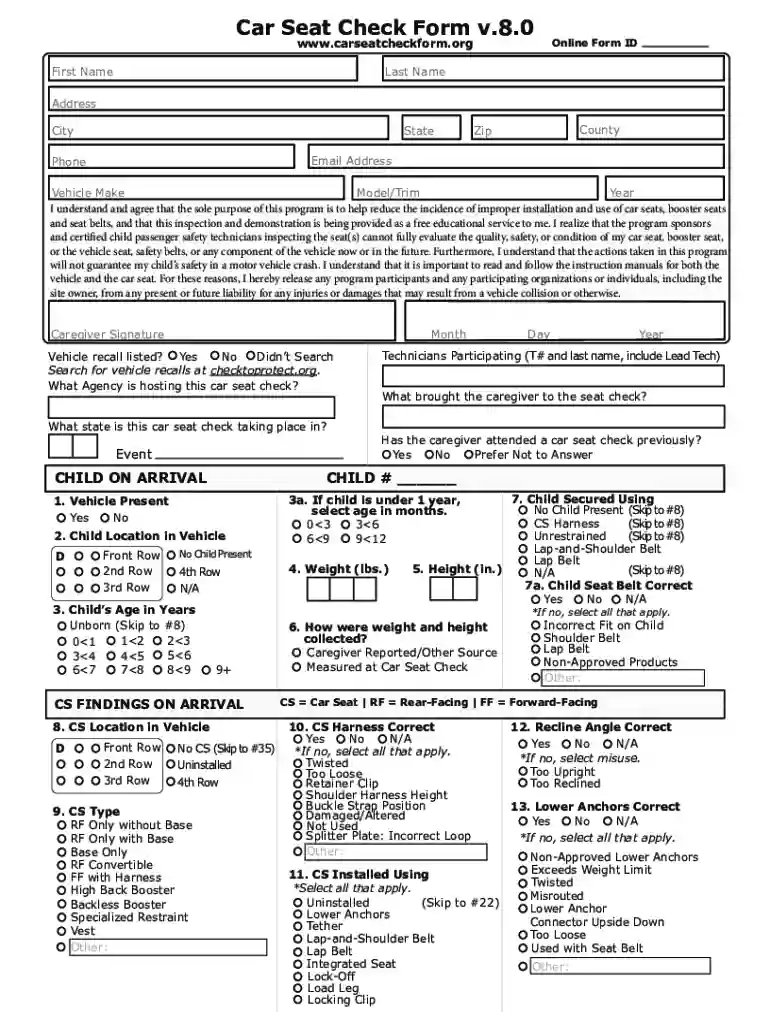
The Car Seat Check Form v 8.0 is instrumental in ensuring the safe installation and use of car seats, booster seats, and seat belts. Primarily used for inspections, the form gathers crucial information about caregivers, the child in question, the vehicle, and the car seat. Such data helps confirm adherence to manufacturer instructions and state laws. This structured document plays a vital educational role, promoting child safety by highlighting key compliance areas during checks.
The Car Seat Check Form includes several critical sections:
Each section is designed to provide comprehensive data that aids in ensuring the car seat is correctly installed and used safely.
Acquiring the Car Seat Check Form v 8.0 is an integral first step for caregivers and professionals aiming to carry out car seat inspections. There are several methods to obtain this form:
The availability of digital versions simplifies the process, allowing for easy download and print from various websites dedicated to child passenger safety.
Completing the Car Seat Check Form v 8.0 requires attention to detail and accuracy. Here are the sequential steps to effectively fill out the form:
Ensuring each section is meticulously filled safeguards compliance and enhances the safety of the child being transported.
Utilizing the Car Seat Check Form v 8.0 offers multiple advantages for both caregivers and inspection professionals:
This form acts as a proactive measure in preventing injuries and fatalities caused by improperly installed car seats.
Understanding the essential elements of the Car Seat Check Form v 8.0 is pivotal for effective use. Key components include:
Each section is tailored to elicit precise information for maximizing child safety during travel.
Compliance with state-specific rules is critical when using the Car Seat Check Form v 8.0. Different states have varying laws regarding car seat specifications:
Understanding these nuances is essential for conducting compliant and effective car seat inspections.
Real-world scenarios highlight the utility of the Car Seat Check Form v 8.0:
These examples illustrate the form's adaptability across different contexts, emphasizing its role as an educational and compliance tool.
There are advantages and disadvantages to both digital and paper versions of the form:
Digital Version:
Paper Version:
Choosing the appropriate format depends on the inspection environment and user preference.
At DocHub, your data security is our priority. We follow HIPAA, SOC2, GDPR, and other standards, so you can work on your documents with confidence.





What state is this car seat check taking place in? Childs Age in Years Unborn (Skip to #8) 0
I understand and agree that the sole purpose of this program is to help reduce the incidence of incorrect installation and use of car seats, booster seats.Read more


