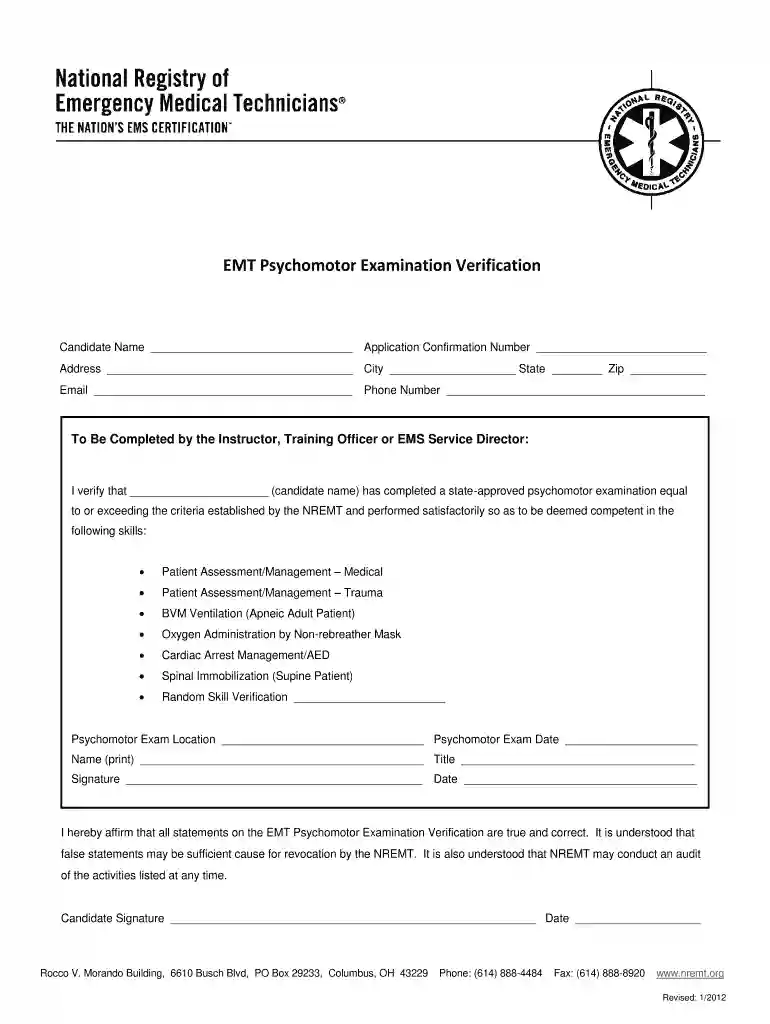
EMR Psychomotor Examination Verification Form - vdh virginia 2026

Get Form
nremt skills sheets Preview on Page 1

Here's how it works

01. Edit your nremt skills sheets online
Type text, add images, blackout confidential details, add comments, highlights and more.

02. Sign it in a few clicks
Draw your signature, type it, upload its image, or use your mobile device as a signature pad.

03. Share your form with others
Send nremt practical exam via email, link, or fax. You can also download it, export it or print it out.

Overview of the EMR Psychomotor Examination Verification Form

The EMR Psychomotor Examination Verification Form is essential for verifying candidates' completion of state-approved psychomotor examinations. This form confirms that individuals have demonstrated proficiency in various emergency medical skills necessary for Emergency Medical Responder (EMR) certification. It ensures that the skills assessment aligns with national standards and state requirements, making it a crucial document in the certification process.

Form Structure and Components

The form typically consists of several key sections, including:

  • Candidate Information: This section gathers essential details about the candidate, such as name, contact information, and identification details.
  • Instructor Details: Information about the instructor who administered the examination is captured here, including their name, contact details, and qualifications.
  • Verification of Skills: This is the core component where specific psychomotor skills are listed. The instructor must verify the candidate's competence in each skill, ensuring that they meet the necessary standards.
  • Signatures: A signature from both the candidate and the instructor is required, reinforcing the accuracy and accountability of the information provided.

Purpose and Importance

The EMR Psychomotor Examination Verification Form serves several important functions:

  • Certification Requirement: Candidates must submit this form as part of their application for EMR certification to ensure compliance with national and state regulations.
  • Skill Verification: The form acts as an official document that verifies the skills a candidate has demonstrated, which is crucial for public safety and regulatory compliance.
  • Record Keeping: It aids in maintaining accurate records for the state’s EMS agency, providing a basis for ongoing evaluation and adjustments in training programs.

Completing the Form

Properly completing the EMR Psychomotor Examination Verification Form involves several important steps:

  1. Gather Required Information: Candidates should collect all necessary personal details and documentation to fill out the form accurately.
  2. Instructor Endorsement: The supervising instructor must assess the candidate’s skills and provide the required endorsements.
  3. Double-Check for Accuracy: It is crucial to review the entire form for any errors or omissions before submission.
  4. Submit the Form: The completed and signed form must be submitted according to state guidelines, which often include specific methods for filing.

Common Skills Verified in the Examination

The EMR psychomotor examination typically covers a wide variety of skills, which may include:

  • Patient Assessment: Techniques for systematic assessment of patients in emergency situations.
  • Cardiac Arrest Management: Procedures for managing cardiac arrest, including CPR and use of an AED.
  • Trauma Management: Skills related to handling different types of trauma, such as bleeding control and immobilization techniques.
  • Medical Emergencies: Responding to various medical emergencies, including diabetic reactions and allergic reactions.

These skills are essential for effective emergency response and patient care.

Legal and Compliance Considerations

Understanding the legal implications surrounding the EMR Psychomotor Examination Verification Form is crucial. Some important aspects include:

  • Compliance with State Regulations: Each state has specific guidelines for certification that must be followed. Non-compliance can result in denial of certification.
  • Record Retention: States often require a retention period for submitted forms for auditing purposes, ensuring transparency and accountability in the certification process.
  • Penalties for Misrepresentation: Inaccurate information or fraudulent claims on the form can lead to serious legal consequences for both the candidate and the instructor.

Process for Retaking the Examination

In cases where candidates do not pass the psychomotor examination, they must understand the retake process, which generally includes:

  1. Review of Feedback: Candidates should review the feedback provided by the instructor to identify areas for improvement.
  2. Additional Training: Engaging in further training or practice in the skills where deficiencies were noted.
  3. Rescheduling the Exam: Candidates need to follow appropriate state procedures to schedule a retake of the examination.

Candidates are typically encouraged to utilize available resources, such as practice exams and skills sheets, to enhance their performance before reattempting the examination.

Resources for Candidates

Candidates preparing for the EMR psychomotor examination can benefit from various resources, including:

  • State-Specific EMR Training Programs: Enrolling in programs recognized by state EMS agencies enhances preparation.
  • NREMT Skills Sheets: These documents outline the necessary skills and procedures, serving as valuable study aids.
  • Practice Exams: Utilizing practice psychomotor exams can help candidates familiarize themselves with the testing environment and expectations.

By leveraging these resources, candidates can enhance their skill competence and improve their chances of successfully completing the psychomotor examination.

See more EMR Psychomotor Examination Verification Form - vdh virginia versions

We've got more versions of the EMR Psychomotor Examination Verification Form - vdh virginia form. Select the right EMR Psychomotor Examination Verification Form - vdh virginia version from the list and start editing it straight away!
Versions Form popularity Fillable & printable
2012 4.8 Satisfied (102 Votes)
be ready to get more

Complete this form in 5 minutes or less

Get form

Got questions?

We have answers to the most popular questions from our customers. If you can't find an answer to your question, please contact us.
Contact us
Psychomotor ability may be measured by accuracy or speed (reaction time). Examples of psychomotor tests include the Grooved Pegboard test, and the Purdue Pegboard test that measure visual-motor coordination.
The exam includes a review of your treatment of cardiac arrest and the use of an automated external defibrillator (AED). The portion also consists of PPE precautions, scene safety, patient responsiveness, requesting additional EMS assistance, breathing and pulse, chest compressions, CPR, and operating an AED.
7 Expert Tips to Pass the NREMT Psychomotor Exam Stand out from the herd. Remember the basics. Ask for updated vitals as needed. Study the NREMT skill sheets. Know the Critical Criteria list for each skill. Practice, Practice, Practice. Watch Psychomotor Exam videos.
EMT Certification Timeline After finishing your coursework, youll take the NREMT exam. Passing this exam is crucial. You need to score above 70% to succeed.
Candidates who fail a full attempt or any portion of a second retest attempt must submit official documentation of remedial training for all skills before the next full attempt of the psychomotor examination testing all six skills, provided all other requirements for National Certification are fulfilled.

Security and compliance

At DocHub, your data security is our priority. We follow HIPAA, SOC2, GDPR, and other standards, so you can work on your documents with confidence.

Learn more
ccpa2
pci-dss
gdpr-compliance
hipaa
soc-compliance
be ready to get more

Complete this form in 5 minutes or less

Get form