01. Edit your form online
Type text, add images, blackout confidential details, add comments, highlights and more.

Type text, add images, blackout confidential details, add comments, highlights and more.

Draw your signature, type it, upload its image, or use your mobile device as a signature pad.

Send it via email, link, or fax. You can also download it, export it or print it out.
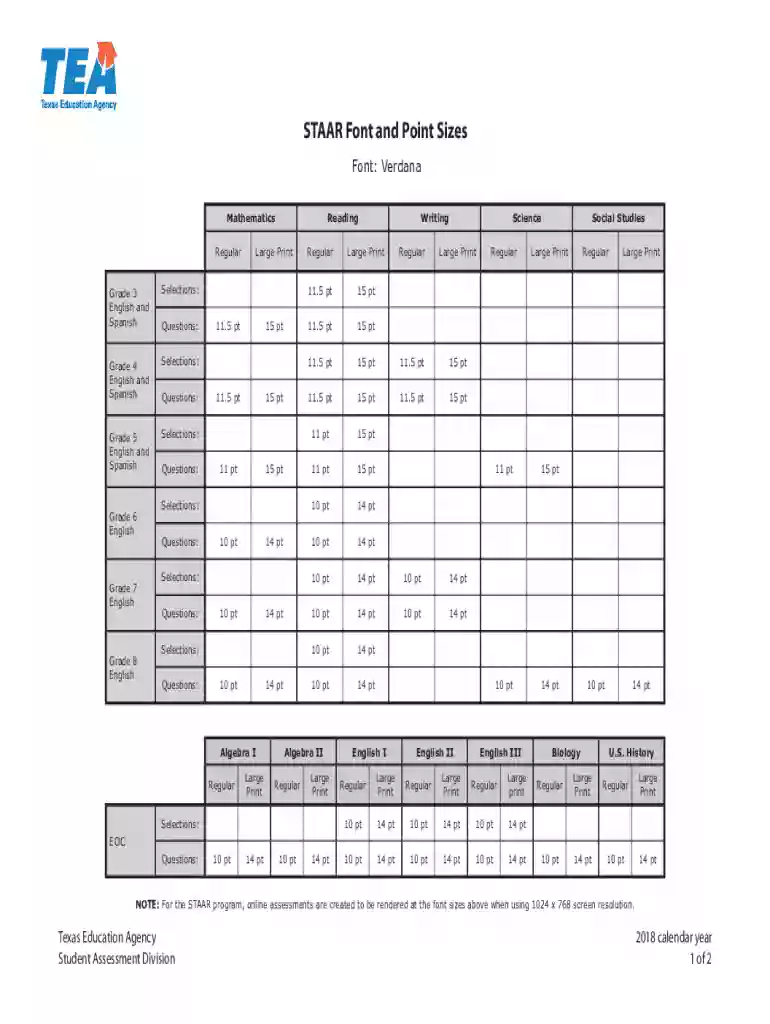
The Staar font and point sizes refer to the standardized typeface and text dimensions used in the State of Texas Assessments of Academic Readiness (STAAR) program. This system is designed to ensure consistency and readability across various assessments, including subjects such as mathematics, reading, writing, science, and social studies. The standardization helps maintain uniformity, allowing students, educators, and examiners a clear and consistent medium to work with during the preparation and administration of these assessments.
The STAAR program primarily incorporates specific fonts like Verdana, Helvetica Neue, and Comic Sans, each selected for its readability across both print and digital platforms. Regular and large print formats are supported to meet diverse accessibility needs. Point sizes vary depending on the assessment and the format used, ensuring that content is accessible to all students, including those with visual impairments. The exact font and size combination is carefully chosen to balance legibility with space constraints, particularly in printed exam materials.
Using the Staar font and point sizes effectively in educational settings involves adhering to pre-defined guidelines for formatting instructional materials, practice tests, and official assessments. Educators must be familiar with these specifications to ensure consistency in the materials they prepare, aligning them with the standard methodologies used during testing. This alignment helps students become accustomed to the formatting expected during official assessments.
Educators and administrators can access the specifications for Staar font and point sizes through official Texas Education Agency (TEA) communications or by consulting with their school district’s assessment coordinator. These resources often provide detailed guidelines on font usage, point size specifications, and any available digital templates to facilitate consistent application in educational materials.
Scenario examples might include creating a mock examination paper where Comic Sans at a 14-point size is used for readability, or preparing an inclusive classroom handout using Helvetica Neue in both regular and large print formats. In doing so, educators can evaluate student accessibility to ensure the material is as inclusive as possible, simulating the conditions of actual assessments.
Understanding terms like "point size," "typeface," and "resolution" is crucial when discussing the Staar font and point sizes. Typeface refers to the design of the lettering, while point size measures the height of the characters. Resolution pertains to the clarity of text when assessments are viewed on-screen, ensuring detail and sharpness, particularly for online examinations.
The primary users of the Staar font and point sizes are educators, exam administrators, and material developers within the Texas education system. These stakeholders are responsible for implementing the standards in instructional resources and assessments, ensuring students receive preparation materials aligned with what they will encounter in official testing environments.


Since the STAAR program is a Texas-specific assessment system, the guidelines for font and point sizes are tailored to meet state educational standards. These rules ensure compliance with both accessibility requirements and educational objectives outlined by the Texas State Board of Education. Each school district may receive additional directives to meet local needs while adhering to these state standards.
While the Staar font and point sizes are standardized for assessments in Texas, alternative resources or supplemental materials may utilize different formatting to target specific educational needs or teaching styles. These alternatives, however, should maintain readability and accessibility principles to support student learning and assessment familiarity effectively.
Educational software like TurboTax or QuickBooks, commonly unrelated to standardized testing, highlights how programs must process form-based data. For Staar applications, digital tools must accurately present the specified font and point details in interactive formats, especially in online assessment platforms used for simulating exam conditions.
We've got more versions of the Staar Font and Point Sizes form. Select the right Staar Font and Point Sizes version from the list and start editing it straight away!
At DocHub, your data security is our priority. We follow HIPAA, SOC2, GDPR, and other standards, so you can work on your documents with confidence.