Dv-530-info S 2026

Get Form
Dv-530-info S Preview on Page 1

Here's how it works

01. Edit your form online
Type text, add images, blackout confidential details, add comments, highlights and more.

02. Sign it in a few clicks
Draw your signature, type it, upload its image, or use your mobile device as a signature pad.

03. Share your form with others
Send it via email, link, or fax. You can also download it, export it or print it out.

Definition and Meaning of Dv-530-info S

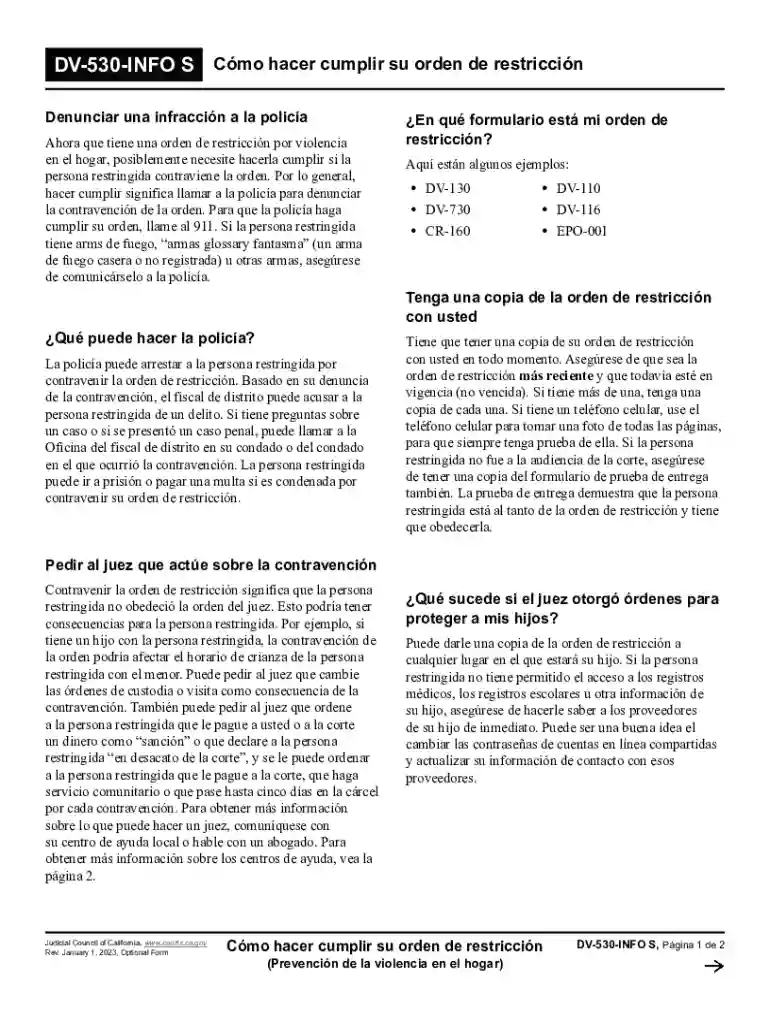
The "Dv-530-info S" form serves as a document often associated with the legal system, typically related to domestic violence cases. It is primarily used to convey critical information to the involved parties, such as victims, legal counsel, and law enforcement agencies. This form plays a crucial role in enforcing the terms of restraining orders, ensuring compliance, and providing advice on how to proceed should violations occur. Understanding the exact purpose and scope of this form is essential for effectively navigating the legal framework surrounding domestic violence cases.

How to Use the Dv-530-info S

The utilization of the Dv-530-info S form generally centers around ensuring that stakeholders are informed about the rights, responsibilities, and procedures related to domestic violence restraining orders. Key steps include:

  1. Reading the instructions carefully: Comprehend the information provided on the form to determine its applicability to your situation.
  2. Filling out appropriate sections: Accurately complete parts of the form that are relevant, ensuring that all personal information is correct.
  3. Sharing with relevant parties: Ensure that copies of the completed form are distributed to necessary individuals or authorities, such as law enforcement and legal representatives.
  4. Keeping an updated version: Maintain an updated form as changes occur in your case or as required by court procedures.

Steps to Complete the Dv-530-info S

Completing the Dv-530-info S involves multiple steps to ensure all necessary information is correctly provided:

  1. Gather necessary information: Before starting, collect all relevant details, including personal identification and case numbers.
  2. Follow instructions: Begin by reading any instructions that accompany the form, ensuring a clear understanding of what information is needed.
  3. Document essential details: Include information such as names, addresses, relevant dates, and any case-specific notes that need to be documented.
  4. Review and verify data: Double-check all entries for accuracy and completeness to avoid processing delays or errors.
  5. Submit form as instructed: Once completed, submit the form through the required channel, either online, by mail, or in person, following the specified guidelines.

Who Typically Uses the Dv-530-info S

Generally, the Dv-530-info S form is utilized by individuals involved in domestic violence cases. This group includes victims seeking protection through restraining orders, attorneys advocating for their clients, and law enforcement tasked with enforcing legal directives. The form is also relevant to court officials responsible for managing and reviewing protective orders. Each of these parties plays a pivotal role in the judicial process, using the form as a tool to uphold legal and personal safety obligations.


decoration image ratings of Dochub

Key Elements of the Dv-530-info S

Several critical elements define the Dv-530-info S form:

  • Identification information: Details about the parties involved, including petitioner and respondent information.
  • Case-related data: Documentation of the orders, violations, and any specific restrictions imposed.
  • Instructions and guidance: Clear steps for recipients on how to proceed in the event of violation, reporting requirements, and additional actions that may be necessary.
  • Contact information: Essential contacts for additional support, including legal, law enforcement, and advocacy resources.

Legal Use of the Dv-530-info S

The Dv-530-info S has significant legal relevance as it outlines the obligations and rights under domestic violence laws. It is used in legal proceedings to validate claims, demonstrate compliance with protective orders, and document any breaches. Its role in legal contexts includes:

  • Evidence submission: Used to support claims in legal actions.
  • Enforcement aid: Assists law enforcement in recognizing and implementing court orders.
  • Legal compliance: Ensures involved parties understand the legal stipulations and consequences of non-compliance.

State-Specific Rules for the Dv-530-info S

While the form serves a standardized purpose, variations might exist depending on state laws and judicial requirements:

  • Procedural differences: Each state may have unique protocols for filing and recognition.
  • Supporting documentation: Some states may require additional evidence or papers to accompany the form.
  • Timeline variances: States might prescribe different timelines for submission and response.

It's essential for users to familiarize themselves with their state's specific requirements to ensure compliance and effectiveness.

Examples of Using the Dv-530-info S

Real-world utilization of the Dv-530-info S often involves scenarios where immediate protection is necessary. Examples include:

  • Victims seeking expedited protection: Individuals needing swift action to prevent further domestic abuse.
  • Legal documentation in court settings: Lawyers presenting the form to uphold their client's safety as part of broader legal strategies.
  • Coordination with law enforcement: Police using the form to implement restrictions and ensure compliance with orders swiftly.

These examples underscore the form's versatility in various contexts, facilitating protective actions for those affected by domestic violence.

be ready to get more

Complete this form in 5 minutes or less

Get form

Got questions?

We have answers to the most popular questions from our customers. If you can't find an answer to your question, please contact us.
Contact us
Permanent restraining orders are the most severe types of restraining orders in this state, and they have the most serious consequences.
The specific elements you need to prove to get a restraining order vary from state to state, but in general, you need to show: A specific instance or instances of abuse or harassment (such as sexual assault by an intimate partner) The threat of violence or of further abusive behavior or harassment.
Stay away orders dictate a distance that must be maintained between the affected persons (often about 100 yards, although accommodations can be made). Stay away orders also can include restrictions on places the restrained person can go, such as the home of a spouse or the restrained persons workplace.
A restraining order is a civil order of protection issued by the family court to any family or household member who has been subject to a continuous threat of present physical pain or physical injury, stalking, or a pattern of threatening by another family or household member, as defined by General Statutes 46b-38a (
209A 7) makes it a crime to violate the terms and conditions of restraining orders in Massachusetts. A conviction of this offense permits a judge to sentence an individual to up to two and one half years in the county house of correction and or a fine of up to five thousand dollars.

Security and compliance

At DocHub, your data security is our priority. We follow HIPAA, SOC2, GDPR, and other standards, so you can work on your documents with confidence.
Learn more
ccpa2
pci-dss
gdpr-compliance
hipaa
soc-compliance
be ready to get more

Complete this form in 5 minutes or less

Get form

People also ask

Other orders that can help protect you restraining order. criminal behaviour order. domestic violence protection order.
There are several types of restraining orders, but the most common ones that defendants face are: Domestic Violence Restraining Orders (DVRO): This is the most common type of restraining order. It is designed to protect victims of domestic violence by family or household members.
What Proof Do You Need For a Restraining Order in California? Police reports. Witness testimony. Digital communication records. Photos and video evidence. Medical records. Criminal records.

Related links