






Definition & Meaning
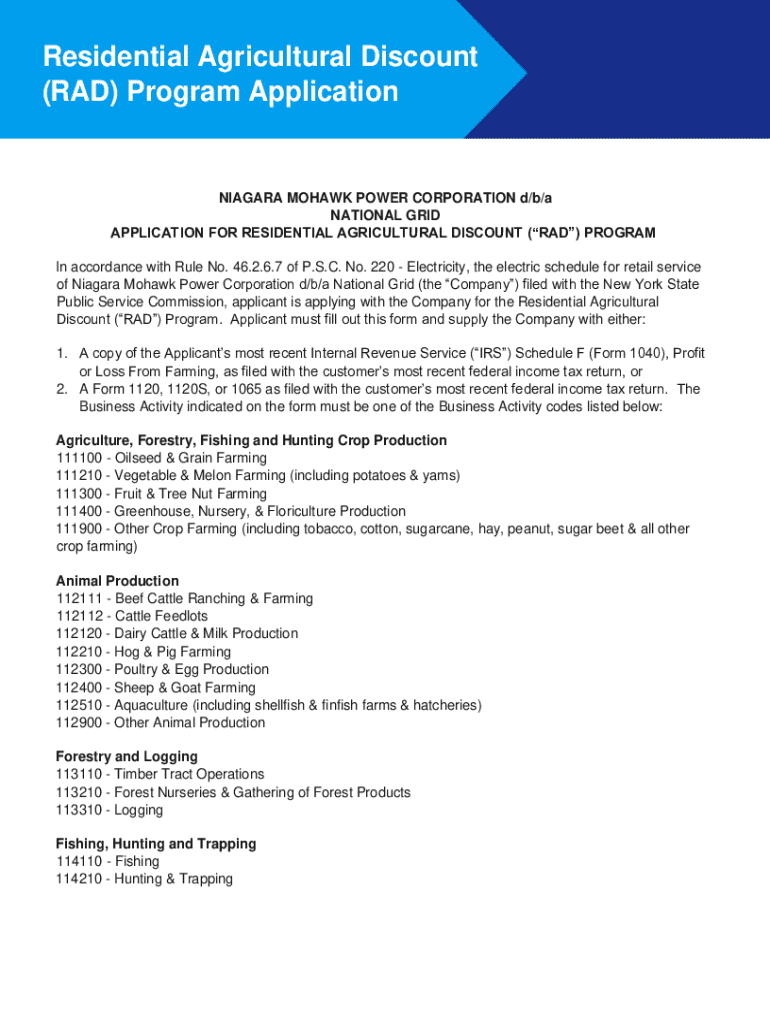
The Residential Agricultural Discount (RAD) Program Application is a formal document used by individuals or entities seeking to qualify for a discount on their residential energy costs, provided by National Grid. This program specifically assists those involved in agriculture by reducing operational expenses associated with energy consumption. It aims to support farmers by decreasing overhead costs, thus promoting agricultural activities.
Eligibility Criteria
To qualify for the RAD Program, applicants must meet specific eligibility guidelines. These typically include:
- Proof of agricultural income, such as IRS forms or farm income statements
- Ownership or lease of property used primarily for agricultural purposes
- Residency within the provider's service area
- Documentation demonstrating connection to agricultural activities
Eligible applicants are often required to reapply annually to sustain their discount.


How to Obtain the Residential Agricultural Discount (RAD) Program Application
Obtaining the RAD Program Application can be done through several channels. Interested parties can typically download the form from the National Grid website or request a physical copy by contacting National Grid’s customer service. Ensuring that you have the latest version of the application form is important, as requirements may change annually.
Form Submission Methods
Applicants can submit the RAD Program Application via multiple methods:
- Online: Many applicants prefer electronic submission due to its convenience.
- Mail: Sending a physical copy via postal service ensures documentation is formally recorded.
- In-Person: Visiting a local National Grid office may be preferred by those who wish to discuss the application in person.
Verifying the preferred submission method with National Grid ahead of time can prevent clerical errors.
Steps to Complete the Residential Agricultural Discount (RAD) Program Application
Completing the RAD Application involves several important steps:
-
Gather Required Documentation: This includes IRS documents, proof of property use, and identification.
-
Fill Out Personal Information: Accurate entry of all personal and property-related details is vital.
-
Read Detailed Instructions: Each section of the application may have specific instructions that guide correct completion.
-
Submit the Application: Ensure all sections are complete, attach necessary documents, and follow specified submission guidelines.
Understanding each step ensures a smooth application process.
Required Documents
- IRS forms verifying farm income
- Property ownership or lease agreement
- Identification such as driver's license or state ID
- Proof of residence in the service area
Key Elements of the Residential Agricultural Discount (RAD) Program Application
Understanding the application’s key components aids in proper completion:
- Applicant Information: Details of the individual or entity applying
- Farm Income Verification: Financial documents to prove agricultural revenue
- Energy Usage Details: Overview of residential energy use patterns
These components ensure that applicants provide a comprehensive picture of their eligibility.
Important Terms Related to Residential Agricultural Discount (RAD) Program Application
Several important terms are associated with the RAD Application:
- Agricultural Income: Revenue derived from agricultural operations, critical for eligibility.
- Service Area: The geographic region served by National Grid, relevant for determining program eligibility.
- Verification: The process of substantiating claims made in the application.
Familiarity with these terms aids applicants in understanding application requirements.
Legal Use of the Residential Agricultural Discount (RAD) Program Application
The RAD Program must be used in accordance with legal guidelines. Misrepresentation or fraudulent submission may result in penalties, including disqualification from the program and legal action. Ensuring accurate and honest representation in applications is paramount.
Examples of Using the Residential Agricultural Discount (RAD) Program Application
Various scenarios illustrate the RAD Application's utility:
- Small Family Farms: A family operating a small dairy farm applies to reduce energy costs.
- Community Gardens: Non-profits managing large urban gardens use the discount to minimize overhead.
- Organic Farmers: Reducing energy expenses allows funds to be allocated towards sustainable practices.
These examples demonstrate the application’s versatility across different agricultural operations.
State-Specific Rules for the Residential Agricultural Discount (RAD) Program Application
While the RAD Program primarily follows National Grid guidelines, state-specific regulations can influence eligibility and application processes. Certain states may have additional requirements or supplemental discounts. Applicants are encouraged to verify their specific state’s rules before submission to ensure compliance.
Understanding these components provides a comprehensive guide to using the RAD Program Application effectively.